Santos-Morales Orestes, Díaz-Machado Alina, Jiménez-Rodríguez Daise, Pomares-Iturralde Yaisel, Festary-Casanovas Tatiana, González-Delgado Carlos A, Pérez-Rodríguez Sonia, Alfonso-Muñoz Eulalia, Viada-González Carmen, Piedra-Sierra Patricia, García-García Idrian, Amaro-González Daniel, García-Rodríguez Julio César, Sosa-Testé Iliana, Lagarto-Parra Alicia, Barrero-Viera Laura, David-Baldo Marlene, Tamayo-Rodríguez Maura, Rivero-Vázquez Ivonne, González-Gamiz Gricel, Martín-Trujillo Alis, Rodríguez-Fernández Yasmila, Ledo-de la Luz Ana Alfa, Álvarez-Delgado Maylén, Howland-Álvarez Ivón, Cruz-Gómez Yolanda
NeuroEPO Research and Development Group, Center of Molecular Immunology, Havana, Cuba.
National Center for Toxicology, "Carlos J. Finlay" University Hospital, Havana, Cuba.
BMC Neurol. 2017 Jul 4;17(1):129. doi: 10.1186/s12883-017-0908-0.
Delivery of therapeutic agents as erythropoietin (EPO) into Central Nervous System through intranasal route could benefit patients with neurological disorders. A new nasal formulation containing a non-hematopoietic recombinant EPO (NeuroEPO) has shown neuroprotective actions in preclinical models. In the current study, the safety of NeuroEPO was evaluated for the first time in humans.
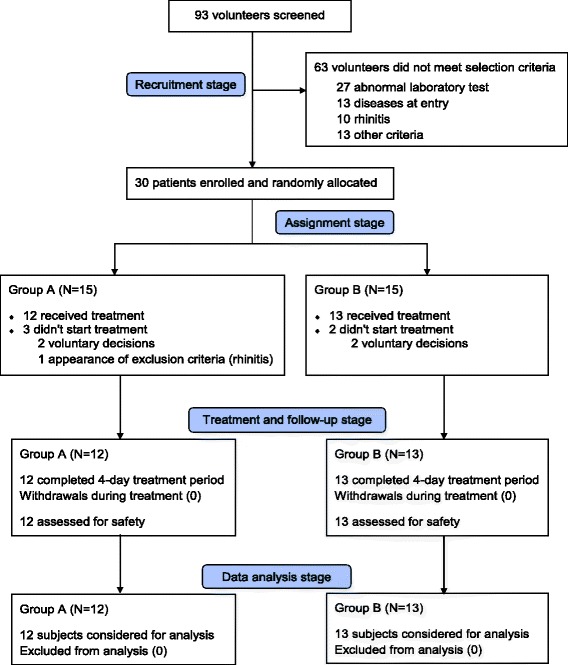
A phase I, randomized, parallel, open-label study was carried out in healthy volunteers. They received, intranasally, 1 mg of NeuroEPO every 8 h during 4 days (Group A) or 0.5 mg of NeuroEPO (Group B) with the same schedule. The working hypothesis was that intranasal NeuroEPO produce <10% of severe adverse reactions in the evaluated groups. Therefore, a rigorous assessment of possible adverse events was carried out, which included tolerance of the nasal mucosa and the effect on hematopoietic activity. Clinical safety evaluation was daily during treatment and laboratory tests were done before and on days 5 and 14 after starting treatment.
Twenty-five volunteers, 56% women, with a mean age of 27 yrs. were included. Twelve of them received the highest NeuroEPO dose. Twenty types of adverse events occurred, with headache (20%) and increase of hepatic enzymes (20%) as the most reported ones. Nasopharyngeal itching was the most common local event but only observed in four patients (16%), all of them from the lowest dose group. About half of the events were very probably or probably caused by the studied product. Most of the events were mild (95.5%), did not require treatment (88.6%) and were completely resolved (81.8%). No severe adverse events were reported. During the study the hematopoietic variables were kept within reference values.
NeuroEPO was a safe product, well tolerated at the nasal mucosa level and did not stimulate erythropoiesis in healthy volunteers.
Cuban Public Registry of Clinical Trials RPCEC00000157 , June 10, 2013.
通过鼻腔途径将促红细胞生成素(EPO)等治疗药物输送到中枢神经系统可能会使神经系统疾病患者受益。一种含有非造血重组EPO(NeuroEPO)的新型鼻腔制剂已在临床前模型中显示出神经保护作用。在本研究中,首次对NeuroEPO在人体中的安全性进行了评估。
在健康志愿者中进行了一项I期随机、平行、开放标签研究。他们在4天内每8小时经鼻接受1毫克NeuroEPO(A组)或按相同时间表接受0.5毫克NeuroEPO(B组)。工作假设是经鼻NeuroEPO在评估组中产生的严重不良反应<10%。因此,对可能的不良事件进行了严格评估,包括鼻黏膜耐受性和对造血活性的影响。治疗期间每天进行临床安全性评估,并在开始治疗前以及治疗后第5天和第14天进行实验室检查。
纳入了25名志愿者,其中56%为女性,平均年龄27岁。其中12人接受了最高剂量的NeuroEPO。发生了20种不良事件,最常报告的是头痛(20%)和肝酶升高(20%)。鼻咽瘙痒是最常见的局部事件,但仅在4名患者(16%)中观察到,他们均来自最低剂量组。约一半的事件很可能或可能是由研究产品引起的。大多数事件为轻度(95.5%),不需要治疗(88.6%)且完全缓解(81.8%)。未报告严重不良事件。在研究期间,造血变量保持在参考值范围内。
NeuroEPO是一种安全的产品,在鼻黏膜水平耐受性良好,并且在健康志愿者中不会刺激红细胞生成。
古巴临床试验公共注册中心RPCEC00000157,2013年6月10日。