Huang Ya-Qiang, Ling Xiao-Hui, Yuan Run-Qiang, Chen Zhi-Yun, Yang Sheng-Bang, Huang Hong-Xing, Zhong Wei-De, Qiu Shao-Peng
Department of Urology, Zhongshan Hospital of Sun Yat‑sen University, Zhongshan, Guangdong 528400, P.R. China.
Reproductive Medicine Centre, Huizhou Municipal Central People's Hospital, Huizhou, Guangdong 516001, P.R. China.
Mol Med Rep. 2017 Sep;16(3):2431-2438. doi: 10.3892/mmr.2017.6910. Epub 2017 Jul 4.
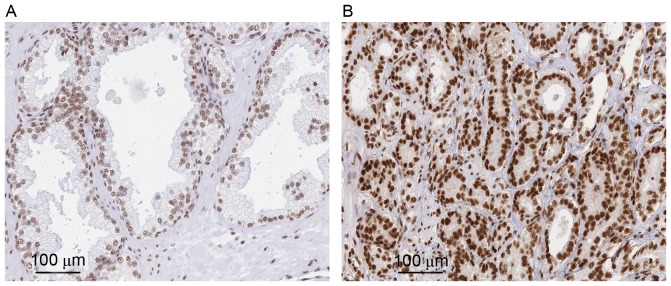
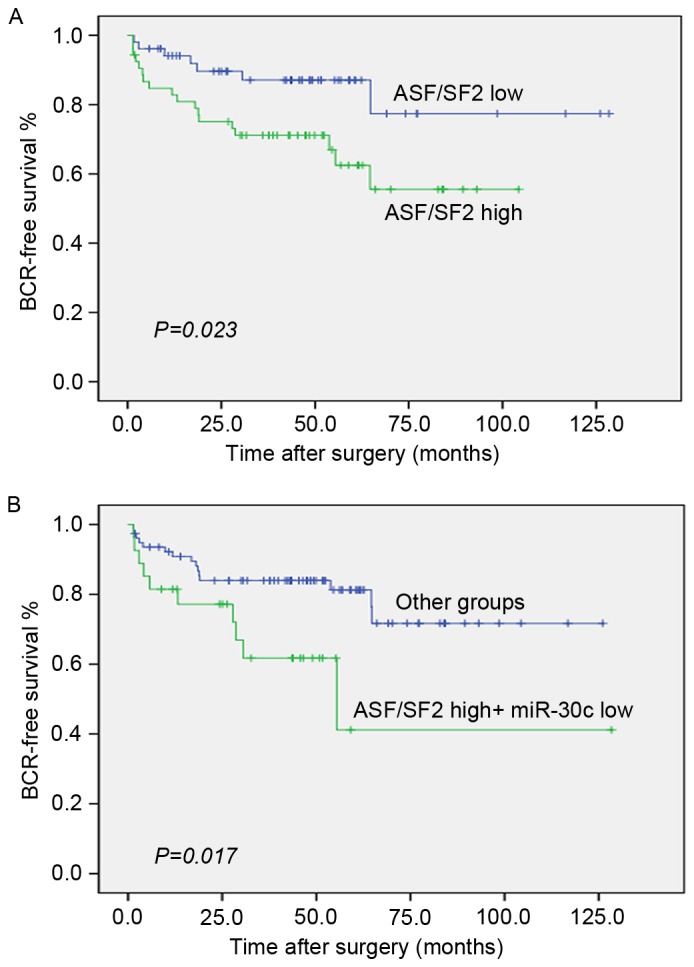
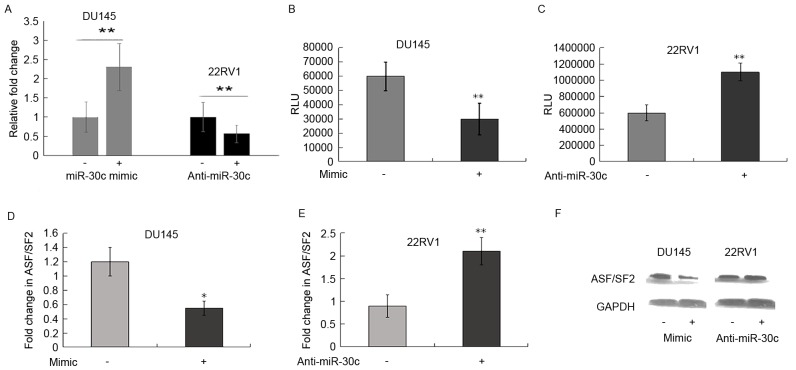
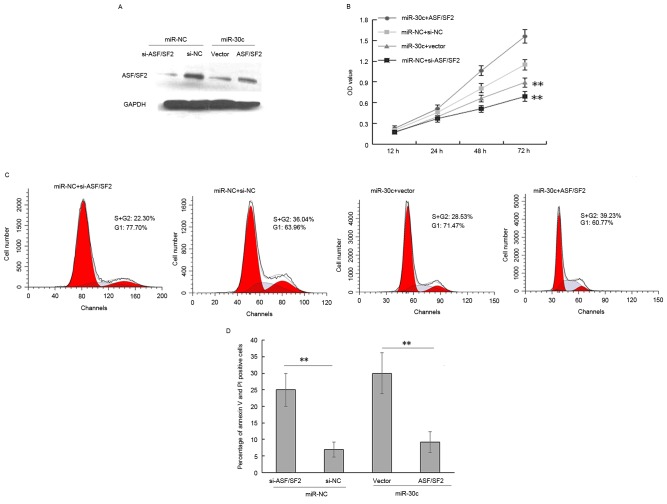
Our previous study revealed that microRNA (miR) ‑30c represents a potential tumor suppressor gene, the expression of which is associated with decreased oncogenic potential in prostate cancer (PCa) cell lines. However, the functional role and underlying mechanisms of miR‑30c in PCa remain to be fully elucidated. Reverse transcription‑quantitative polymerase chain reaction and immunohistochemical analysis were used to detect the expression levels of alternative splicing factor/splicing factor 2 (ASF/SF2) in PCa tissues. A luciferase reporter assay was used to investigate whether ASF/SF2 may be a direct target gene of miR‑30c. In addition, the effects of miR‑30c on the proliferation and apoptosis of PCa cell lines were examined, following transfection with miR‑30c mimics. Furthermore, correlation analysis was performed to investigate the relationship between the expression of miR‑30c and ASF/SF2 and various clinicopathological parameters of patients with PCa. The present results demonstrated that PCa tissues exhibited higher levels of alternative splicing factor/splicing factor 2 (ASF/SF2), compared with normal tissues. In addition, miR‑30c was revealed to targete the 3'‑untranslated region of the ASF/SF2 gene, causing a decrease in the mRNA and protein levels of ASF/SF2. Furthermore, miR‑30c was reported to decrease cell proliferation, increase the percentage of cells in the G1 cell cycle phase, and promote apoptosis through the inhibition of ASF/SF2. Following correlation analysis using patient samples, the expression of ASF/SF2 was revealed to be tightly correlated with the pathological stage of PCa and biochemical recurrence (BCR). In addition, patients with PCa exhibiting low expression levels of miR‑30c and high expression of ASF/SF2 had significantly lower rates of BCR‑free survival. In conclusion, the present study suggested that the tumor suppressor miR‑30c may be involved in PCa tumorigenesis, possibly via targeting ASF/SF2. The combined analysis of the expression of ASF/SF2 and miR‑30c may be a valuable tool for early prediction of BCR in patients with PCa following radical prostatectomy.
我们之前的研究表明,微小RNA(miR)-30c是一种潜在的肿瘤抑制基因,其表达与前列腺癌细胞系致癌潜能的降低有关。然而,miR-30c在前列腺癌中的功能作用及潜在机制仍有待充分阐明。采用逆转录定量聚合酶链反应和免疫组化分析检测前列腺癌组织中可变剪接因子/剪接因子2(ASF/SF2)的表达水平。采用荧光素酶报告基因检测法研究ASF/SF2是否可能是miR-30c的直接靶基因。此外,在用miR-30c模拟物转染后,检测miR-30c对前列腺癌细胞系增殖和凋亡的影响。此外,进行相关性分析以研究miR-30c和ASF/SF2的表达与前列腺癌患者各种临床病理参数之间的关系。目前的结果表明,与正常组织相比,前列腺癌组织中可变剪接因子/剪接因子2(ASF/SF2)的水平更高。此外,研究发现miR-30c靶向ASF/SF2基因的3'非翻译区,导致ASF/SF2的mRNA和蛋白水平降低。此外,据报道,miR-30c可通过抑制ASF/SF2来减少细胞增殖,增加处于G1细胞周期阶段的细胞百分比,并促进细胞凋亡。使用患者样本进行相关性分析后,发现ASF/SF2的表达与前列腺癌的病理分期和生化复发(BCR)密切相关。此外,miR-30c表达水平低且ASF/SF2表达高的前列腺癌患者无BCR生存率显著较低。总之,本研究表明,肿瘤抑制因子miR-30c可能通过靶向ASF/SF2参与前列腺癌的发生发展。联合分析ASF/SF2和miR-30c的表达可能是前列腺癌根治术后早期预测患者BCR的有价值工具。