• 文献检索
  • 文档翻译
  • 深度研究
  • 学术资讯
  • Suppr Zotero 插件Zotero 插件
  • 邀请有礼
  • 套餐&价格
  • 历史记录
应用&插件
Suppr Zotero 插件Zotero 插件浏览器插件Mac 客户端Windows 客户端微信小程序
定价
高级版会员购买积分包购买API积分包
服务
文献检索文档翻译深度研究API 文档MCP 服务
关于我们
关于 Suppr公司介绍联系我们用户协议隐私条款
关注我们

Suppr 超能文献

核心技术专利:CN118964589B侵权必究
粤ICP备2023148730 号-1Suppr @ 2026

文献检索

告别复杂PubMed语法,用中文像聊天一样搜索,搜遍4000万医学文献。AI智能推荐,让科研检索更轻松。

立即免费搜索

文件翻译

保留排版,准确专业,支持PDF/Word/PPT等文件格式,支持 12+语言互译。

免费翻译文档

深度研究

AI帮你快速写综述,25分钟生成高质量综述,智能提取关键信息,辅助科研写作。

立即免费体验

德系犹太人、德系犹太人和意第绪语的起源。

The Origins of Ashkenaz, Ashkenazic Jews, and Yiddish.

作者信息

Das Ranajit, Wexler Paul, Pirooznia Mehdi, Elhaik Eran

机构信息

Manipal Centre for Natural Sciences, Manipal UniversityManipal, India.

Department of Linguistics, Tel Aviv UniversityTel-Aviv, Israel.

出版信息

Front Genet. 2017 Jun 21;8:87. doi: 10.3389/fgene.2017.00087. eCollection 2017.

DOI:10.3389/fgene.2017.00087
PMID:28680441
原文链接:https://pmc.ncbi.nlm.nih.gov/articles/PMC5478715/
Abstract

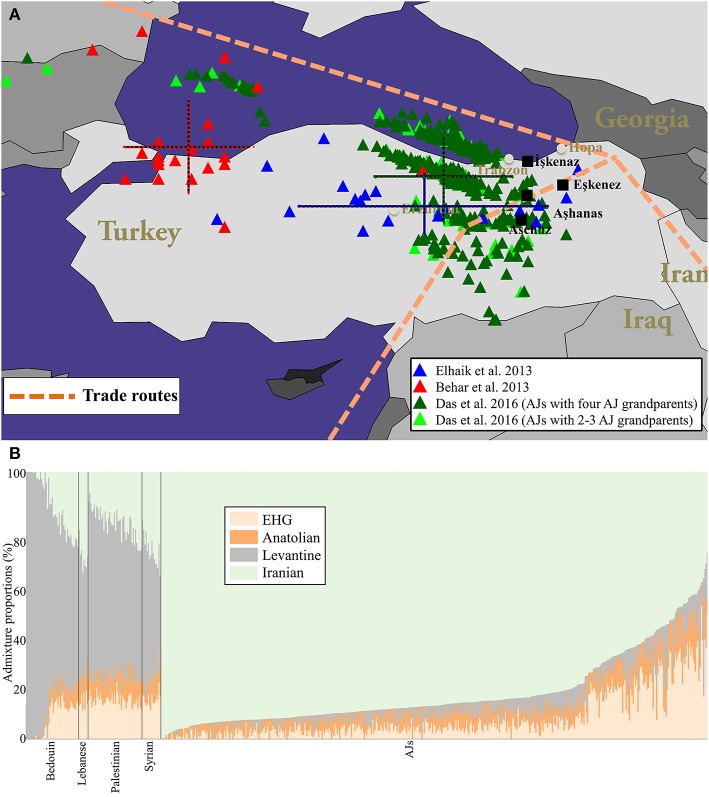
Recently, the geographical origins of Ashkenazic Jews (AJs) and their native language Yiddish were investigated by applying the Geographic Population Structure (GPS) to a cohort of exclusively Yiddish-speaking and multilingual AJs. GPS localized most AJs along major ancient trade routes in northeastern Turkey adjacent to primeval villages with names that resemble the word "Ashkenaz." These findings were compatible with the hypothesis of an Irano-Turko-Slavic origin for AJs and a Slavic origin for Yiddish and at odds with the Rhineland hypothesis advocating a Levantine origin for AJs and German origins for Yiddish. We discuss how these findings advance three ongoing debates concerning (1) the historical meaning of the term "Ashkenaz;" (2) the genetic structure of AJs and their geographical origins as inferred from multiple studies employing both modern and ancient DNA and original ancient DNA analyses; and (3) the development of Yiddish. We provide additional validation to the non-Levantine origin of AJs using ancient DNA from the Near East and the Levant. Due to the rising popularity of geo-localization tools to address questions of origin, we briefly discuss the advantages and limitations of popular tools with focus on the GPS approach. Our results reinforce the non-Levantine origins of AJs.

摘要

最近,通过对一组只会说意第绪语和会说多种语言的阿什肯纳兹犹太人(AJs)应用地理种群结构(GPS)方法,对AJs的地理起源及其母语意第绪语进行了调查。GPS将大多数AJs定位在土耳其东北部主要的古代贸易路线沿线,这些路线毗邻一些原始村庄,其名字类似于“Ashkenaz”这个词。这些发现与AJs起源于伊朗 - 土耳其 - 斯拉夫以及意第绪语起源于斯拉夫的假设相符,与主张AJs起源于黎凡特地区且意第绪语起源于德语的莱茵兰假设相悖。我们讨论了这些发现如何推动了关于以下三个正在进行的争论:(1)“Ashkenaz”一词的历史含义;(2)从使用现代和古代DNA以及原始古代DNA分析的多项研究中推断出的AJs的遗传结构及其地理起源;(3)意第绪语的发展。我们利用来自近东和黎凡特地区的古代DNA为AJs非黎凡特起源提供了额外的验证。由于地理定位工具在解决起源问题方面越来越受欢迎,我们简要讨论了常用工具的优点和局限性,重点是GPS方法。我们的结果强化了AJs非黎凡特起源的观点。
https://cdn.ncbi.nlm.nih.gov/pmc/blobs/c4b3/5478715/ded11efdbb9c/fgene-08-00087-g0001.jpg

相似文献

1
The Origins of Ashkenaz, Ashkenazic Jews, and Yiddish.德系犹太人、德系犹太人和意第绪语的起源。
Front Genet. 2017 Jun 21;8:87. doi: 10.3389/fgene.2017.00087. eCollection 2017.
2
Localizing Ashkenazic Jews to Primeval Villages in the Ancient Iranian Lands of Ashkenaz.将德系犹太人溯源至古代伊朗境内阿什肯纳兹地区的原始村落。
Genome Biol Evol. 2016 Apr 19;8(4):1132-49. doi: 10.1093/gbe/evw046.
3
Yiddish Language and Ashkenazic Jews: A Perspective from Culture, Language, and Literature.意第绪语与德系犹太人:从文化、语言和文学角度的审视
Genome Biol Evol. 2016 Jul 2;8(6):1948-9. doi: 10.1093/gbe/evw131.
4
Pitfalls of the Geographic Population Structure (GPS) Approach Applied to Human Genetic History: A Case Study of Ashkenazi Jews.应用于人类遗传史的地理种群结构(GPS)方法的陷阱:以阿什肯纳兹犹太人为例的研究
Genome Biol Evol. 2016 Aug 16;8(7):2259-65. doi: 10.1093/gbe/evw162.
5
Origin and spread of the 1278insTATC mutation causing Tay-Sachs disease in Ashkenazi Jews: genetic drift as a robust and parsimonious hypothesis.导致阿什肯纳兹犹太人患泰-萨克斯病的1278insTATC突变的起源与传播:遗传漂变作为一个有力且简洁的假说
Hum Genet. 2004 Mar;114(4):366-76. doi: 10.1007/s00439-003-1072-8. Epub 2004 Jan 15.
6
Speech disfluencies in bilingual Yiddish-Dutch speaking children.双语儿童的言语不流畅现象。
Clin Linguist Phon. 2020 Jun 2;34(6):576-592. doi: 10.1080/02699206.2019.1678670. Epub 2019 Oct 23.
7
[A document by the late Prof. Saburo Matubara, a medico-historical material written in Yiddish].
Nihon Ishigaku Zasshi. 2002 Dec;48(4):541-73.
8
Giving Tshuve to the sick: correspondence columns of the Yiddish medical press in Poland.给病人服用舒韦:波兰意第绪语医学报刊的读者来信专栏
Sci Context. 2019 Mar;32(1):25-41. doi: 10.1017/S0269889719000024.
9
Implicit Standardization in a Minority Language Community: Real-Time Syntactic Change among Hasidic Yiddish Writers.少数族裔语言社区中的隐性标准化:哈西德派意第绪语作家的实时句法变化
Front Artif Intell. 2020 May 29;3:35. doi: 10.3389/frai.2020.00035. eCollection 2020.
10
Application of the geographic population structure (GPS) algorithm for biogeographical analyses of wild and captive gorillas.应用地理种群结构(GPS)算法进行野生和圈养大猩猩的生物地理分析。
BMC Bioinformatics. 2019 Feb 5;20(Suppl 1):35. doi: 10.1186/s12859-018-2568-5.

引用本文的文献

1
Clinical, laboratory and molecular features of glycogen storage disease type 1a and 1b patients from Turkey: novel mutations and phenotypes.来自土耳其的1a型和1b型糖原贮积病患者的临床、实验室及分子特征:新突变与表型
Eur J Pediatr. 2025 Aug 9;184(9):540. doi: 10.1007/s00431-025-06371-7.
2
Editorial: 10 years of Frontiers in genetics: past discoveries, current challenges and future perspectives.社论:《遗传学前沿》十年:过去的发现、当前的挑战与未来展望
Front Genet. 2023 May 5;14:1192071. doi: 10.3389/fgene.2023.1192071. eCollection 2023.
3
The impact of cross-kingdom molecular forensics on genetic privacy.

本文引用的文献

1
The time and place of European admixture in Ashkenazi Jewish history.阿什肯纳兹犹太历史中欧洲人混合的时间和地点。
PLoS Genet. 2017 Apr 4;13(4):e1006644. doi: 10.1371/journal.pgen.1006644. eCollection 2017 Apr.
2
Reconstructing Druze population history.重建德鲁兹人的人口历史。
Sci Rep. 2016 Nov 16;6:35837. doi: 10.1038/srep35837.
3
In Search of the jüdische Typus: A Proposed Benchmark to Test the Genetic Basis of Jewishness Challenges Notions of "Jewish Biomarkers".寻找犹太类型:一个用于测试犹太性遗传基础的拟议基准对“犹太生物标志物”概念提出了挑战。
跨界分子法医鉴定对遗传隐私的影响。
Microbiome. 2021 May 20;9(1):114. doi: 10.1186/s40168-021-01076-z.
4
Population genetic considerations for using biobanks as international resources in the pandemic era and beyond.大流行时代及以后利用生物库作为国际资源的群体遗传学考虑因素。
BMC Genomics. 2021 May 17;22(1):351. doi: 10.1186/s12864-021-07618-x.
5
The story of the lost twins: decoding the genetic identities of the Kumhar and Kurcha populations from the Indian subcontinent.失落双胞胎的故事:解码来自印度次大陆的库马尔和库尔查人群的遗传身份。
BMC Genet. 2020 Oct 22;21(Suppl 1):117. doi: 10.1186/s12863-020-00919-2.
6
Application of the geographic population structure (GPS) algorithm for biogeographical analyses of wild and captive gorillas.应用地理种群结构(GPS)算法进行野生和圈养大猩猩的生物地理分析。
BMC Bioinformatics. 2019 Feb 5;20(Suppl 1):35. doi: 10.1186/s12859-018-2568-5.
7
Ancient Ancestry Informative Markers for Identifying Fine-Scale Ancient Population Structure in Eurasians.用于识别欧亚大陆人群精细尺度古代种群结构的古代祖先信息标记
Genes (Basel). 2018 Dec 12;9(12):625. doi: 10.3390/genes9120625.
8
Pair Matcher (PaM): fast model-based optimization of treatment/case-control matches.配对匹配器 (PaM):基于模型的快速治疗/病例对照匹配优化。
Bioinformatics. 2019 Jul 1;35(13):2243-2250. doi: 10.1093/bioinformatics/bty946.
9
Application of geographic population structure (GPS) algorithm for biogeographical analyses of populations with complex ancestries: a case study of South Asians from 1000 genomes project.地理种群结构(GPS)算法在复杂祖先群体生物地理分析中的应用:以千人基因组计划中的南亚人为例
BMC Genet. 2017 Dec 28;18(Suppl 1):109. doi: 10.1186/s12863-017-0579-2.
10
The Diversity of REcent and Ancient huMan (DREAM): A New Microarray for Genetic Anthropology and Genealogy, Forensics, and Personalized Medicine.近期和远古人类多样性研究(DREAM):一个新的基因人类学和遗传学、法医学及个性化医疗的基因芯片。
Genome Biol Evol. 2017 Dec 1;9(12):3225-3237. doi: 10.1093/gbe/evx237.
Front Genet. 2016 Aug 5;7:141. doi: 10.3389/fgene.2016.00141. eCollection 2016.
4
Genomic insights into the origin of farming in the ancient Near East.对古代近东地区农业起源的基因组学洞察。
Nature. 2016 Aug 25;536(7617):419-24. doi: 10.1038/nature19310. Epub 2016 Jul 25.
5
Pitfalls of the Geographic Population Structure (GPS) Approach Applied to Human Genetic History: A Case Study of Ashkenazi Jews.应用于人类遗传史的地理种群结构(GPS)方法的陷阱:以阿什肯纳兹犹太人为例的研究
Genome Biol Evol. 2016 Aug 16;8(7):2259-65. doi: 10.1093/gbe/evw162.
6
Yiddish Language and Ashkenazic Jews: A Perspective from Culture, Language, and Literature.意第绪语与德系犹太人:从文化、语言和文学角度的审视
Genome Biol Evol. 2016 Jul 2;8(6):1948-9. doi: 10.1093/gbe/evw131.
7
Localizing Ashkenazic Jews to Primeval Villages in the Ancient Iranian Lands of Ashkenaz.将德系犹太人溯源至古代伊朗境内阿什肯纳兹地区的原始村落。
Genome Biol Evol. 2016 Apr 19;8(4):1132-49. doi: 10.1093/gbe/evw046.
8
The Kalash Genetic Isolate? The Evidence for Recent Admixture.卡拉什遗传隔离群体?近期基因混合的证据。
Am J Hum Genet. 2016 Feb 4;98(2):396-7. doi: 10.1016/j.ajhg.2015.12.025.
9
Spatial localization of recent ancestors for admixed individuals.混合个体近期祖先的空间定位。
G3 (Bethesda). 2014 Nov 3;4(12):2505-18. doi: 10.1534/g3.114.014274.
10
No evidence from genome-wide data of a Khazar origin for the Ashkenazi Jews.没有全基因组数据能证明阿什肯纳兹犹太人有哈扎尔人起源的证据。
Hum Biol. 2013 Dec;85(6):859-900. doi: 10.3378/027.085.0604.