Obst Juliane, Simon Emilie, Mancuso Renzo, Gomez-Nicola Diego
Biological Sciences, University of Southampton, Southampton General HospitalSouthampton, United Kingdom.
Front Aging Neurosci. 2017 Jun 23;9:207. doi: 10.3389/fnagi.2017.00207. eCollection 2017.
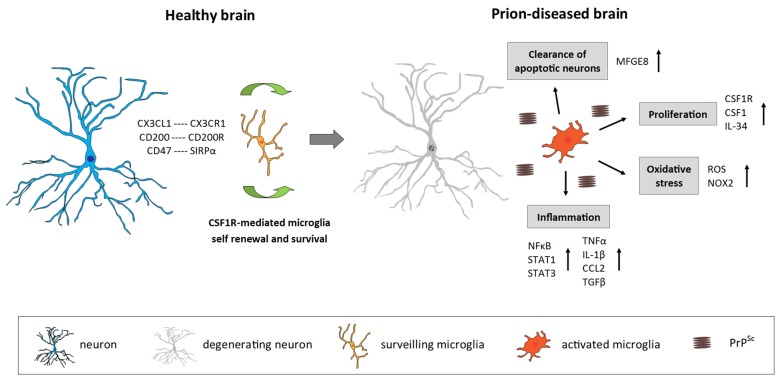
Inflammation is a major component of neurodegenerative diseases. Microglia are the innate immune cells in the central nervous system (CNS). In the healthy brain, microglia contribute to tissue homeostasis and regulation of synaptic plasticity. Under disease conditions, they play a key role in the development and maintenance of the neuroinflammatory response, by showing enhanced proliferation and activation. Prion diseases are progressive chronic neurodegenerative disorders associated with the accumulation of the scrapie prion protein PrP, a misfolded conformer of the cellular prion protein PrP. This review article provides the current knowledge on the role of microglia in the pathogenesis of prion disease. A large body of evidence shows that microglia can trigger neurotoxic pathways contributing to progressive degeneration. Yet, microglia are also crucial for controlling inflammatory, repair and regenerative processes. This dual role of microglia is regulated by multiple pathways and evidences the ability of these cells to polarize into distinct phenotypes with characteristic functions. The awareness that the neuroinflammatory response is inextricably involved in producing tissue damage as well as repair in neurodegenerative disorders, opens new perspectives for the modulation of the immune system. A better understanding of this complex process will be essential for developing effective therapies for neurodegenerative diseases, in order to improve the quality of life of patients and mitigating the personal, economic and social consequences derived from these diseases.
炎症是神经退行性疾病的主要组成部分。小胶质细胞是中枢神经系统(CNS)中的固有免疫细胞。在健康的大脑中,小胶质细胞有助于组织稳态和突触可塑性的调节。在疾病状态下,它们通过增强增殖和激活,在神经炎症反应的发生和维持中发挥关键作用。朊病毒疾病是与瘙痒病朊病毒蛋白PrP(细胞朊病毒蛋白PrP的错误折叠构象异构体)积累相关的进行性慢性神经退行性疾病。这篇综述文章提供了关于小胶质细胞在朊病毒疾病发病机制中作用的当前知识。大量证据表明,小胶质细胞可触发导致进行性退化的神经毒性途径。然而,小胶质细胞对于控制炎症、修复和再生过程也至关重要。小胶质细胞的这种双重作用受多种途径调节,并证明这些细胞能够极化为具有特征性功能的不同表型。认识到神经炎症反应与神经退行性疾病中的组织损伤以及修复密切相关,为免疫系统的调节开辟了新的视角。更好地理解这一复杂过程对于开发神经退行性疾病的有效疗法至关重要,以便提高患者的生活质量并减轻这些疾病带来的个人、经济和社会后果。