Tschiersch Henning, Junker Astrid, Meyer Rhonda C, Altmann Thomas
Leibniz Institute of Plant Genetics and Crop Plant Research (IPK) Gatersleben, Corrensstr. 3, 06466 Seeland, OT Gatersleben, Germany.
Plant Methods. 2017 Jul 4;13:54. doi: 10.1186/s13007-017-0204-4. eCollection 2017.
Automated plant phenotyping has been established as a powerful new tool in studying plant growth, development and response to various types of biotic or abiotic stressors. Respective facilities mainly apply non-invasive imaging based methods, which enable the continuous quantification of the dynamics of plant growth and physiology during developmental progression. However, especially for plants of larger size, integrative, automated and high throughput measurements of complex physiological parameters such as photosystem II efficiency determined through kinetic chlorophyll fluorescence analysis remain a challenge.
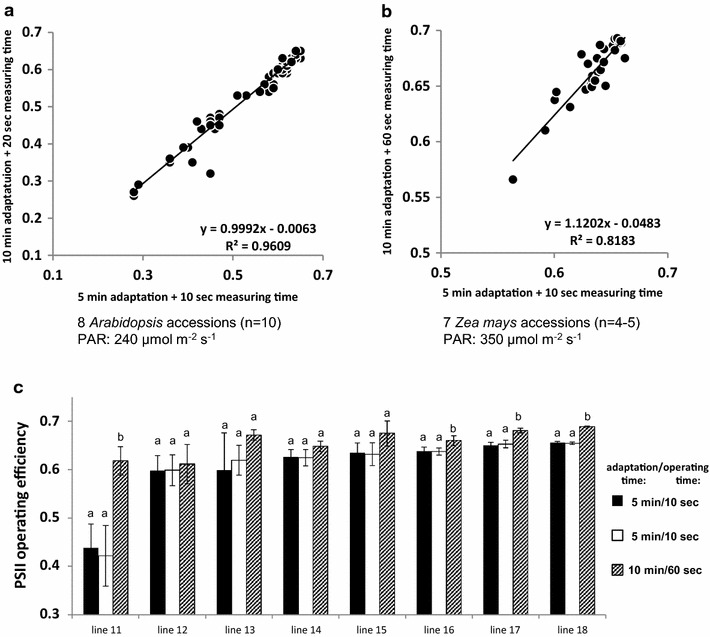
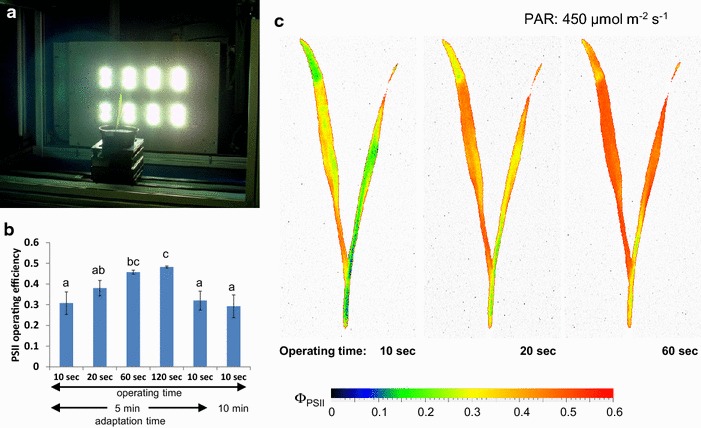
We present the technical installations and the establishment of experimental procedures that allow the integrated high throughput imaging of all commonly determined PSII parameters for small and large plants using kinetic chlorophyll fluorescence imaging systems (FluorCam, PSI) integrated into automated phenotyping facilities (Scanalyzer, LemnaTec). Besides determination of the maximum PSII efficiency, we focused on implementation of high throughput amenable protocols recording PSII operating efficiency (Φ). Using the presented setup, this parameter is shown to be reproducibly measured in differently sized plants despite the corresponding variation in distance between plants and light source that caused small differences in incident light intensity. Values of Φ obtained with the automated chlorophyll fluorescence imaging setup correlated very well with conventionally determined data using a spot-measuring chlorophyll fluorometer. The established high throughput operating protocols enable the screening of up to 1080 small and 184 large plants per hour, respectively. The application of the implemented high throughput protocols is demonstrated in screening experiments performed with large Arabidopsis and maize populations assessing natural variation in PSII efficiency.
The incorporation of imaging systems suitable for kinetic chlorophyll fluorescence analysis leads to a substantial extension of the feature spectrum to be assessed in the presented high throughput automated plant phenotyping platforms, thus enabling the simultaneous assessment of plant architectural and biomass-related traits and their relations to physiological features such as PSII operating efficiency. The implemented high throughput protocols are applicable to a broad spectrum of model and crop plants of different sizes (up to 1.80 m height) and architectures. The deeper understanding of the relation of plant architecture, biomass formation and photosynthetic efficiency has a great potential with respect to crop and yield improvement strategies.
自动植物表型分析已成为研究植物生长、发育以及对各种生物或非生物胁迫反应的强大新工具。相关设施主要采用基于非侵入性成像的方法,这使得在植物发育过程中能够持续量化植物生长和生理动态。然而,特别是对于较大型植物,通过动力学叶绿素荧光分析确定的复杂生理参数(如光系统II效率)的综合、自动和高通量测量仍然是一个挑战。
我们展示了技术装置以及实验程序的建立,这些装置和程序允许使用集成到自动表型分析设施(Scanalyzer,LemnaTec)中的动力学叶绿素荧光成像系统(FluorCam,PSI),对小型和大型植物所有常用测定的光系统II参数进行集成高通量成像。除了测定光系统II的最大效率外,我们还专注于实施适用于高通量的方案来记录光系统II的运行效率(Φ)。使用所展示的设置,尽管植物与光源之间的距离相应变化导致入射光强度存在微小差异,但该参数在不同大小的植物中仍能被重复测量。通过自动叶绿素荧光成像设置获得的Φ值与使用点测量叶绿素荧光计常规测定的数据非常吻合。已建立的高通量操作方案分别能够每小时筛选多达1080株小型植物和184株大型植物。在对大型拟南芥和玉米群体进行的筛选实验中展示了所实施的高通量方案的应用,这些实验评估了光系统II效率的自然变异。
纳入适用于动力学叶绿素荧光分析的成像系统,极大地扩展了所展示的高通量自动植物表型分析平台中要评估的特征谱,从而能够同时评估植物结构和生物量相关性状及其与诸如光系统II运行效率等生理特征的关系。所实施的高通量方案适用于不同大小(高达1.80米高)和结构的广泛模型植物和作物。对植物结构、生物量形成和光合效率之间关系的更深入理解对于作物和产量提高策略具有巨大潜力。