Sachett Jacqueline A G, da Silva Iran Mendonça, Alves Eliane Campos, Oliveira Sâmella S, Sampaio Vanderson S, do Vale Fábio Francesconi, Romero Gustavo Adolfo Sierra, Dos Santos Marcelo Cordeiro, Marques Hedylamar Oliveira, Colombini Mônica, da Silva Ana Maria Moura, Wen Fan Hui, Lacerda Marcus V G, Monteiro Wuelton M, Ferreira Luiz C L
Diretoria de Ensino e Pesquisa, Fundação de Medicina Tropical Dr. Heitor Vieira Dourado, Manaus, Brazil.
Escola Superior de Ciências da Saúde, Universidade do Estado do Amazonas, Manaus, Brazil.
PLoS Negl Trop Dis. 2017 Jul 10;11(7):e0005745. doi: 10.1371/journal.pntd.0005745. eCollection 2017 Jul.
Secondary bacterial infections from snakebites contribute to the high complication rates that can lead to permanent function loss and disabilities. Although common in endemic areas, routine empirical prophylactic use of antibiotics aiming to prevent secondary infection lacks a clearly defined policy. The aim of this work was to estimate the efficacy of amoxicillin clavulanate for reducing the secondary infection incidence in patients bitten by Bothrops snakes, and, secondarily, identify risk factors for secondary infections from snakebites in the Western Brazilian Amazon.
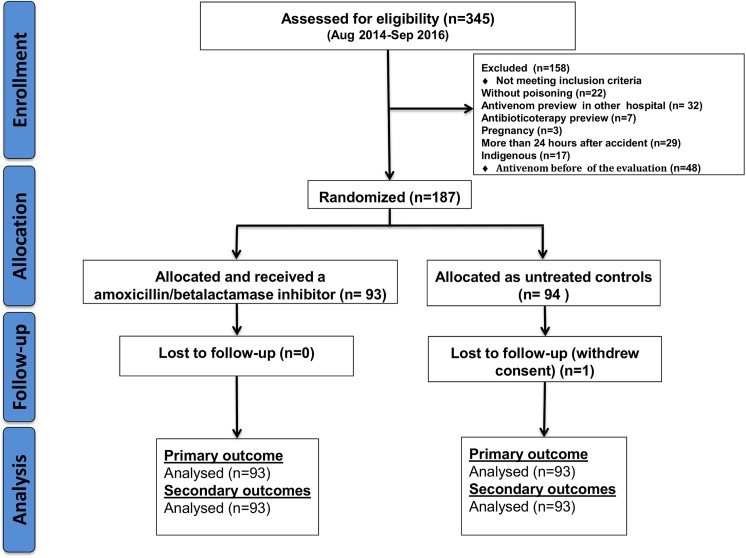
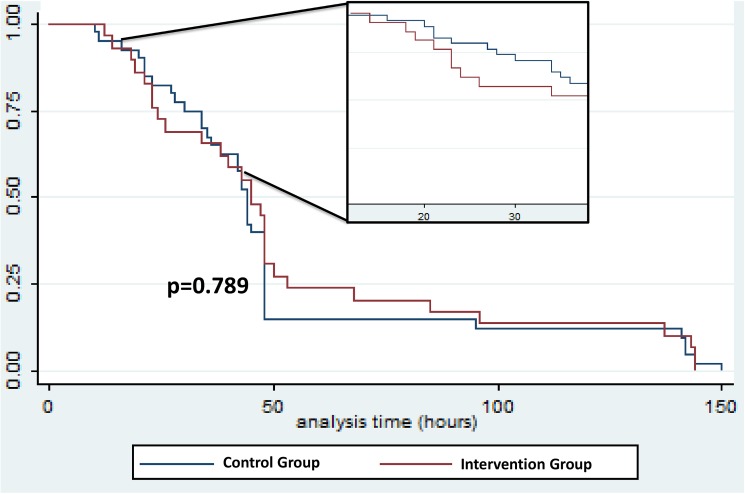
This was an open-label, two-arm individually randomized superiority trial to prevent secondary infection from Bothrops snakebites. The antibiotic chosen for this clinical trial was oral amoxicillin clavulanate per seven days compared to no intervention. A total of 345 patients were assessed for eligibility in the study period. From this total, 187 accomplished the inclusion criteria and were randomized, 93 in the interventional group and 94 in the untreated control group. All randomized participants completed the 7 days follow-up period. Enzyme immunoassay confirmed Bothrops envenoming diagnosis in all participants. Primary outcome was defined as secondary infection (abscess and/or cellulitis) until day 7 after admission. Secondary infection incidence until 7 days after admission was 35.5% in the intervention group and 44.1% in the control group [RR = 0.80 (95%CI = 0.56 to 1.15; p = 0.235)]. Survival analysis demonstrated that the time from patient admission to the onset of secondary infection was not different between amoxicillin clavulanate treated and control group (Log-rank = 2.23; p = 0.789).Secondary infections incidence in 7 days of follow-up was independently associated to fibrinogen >400 mg/dL [AOR = 4.78 (95%CI = 2.17 to 10.55; p<0.001)], alanine transaminase >44 IU/L [AOR = 2.52 (95%CI = 1.06 to 5.98; p = 0.037)], C-reactive protein >6.5 mg/L [AOR = 2.98 (95%CI = 1.40 to 6.35; p = 0.005)], moderate pain [AOR = 24.30 (95%CI = 4.69 to 125.84; p<0.001)] and moderate snakebites [AOR = 2.43 (95%CI = 1.07 to 5.50; p = 0.034)].
CONCLUSIONS/SIGNIFICANCE: Preemptive amoxicillin clavulanate was not effective for preventing secondary infections from Bothrops snakebites. Laboratorial markers, such as high fibrinogen, alanine transaminase and C-reactive protein levels, and severity clinical grading of snakebites, may help to accurately diagnose secondary infections.
Brazilian Clinical Trials Registry (ReBec): RBR-3h33wy; UTN Number: U1111-1169-1005.
蛇咬伤后的继发性细菌感染导致了较高的并发症发生率,可能会导致永久性功能丧失和残疾。虽然在流行地区很常见,但旨在预防继发性感染的抗生素常规经验性预防性使用缺乏明确的政策。这项工作的目的是评估阿莫西林克拉维酸减少被矛头蝮蛇咬伤患者继发性感染发生率的疗效,其次,确定巴西亚马逊西部蛇咬伤继发性感染的危险因素。
这是一项开放标签、双臂个体随机优效性试验,以预防矛头蝮蛇咬伤后的继发性感染。与不进行干预相比,本临床试验选择的抗生素是每七天口服一次阿莫西林克拉维酸。在研究期间,共有345名患者接受了资格评估。其中,187名符合纳入标准并被随机分组,93名在干预组,94名在未治疗的对照组。所有随机参与者均完成了7天的随访期。酶免疫测定法证实所有参与者均为矛头蝮蛇毒中毒。主要结局定义为入院后7天内的继发性感染(脓肿和/或蜂窝织炎)。干预组入院后7天内的继发性感染发生率为35.5%,对照组为44.1%[相对危险度=0.80(95%置信区间=0.56至1.15;p=0.2第35页)]。生存分析表明,阿莫西林克拉维酸治疗组和对照组从患者入院到继发性感染发作的时间没有差异(对数秩检验=2.23;p=0.789)。随访7天内的继发性感染发生率与纤维蛋白原>400mg/dL[调整后比值比=4.78(95%置信区间=2.17至10第35页55;p<0.001)]、丙氨酸转氨酶>44IU/L[调整后比值比=2.52(95%置信区间=1.06至5.98;p=0.037)]、C反应蛋白>6.5mg/L[调整后比值比=2.98(95%置信区间=1.40至6.35;p=0.005)]、中度疼痛[调整后比值比=24.30(95%置信区间=4.69至125.84;p<0.001)]和中度蛇咬伤[调整后比值比=2.43(95%置信区间=1.07至5.50;p=0.034)]独立相关。
结论/意义:预防性使用阿莫西林克拉维酸对预防矛头蝮蛇咬伤后的继发性感染无效。实验室指标,如高纤维蛋白原、丙氨酸转氨酶和C反应蛋白水平,以及蛇咬伤的严重程度临床分级,可能有助于准确诊断继发性感染。
巴西临床试验注册中心(ReBec):RBR-3h33wy;UTN编号:U1111-1169-1005。