Primary Care Research Unit of Mallorca, Baleares Health Services-IbSalut, 07005, Palma, Spain.
Instituto de Investigación Sanitaria de Palma (IdISPa), 07010, Palma, Spain.
BMC Palliat Care. 2017 Jul 10;17(1):4. doi: 10.1186/s12904-017-0217-9.
The objective of the Balearic Islands Palliative Care (PC) Program is to improve the quality of PC through a shared model consisting of primary health care professionals, home-based PC teams, and PC units in hospitals. According to the World Health Organization (WHO), patients with advanced cancer and other terminal diseases benefit from early identification and proactive PC. We will evaluate the effectiveness of an intervention in which a PC leader is established in the primary health care center, and assess the effect of this intervention on the early identification of patients in need of PC, the efficient use of health care services, and direct health care costs.
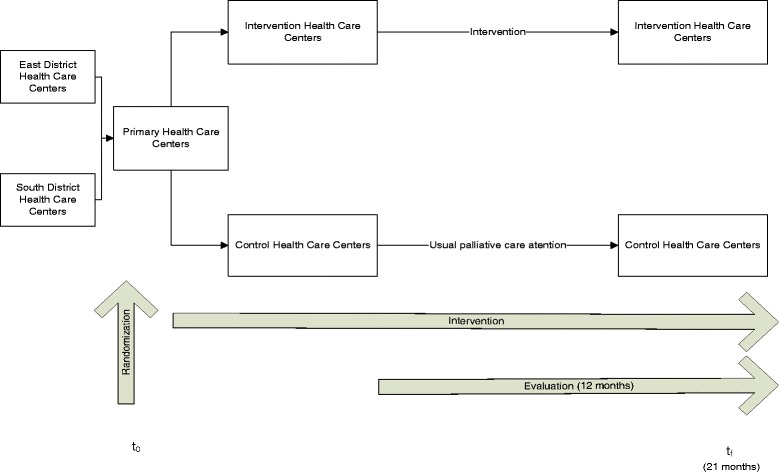
Design: A two-arm cluster randomized clinical trial of 30 Primary Health Care Centers (PHCC) in Mallorca (Spain), in which each center was randomized to an intervention arm or a usual care arm. We expect that the number of patients identified as suitable for PC (including non-oncological PC) is at least 5% greater in the intervention arm.
A total of 4640 deceased patients. Outcomes will be assessed by a blinded external review of the electronic records.
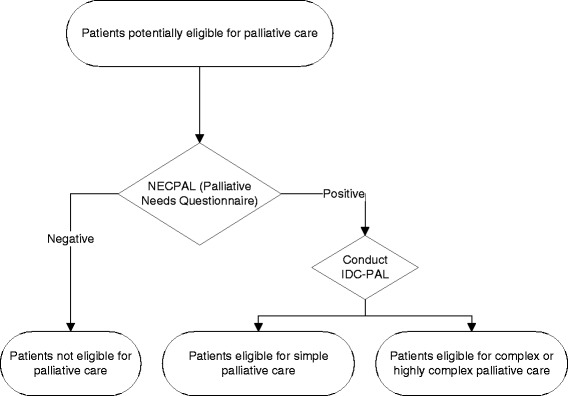
General practitioners (GPs) and nurse leaders in PC for each PHCC will be appointed. These leaders will help promote PC training of colleagues, improve symptom management and psychological support of patients, and evaluate the complexity of individual cases so that these cases receive assistance from PC home-based teams.
Early identification (>90 days before death), evaluation of case complexity, level of case complexity (with referral to a home-based PC team), use and cost of hospital and primary care services, and quality of life during the last month of life (≥2 emergency room visits, ≥2 hospital admissions, ≥14 days of hospitalization).
PC leaders in primary care teams will improve the early identification of patients eligible for PC. This initiative could improve the quality of end-of-life care and utilization of hospital resources.
ISRCTN Registry identifier: ISRCTN92479122 . Retrospectively registered on 28 February 2017.
巴利阿里群岛姑息治疗(PC)计划的目标是通过由初级保健专业人员、家庭 PC 团队和医院 PC 单元组成的共享模式来提高 PC 的质量。根据世界卫生组织(WHO)的说法,患有晚期癌症和其他终末期疾病的患者受益于早期识别和积极的 PC。我们将评估在初级保健中心设立 PC 负责人的干预措施的有效性,并评估该干预措施对早期识别需要 PC 的患者、有效利用医疗保健服务以及直接医疗保健成本的影响。
设计:在西班牙马略卡岛的 30 个初级保健中心(PHCC)进行的一项两臂聚类随机临床试验,每个中心被随机分配到干预组或常规护理组。我们预计干预组中适合 PC(包括非肿瘤 PC)的患者数量至少增加 5%。
共 4640 名已故患者。将通过对电子记录的盲法外部审查来评估结果。
为每个 PHCC 的全科医生(GP)和 PC 护士负责人任命。这些负责人将帮助促进同事的 PC 培训,改善患者的症状管理和心理支持,并评估个体病例的复杂性,以便这些病例得到家庭 PC 团队的帮助。
早期识别(死亡前>90 天)、病例复杂性评估、病例复杂性水平(转介至家庭 PC 团队)、医院和初级保健服务的使用和成本,以及生命最后一个月的生活质量(≥2 次急诊就诊、≥2 次住院、≥14 天住院)。
初级保健团队中的 PC 负责人将改善对符合 PC 条件的患者的早期识别。这项倡议可以改善临终关怀的质量和医院资源的利用。
ISRCTN 注册表标识符:ISRCTN92479122。于 2017 年 2 月 28 日回顾性注册。