Cahn B Rael, Goodman Matthew S, Peterson Christine T, Maturi Raj, Mills Paul J
Department of Psychiatry and Behavioral Sciences, University of Southern CaliforniaLos Angeles, CA, United States.
Brain and Creativity Institute, University of Southern CaliforniaLos Angeles, CA, United States.
Front Hum Neurosci. 2017 Jun 26;11:315. doi: 10.3389/fnhum.2017.00315. eCollection 2017.
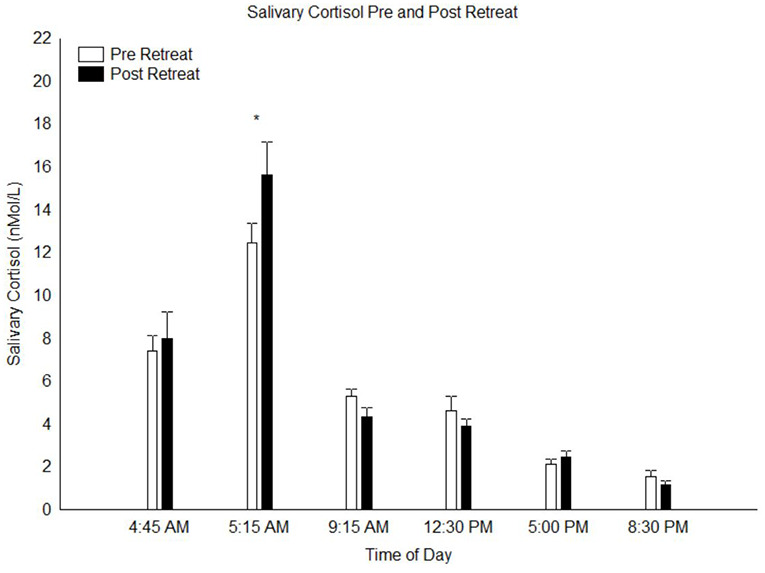
Thirty-eight individuals (mean age: 34.8 years old) participating in a 3-month yoga and meditation retreat were assessed before and after the intervention for psychometric measures, brain derived neurotrophic factor (BDNF), circadian salivary cortisol levels, and pro- and anti-inflammatory cytokines. Participation in the retreat was found to be associated with decreases in self-reported anxiety and depression as well as increases in mindfulness. As hypothesized, increases in the plasma levels of BDNF and increases in the magnitude of the cortisol awakening response (CAR) were also observed. The normalized change in BDNF levels was inversely correlated with BSI-18 anxiety scores at both the pre-retreat ( = 0.40, < 0.05) and post-retreat ( = 0.52, < 0.005) such that those with greater anxiety scores tended to exhibit smaller pre- to post-retreat increases in plasma BDNF levels. In line with a hypothesized decrease in inflammatory processes resulting from the yoga and meditation practices, we found that the plasma level of the anti-inflammatory cytokine Interleukin-10 was increased and the pro-inflammatory cytokine Interleukin-12 was reduced after the retreat. Contrary to our initial hypotheses, plasma levels of other pro-inflammatory cytokines, including Interferon Gamma (IFN-γ), Tumor Necrosis Factor (TNF-α), Interleukin-1β (IL-1β), Interleukin-6 (IL-6), and Interleukin-8 (IL-8) were increased after the retreat. Given evidence from previous studies of the positive effects of meditative practices on mental fitness, autonomic homeostasis and inflammatory status, we hypothesize that these findings are related to the meditative practices throughout the retreat; however, some of the observed changes may also be related to other aspects of the retreat such as physical exercise-related components of the yoga practice and diet. We hypothesize that the patterns of change observed here reflect mind-body integration and well-being. The increased BDNF levels observed is a potential mediator between meditative practices and brain health, the increased CAR is likely a reflection of increased dynamic physiological arousal, and the relationship of the dual enhancement of pro- and anti-inflammatory cytokine changes to healthy immunologic functioning is discussed.
对38名参与为期3个月瑜伽与冥想静修活动的人员(平均年龄:34.8岁)在干预前后进行了心理测量指标、脑源性神经营养因子(BDNF)、昼夜唾液皮质醇水平以及促炎和抗炎细胞因子的评估。结果发现,参与静修与自我报告的焦虑和抑郁情绪降低以及正念增加有关。正如所假设的那样,还观察到血浆BDNF水平升高以及皮质醇觉醒反应(CAR)幅度增加。BDNF水平的标准化变化在静修前(r = 0.40,p < 0.05)和静修后(r = 0.52,p < 0.005)均与BSI - 18焦虑评分呈负相关,即焦虑评分较高者静修前后血浆BDNF水平的升高幅度往往较小。与瑜伽和冥想练习导致炎症过程减少的假设一致,我们发现静修后抗炎细胞因子白细胞介素 - 10的血浆水平升高,促炎细胞因子白细胞介素 - 12降低。与我们最初的假设相反,包括干扰素γ(IFN - γ)、肿瘤坏死因子(TNF - α)、白细胞介素 - 1β(IL - 1β)、白细胞介素 - 6(IL - 6)和白细胞介素 - 8(IL - 8)在内的其他促炎细胞因子的血浆水平在静修后升高。鉴于先前研究表明冥想练习对心理健康、自主稳态和炎症状态有积极影响,我们假设这些发现与整个静修过程中的冥想练习有关;然而,一些观察到的变化也可能与静修的其他方面有关,如瑜伽练习中与体育锻炼相关的部分以及饮食。我们假设这里观察到的变化模式反映了身心整合与幸福感。观察到的BDNF水平升高是冥想练习与大脑健康之间的潜在中介,CAR增加可能反映了动态生理唤醒的增加,并且讨论了促炎和抗炎细胞因子变化的双重增强与健康免疫功能的关系。