Afzelius Pia, Garding Mette-Marie, Molsted Stig
Department of Diagnostic Imaging, Copenhagen University Hospital, North Zealand Hospital, DK-3400 Hillerød, Denmark.
Department of Clinical Research, Copenhagen University Hospital, North Zealand Hospital, DK-3400 Hillerød, Denmark.
Diagnostics (Basel). 2017 Jul 9;7(3):41. doi: 10.3390/diagnostics7030041.
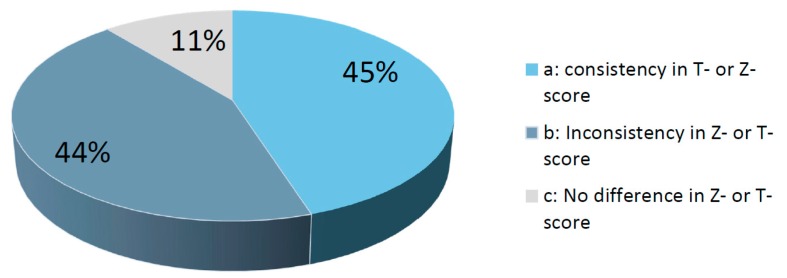
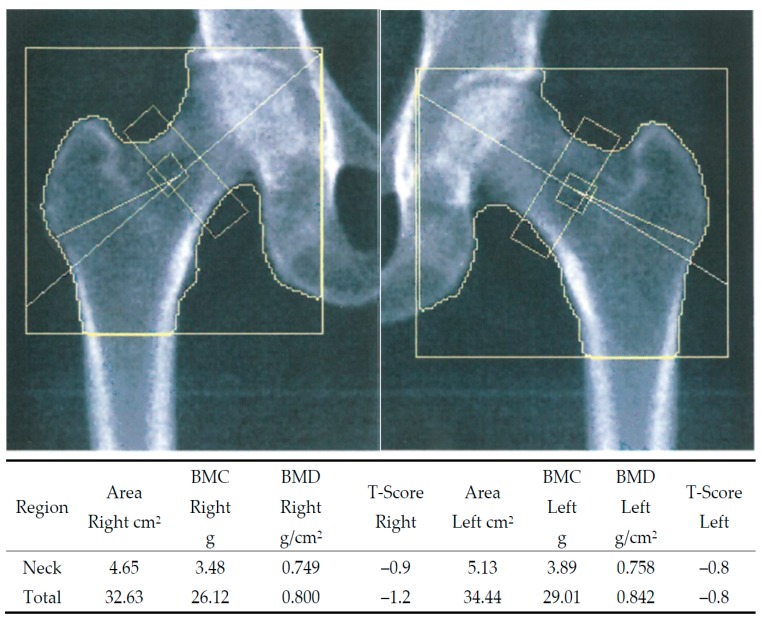
Controversy still remains regarding the use of bilateral hip scanning when bone mineral density (BMD) is measured, and bilateral hip scanning is not mandatory in international guidelines for screening of osteoporosis. BMD of both hips and the lumbar spine was analyzed in 133 consecutive individuals. There were discrepancies between the lowest -scores of both hips. Fourteen of the 133 participants (11%) were diagnosed with a poorer BMD status when the BMD of the hip of the dominant leg was analyzed. The total hip BMD of the dominant hip was lower than in the non-dominant hip, ( = 0.035), whereas there were no differences in the femoral neck area of the dominant and the non-dominant leg ( = 0.754). When classified by - or -scores, there was consistency in 60 cases (45%) and inconsistency in 59 cases (44%). In 14 cases (11%), - or -scores were the same, and it did not matter whether the non-dominant hip or the dominant hip had been chosen. A diagnostic discordance of 11% between the left and the right hip was observed when the lumbar spine was evaluated. The lowest - and -scores of the hips were, in 44% of the cases, found in the hip of the assumed dominant leg. BMD measurements of both hips are recommended as clinical practice.
在测量骨密度(BMD)时,双侧髋部扫描的应用仍存在争议,并且在国际骨质疏松症筛查指南中,双侧髋部扫描并非强制要求。对133名连续个体的双侧髋部和腰椎骨密度进行了分析。双侧髋部的最低分数之间存在差异。在分析优势腿髋部的骨密度时,133名参与者中有14名(11%)被诊断为骨密度状况较差。优势髋部的全髋骨密度低于非优势髋部(P = 0.035),而优势腿和非优势腿的股骨颈区域没有差异(P = 0.754)。按T值或Z值分类时,60例(45%)结果一致,59例(44%)结果不一致。14例(11%)的T值或Z值相同,选择非优势髋部还是优势髋部无关紧要。在评估腰椎时,观察到左右髋部之间存在11%的诊断不一致。在44%的病例中,髋部的最低T值和Z值出现在假定的优势腿的髋部。建议在临床实践中进行双侧髋部的骨密度测量。