Laboratoire National des Champs Magnétiques Intenses, CNRS-UGA-UPS-INSA-EMFL, 25, avenue des Martyrs, 38042, Grenoble, France.
Faculty of Physics, University of Warsaw, ul. Pasteura 5, 02-093, Warszawa, Poland.
Sci Rep. 2017 Jul 11;7(1):5036. doi: 10.1038/s41598-017-05367-0.
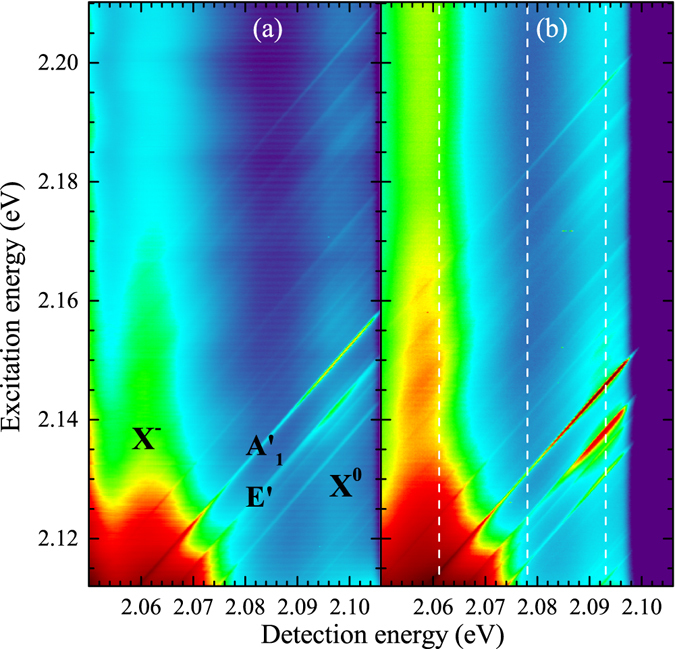
Resonant Raman scattering is investigated in monolayer WS at low temperature with the aid of an unconventional technique, i.e., Raman scattering excitation (RSE) spectroscopy. The RSE spectrum is made up by sweeping the excitation energy, when the detection energy is fixed in resonance with excitonic transitions related to either neutral or charged excitons. We demonstrate that the shape of the RSE spectrum strongly depends on the selected detection energy. The resonance of outgoing light with the neutral exciton leads to an extremely rich RSE spectrum, which displays several Raman scattering features not reported so far, while no clear effect on the associated background photoluminescence is observed. Instead, when the outgoing photons resonate with the negatively charged exciton, a strong enhancement of the related emission occurs. Presented results show that the RSE spectroscopy can be a useful technique to study electron-phonon interactions in thin layers of transition metal dichalcogenides.
在低温下,借助一种非传统的技术,即拉曼散射激发(RSE)光谱学,研究了单层 WS 中的共振拉曼散射。RSE 光谱通过扫描激发能量来产生,此时检测能量与中性或带电激子相关的激子跃迁共振。我们证明了 RSE 光谱的形状强烈依赖于所选的检测能量。与中性激子的出射光的共振导致极其丰富的 RSE 光谱,其显示了迄今为止尚未报道的几个拉曼散射特征,而与相关的背景光致发光没有明显的相互作用。相反,当出射光子与带负电荷的激子共振时,相关的发射会发生强烈增强。呈现的结果表明,RSE 光谱学可以成为研究过渡金属二卤化物薄层中电子-声子相互作用的有用技术。