Jiménez-Alejo Abel, Morales-Pérez Arcadio, Nava-Aguilera Elizabeth, Flores-Moreno Miguel, Apreza-Aguilar Sinahí, Carranza-Alcaraz Wilhelm, Cortés-Guzmán Antonio Juan, Fernández-Salas Ildefonso, Ledogar Robert J, Cockcroft Anne, Andersson Neil
Centro de Investigación de Enfermedades Tropicales (CIET), Universidad Autónoma de Guerrero, Acapulco, Guerrero, Mexico.
Unidad Académica de Ciencias Químico Biológicas, Universidad Autónoma de Guerrero, Chilpancingo, Guerrero, Mexico.
BMC Public Health. 2017 May 30;17(Suppl 1):428. doi: 10.1186/s12889-017-4294-8.
The follow-up survey of a cluster-randomised controlled trial of evidence-based community mobilisation for dengue control in Nicaragua and Mexico included entomological information from the 2012 rainy and dry seasons. We used data from the Mexican arm of the trial to assess the impact of the community action on pupal production of the dengue vector Aedes aegypti in both rainy and dry seasons.
Trained field workers inspected household water containers in 90 clusters and collected any pupae or larvae present for entomological examination. We calculated indices of pupae per person and pupae per household, and traditional entomological indices of container index, household index and Breteau index, and compared these between rainy and dry seasons and between intervention and control clusters, using a cluster t-test to test significance of differences.
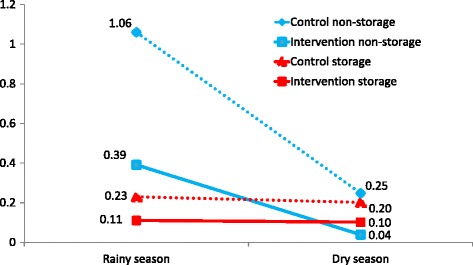
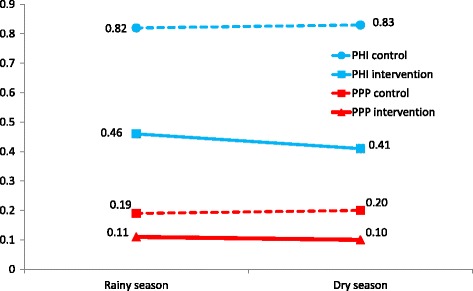
In 11,933 houses in the rainy season, we inspected 40,323 containers and found 7070 Aedes aegypti pupae. In the dry season, we inspected 43,461 containers and counted 6552 pupae. All pupae and entomological indices were lower in the intervention clusters (IC) than in control clusters (CC) in both the rainy season (RS) and the dry season (DS): pupae per container 0.12 IC and 0.24 CC in RS, and 0.10 IC and 0.20 CC in DS; pupae per household 0.46 IC and 0.82 CC in RS, and 0.41 IC and 0.83 CC in DS; pupae per person 0.11 IC and 0.19 CC in RS, and 0.10 IC and 0.20 CC in DS; household index 16% IC and 21% CC in RS, and 12.1% IC and 17.9% CC in DS; container index 7.5% IC and 11.5% CC in RS, and 4.6% IC and 7.1% CC in DS; Breteau index 27% IC and 36% CC in RS, and 19% IC and 29% CC in DS. All differences between the intervention and control clusters were statistically significant, taking into account clustering.
The trial intervention led to significant decreases in pupal and conventional entomological indices in both rainy and dry seasons.
ISRCTN27581154 .
对尼加拉瓜和墨西哥开展的一项基于证据的社区登革热防控动员整群随机对照试验的随访调查涵盖了2012年雨季和旱季的昆虫学信息。我们利用该试验墨西哥部分的数据,评估社区行动对雨季和旱季登革热媒介埃及伊蚊蛹产量的影响。
经过培训的现场工作人员检查了90个群组中的家庭储水容器,并收集所有发现的蛹或幼虫用于昆虫学检查。我们计算了人均蛹指数和每户蛹指数,以及传统的昆虫学指数,即容器指数、家庭指数和布雷图指数,并使用整群t检验来检验差异的显著性,比较了雨季和旱季之间以及干预群组和对照群组之间的这些指数。
在雨季的11933所房屋中,我们检查了40323个容器,发现7070只埃及伊蚊蛹。在旱季,我们检查了43461个容器,统计到6552只蛹。在雨季(RS)和旱季(DS),干预群组(IC)的所有蛹和昆虫学指数均低于对照群组(CC):雨季时,每容器蛹数IC为0.12,CC为0.24;旱季时,IC为0.10,CC为0.20。每户蛹数在雨季时IC为0.46,CC为0.82;旱季时,IC为0.41,CC为0.83。人均蛹数在雨季时IC为0.11,CC为0.19;旱季时,IC为0.10,CC为0.20。家庭指数在雨季时IC为16%,CC为21%;旱季时,IC为12.1%,CC为17.9%。容器指数在雨季时IC为7.5%,CC为11.5%;旱季时,IC为4.6%,CC为7.1%。布雷图指数在雨季时IC为27%,CC为36%;旱季时,IC为19%,CC为29%。考虑到群组因素,干预群组和对照群组之间的所有差异均具有统计学显著性。
该试验干预导致雨季和旱季的蛹指数和传统昆虫学指数均显著下降。
ISRCTN27581154 。