Lee Yeunkum, Kim Sun Gyun, Lee Bokyoung, Zhang Yinhua, Kim Yoonhee, Kim Shinhyun, Kim Eunjoon, Kang Hyojin, Han Kihoon
Department of Neuroscience, College of Medicine, Korea UniversitySeoul, South Korea.
Department of Biomedical Sciences, College of Medicine, Korea UniversitySeoul, South Korea.
Front Mol Neurosci. 2017 Jun 28;10:201. doi: 10.3389/fnmol.2017.00201. eCollection 2017.
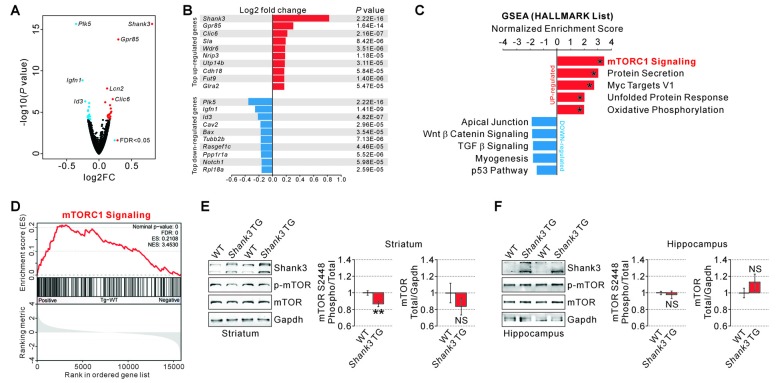
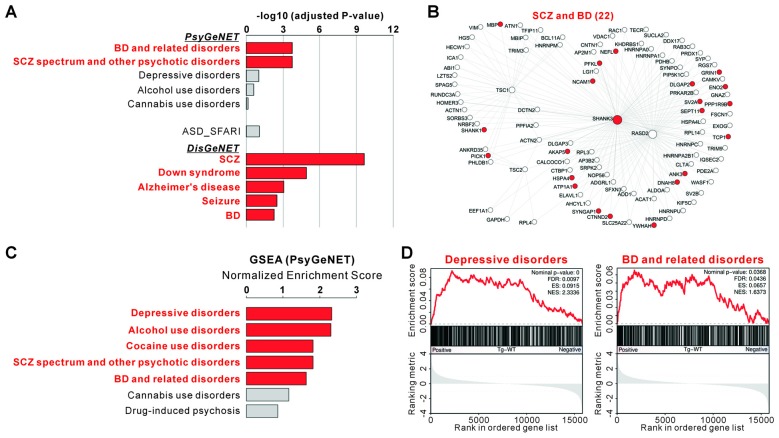
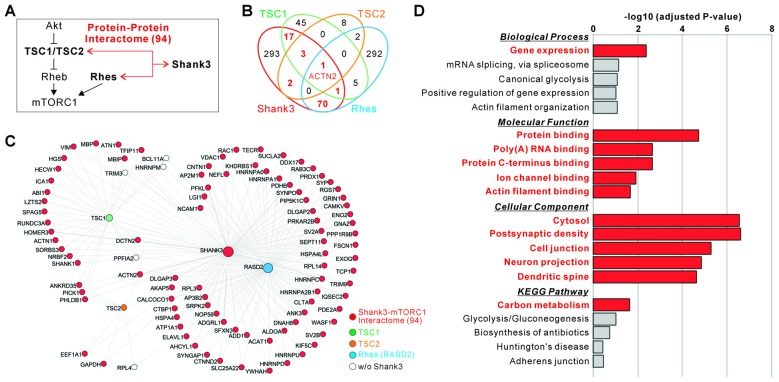
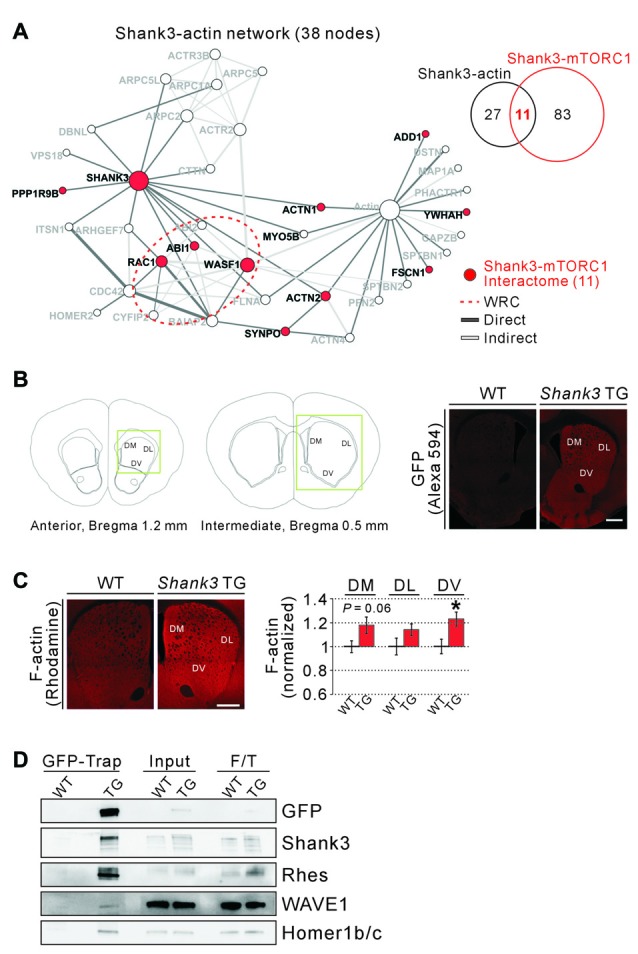
Mania causes symptoms of hyperactivity, impulsivity, elevated mood, reduced anxiety and decreased need for sleep, which suggests that the dysfunction of the striatum, a critical component of the brain motor and reward system, can be causally associated with mania. However, detailed molecular pathophysiology underlying the striatal dysfunction in mania remains largely unknown. In this study, we aimed to identify the molecular pathways showing alterations in the striatum of SH3 and multiple ankyrin repeat domains 3 (Shank3)-overexpressing transgenic (TG) mice that display manic-like behaviors. The results of transcriptome analysis suggested that mammalian target of rapamycin complex 1 (mTORC1) signaling may be the primary molecular signature altered in the TG striatum. Indeed, we found that striatal mTORC1 activity, as measured by mTOR S2448 phosphorylation, was significantly decreased in the TG mice compared to wild-type (WT) mice. To elucidate the potential underlying mechanism, we re-analyzed previously reported protein interactomes, and detected a high connectivity between Shank3 and several upstream regulators of mTORC1, such as tuberous sclerosis 1 (TSC1), TSC2 and Ras homolog enriched in striatum (Rhes), via 94 common interactors that we denominated "Shank3-mTORC1 interactome". We noticed that, among the 94 common interactors, 11 proteins were related to actin filaments, the level of which was increased in the dorsal striatum of TG mice. Furthermore, we could co-immunoprecipitate Shank3, Rhes and Wiskott-Aldrich syndrome protein family verprolin-homologous protein 1 (WAVE1) proteins from the striatal lysate of TG mice. By comparing with the gene sets of psychiatric disorders, we also observed that the 94 proteins of Shank3-mTORC1 interactome were significantly associated with bipolar disorder (BD). Altogether, our results suggest a protein interaction-mediated connectivity between Shank3 and certain upstream regulators of mTORC1 that might contribute to the abnormal striatal mTORC1 activity and to the manic-like behaviors of TG mice.
躁狂症会引发多动、冲动、情绪高涨、焦虑减轻以及睡眠需求减少等症状,这表明纹状体功能障碍可能与躁狂症存在因果关系,而纹状体是大脑运动和奖赏系统的关键组成部分。然而,躁狂症中纹状体功能障碍背后详细的分子病理生理学机制在很大程度上仍不为人知。在本研究中,我们旨在确定在表现出躁狂样行为的过表达SH3和多个锚蛋白重复结构域3(Shank3)的转基因(TG)小鼠纹状体中显示出改变的分子途径。转录组分析结果表明,雷帕霉素复合物1(mTORC1)信号通路可能是TG小鼠纹状体中改变的主要分子特征。实际上,我们发现,通过mTOR S2448磷酸化水平测定,与野生型(WT)小鼠相比,TG小鼠纹状体中的mTORC1活性显著降低。为了阐明潜在的潜在机制,我们重新分析了先前报道的蛋白质相互作用组,并通过94个共同相互作用分子检测到Shank3与mTORC1的几个上游调节因子之间存在高度连接性,这些上游调节因子包括结节性硬化症1(TSC1)、TSC2和富含纹状体的Ras同源物(Rhes),我们将这94个共同相互作用分子命名为“Shank3-mTORC1相互作用组”。我们注意到,在这94个共同相互作用分子中,有11种蛋白质与肌动蛋白丝有关,其水平在TG小鼠的背侧纹状体中有所增加。此外,我们可以从TG小鼠的纹状体裂解物中共免疫沉淀Shank3、Rhes和威斯科特-奥尔德里奇综合征蛋白家族维普洛林同源蛋白1(WAVE1)。通过与精神疾病的基因集进行比较,我们还观察到Shank3-mTORC1相互作用组的94种蛋白质与双相情感障碍(BD)显著相关。总之,我们的结果表明,Shank3与mTORC1的某些上游调节因子之间存在蛋白质相互作用介导的连接性,这可能导致TG小鼠纹状体mTORC1活性异常以及出现躁狂样行为。