Onukwufor John O, Berry Brandon J, Wojtovich Andrew P
Department of Anesthesiology and Perioperative Medicine, University of Rochester Medical Center, Rochester, NY 14642, USA.
Department of Pharmacology and Physiology, University of Rochester Medical Center, Rochester, NY 14642, USA.
Antioxidants (Basel). 2019 Aug 6;8(8):285. doi: 10.3390/antiox8080285.
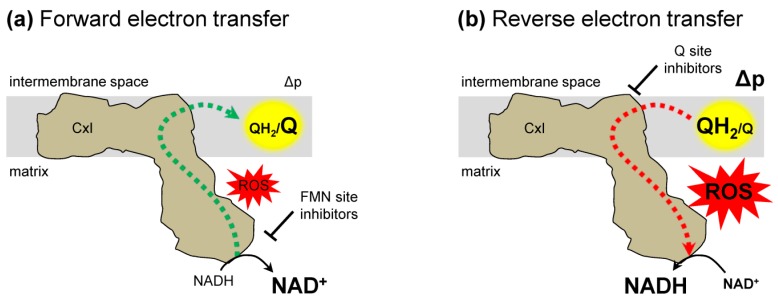
Mitochondrial reactive oxygen species (ROS) can be either detrimental or beneficial depending on the amount, duration, and location of their production. Mitochondrial complex I is a component of the electron transport chain and transfers electrons from NADH to ubiquinone. Complex I is also a source of ROS production. Under certain thermodynamic conditions, electron transfer can reverse direction and reduce oxygen at complex I to generate ROS. Conditions that favor this reverse electron transport (RET) include highly reduced ubiquinone pools, high mitochondrial membrane potential, and accumulated metabolic substrates. Historically, complex I RET was associated with pathological conditions, causing oxidative stress. However, recent evidence suggests that ROS generation by complex I RET contributes to signaling events in cells and organisms. Collectively, these studies demonstrate that the impact of complex I RET, either beneficial or detrimental, can be determined by the timing and quantity of ROS production. In this article we review the role of site-specific ROS production at complex I in the contexts of pathology and physiologic signaling.
线粒体活性氧(ROS)根据其产生的量、持续时间和位置,既可能有害也可能有益。线粒体复合物I是电子传递链的一个组成部分,可将电子从NADH转移至泛醌。复合物I也是ROS的一个产生源。在某些热力学条件下,电子传递可逆向进行,并在复合物I处将氧气还原以产生活性氧。有利于这种逆向电子传递(RET)的条件包括高度还原的泛醌池、高线粒体膜电位和积累的代谢底物。从历史上看,复合物I的RET与病理状况相关,会导致氧化应激。然而,最近的证据表明,复合物I的RET产生活性氧有助于细胞和生物体中的信号传导事件。总体而言,这些研究表明,复合物I的RET产生的有益或有害影响可由活性氧产生的时间和数量来决定。在本文中,我们综述了复合物I位点特异性产生活性氧在病理学和生理信号传导背景下的作用。