Arikawa Andrea Y, Kaufman Beth C, Raatz Susan K, Kurzer Mindy S
Department of Nutrition and Dietetics, University of North Florida, Jacksonville, FL - 1 UNF Drive, Jacksonville, FL 32224 USA.
Department of Food Science and Nutrition, University of Minnesota, St. Paul, MN - 1334 Eckles Ave, Saint Paul, MN 55108 USA.
Pilot Feasibility Stud. 2017 Jul 10;4:17. doi: 10.1186/s40814-017-0160-9. eCollection 2018.
Weight gain often occurs after breast cancer (BC) diagnosis and obesity along with sedentary behavior are associated with increased risk of BC recurrence and mortality. The primary objective of this study was to determine whether a significant weight loss, of approximately 10%, would lead to beneficial changes in biomarkers associated with cancer and/or cancer recurrence, and quality of life (QOL) in overweight and obese BC survivors.
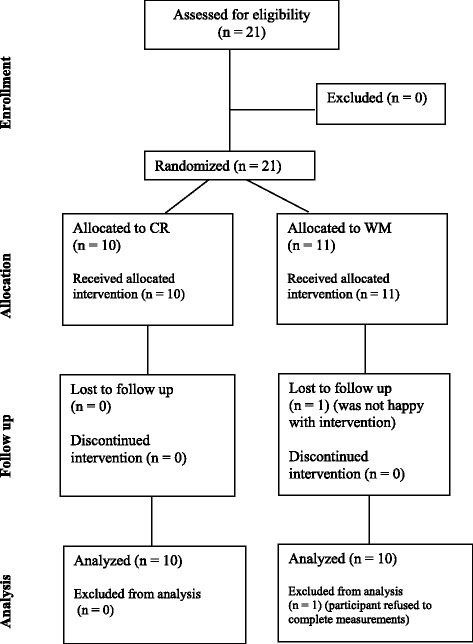
This parallel-arm study took place in Minneapolis, Minnesota, from January 2009 until March 2010. Participants were overweight and obese postmenopausal BC survivors who had completed treatment at least 3 months prior to enrollment and who did not smoke. Twenty-one BC survivors were randomized, via a random number generator computer software, to a 1000-calorie deficit feeding and exercise intervention (CR) or a weight management counseling intervention (WM) for 12 weeks followed by a 6-week follow-up. Body weight, biomarkers, and QOL were measured at baseline, weeks 6, 12, and 18. Body composition and fitness level were measured at only two time points.
Twenty-one women were enrolled into the study and 20 completed all time points. Weight loss occurred with both interventions. Body weight in CR changed from 85.5 (95% confidence interval (CI) 77, 94) kg to 76.7 (95% CI 68.1, 85.2) kg, whereas in WM it changed from 98.3 (95% CI 89.8, 106.8) kg to 93.2 (95% CI 84.6, 101.7) kg. Fitness in CR changed from 4.9 (95% CI 4, 5.8) to 6.3 (95% CI 5.4, 7.2). CR led to lower plasma levels of leptin, F2-isoprostanes, and CRP. Quality of life seemed to improve with both interventions, while sleep quality decreased only in CR.
Overweight and obese BC survivors were able to adhere to a strict diet and exercise program, which significantly decreased body weight, increased fitness level, and improved biomarkers and QOL. However, the strict dietary intervention in CR seemed to decrease participants' sleep quality and social relationships. Future larger randomized controlled trials should focus on behavioral modification and personalized nutrition counseling to help breast cancer survivors achieve a sustainable weight loss and fitness level.
ClinicalTrials.gov identifier: NCT02940470.
乳腺癌(BC)诊断后体重增加常见,肥胖以及久坐行为与BC复发和死亡风险增加相关。本研究的主要目的是确定约10%的显著体重减轻是否会使超重和肥胖的BC幸存者体内与癌症和/或癌症复发相关的生物标志物以及生活质量(QOL)发生有益变化。
这项平行组研究于2009年1月至2010年3月在明尼苏达州明尼阿波利斯进行。参与者为超重和肥胖的绝经后BC幸存者,她们在入组前至少3个月已完成治疗且不吸烟。通过随机数生成器计算机软件将21名BC幸存者随机分为1000卡路里热量亏空饮食和运动干预组(CR)或体重管理咨询干预组(WM),干预12周,随后进行6周随访。在基线、第6周、第12周和第18周测量体重、生物标志物和QOL。仅在两个时间点测量身体成分和体能水平。
21名女性纳入研究,20名完成了所有时间点的测量。两种干预均导致体重减轻。CR组体重从85.5(95%置信区间(CI)77,94)kg变为76.7(95%CI 68.1,85.2)kg,而WM组体重从98.3(95%CI 89.8,106.8)kg变为93.2(95%CI 84.6,101.7)kg。CR组的体能从4.9(95%CI 4,5.8)变为6.3(95%CI 5.4,7.2)。CR组导致血浆瘦素、F2 -异前列腺素和CRP水平降低。两种干预似乎都改善了生活质量,而仅CR组的睡眠质量下降。
超重和肥胖的BC幸存者能够坚持严格的饮食和运动计划,这显著降低了体重,提高了体能水平,并改善了生物标志物和生活质量。然而,CR组的严格饮食干预似乎降低了参与者的睡眠质量和社交关系。未来更大规模的随机对照试验应侧重于行为改变和个性化营养咨询,以帮助乳腺癌幸存者实现可持续的体重减轻和体能水平提升。
ClinicalTrials.gov标识符:NCT02940470。