Ai Junhong, Xie Zhengde, Liu Gang, Chen Zongbo, Yang Yong, Li Yuning, Chen Jing, Zheng Guo, Shen Kunling
Key Laboratory of Major Diseases in Children, Ministry of Education, Beijing Key Laboratory of Pediatric Respiratory Infection Diseases, Virology Laboratory, Beijing Pediatric Research Institute, Beijing Children's Hospital, Capital Medical University, National Center for Children's Health, Beijing, 100045, China.
The Affiliated Hospital of Qingdao University, Shandong province, Qingdao, China.
BMC Infect Dis. 2017 Jul 14;17(1):494. doi: 10.1186/s12879-017-2572-9.
In China, there were few studies about the pathogens of acute viral encephalitis and meningitis in children in recent years. The aims of this study were to characterize the etiology and prognosis of acute viral encephalitis and meningitis in Chinese children.
This was a multicentre prospective study. Two hundred and sixty one viral encephalitis patients and 285 viral meningitis patients were enrolled. The mean age of viral encephalitis and meningitis were 5.88 ± 3.60 years and 6.39 ± 3.57 years, respectively. Real-time reverse transcription PCR and multiplex PCR were used to detect human enteroviruses and herpes viruses in cerebrospinal fluid (CSF) of patients with encephalitis or meningitis. The enzyme-linked immune absorbent assay (ELISA) was used for detecting IgM antibody against Japanese encephalitis virus (JEV) in CSF and against mumps virus, tick-borne encephalitis virus (TBEV), dengue virus and rubella virus in acute serum. The clinical and outcome data were collected during patients' hospitalization.
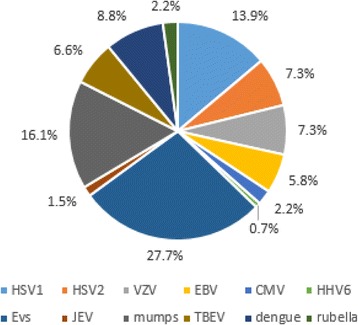
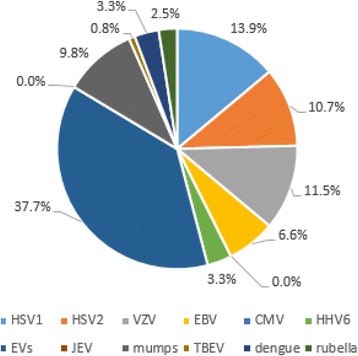
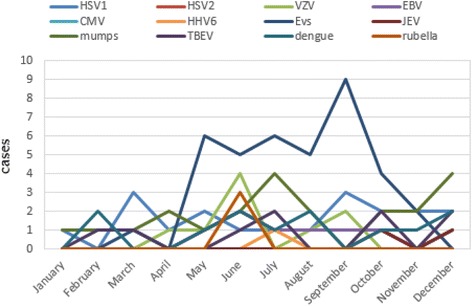
The etiology of viral encephalitis was confirmed in 52.5% patients. The primary pathogen was human enteroviruses (27.7%) in viral encephalitis. The incidence of sequelae and the fatality rate of viral encephalitis with confirmed etiology were 7.5% and 0.8%, respectively. The etiology of viral meningitis was identified in 42.8% cases. The leading pathogen was also human enteroviruses (37.7%) in viral meningitis. The prognosis of viral meningitis was favorable with only 0.7% patients had neurological sequelae.
Human enteroviruses were the leading cause both in acute viral encephalitis and viral meningitis in children. The incidence of sequelae and fatality rate of viral encephalitis with confirmed etiology were 7.5% and 0.8%, respectively. The prognosis of viral meningitis was favorable compared to viral encephalitis.
近年来,中国针对儿童急性病毒性脑炎和脑膜炎病原体的研究较少。本研究旨在明确中国儿童急性病毒性脑炎和脑膜炎的病因及预后情况。
这是一项多中心前瞻性研究。共纳入261例病毒性脑炎患者和285例病毒性脑膜炎患者。病毒性脑炎患者的平均年龄为5.88 ± 3.60岁,病毒性脑膜炎患者的平均年龄为6.39 ± 3.57岁。采用实时逆转录聚合酶链反应(RT-PCR)和多重聚合酶链反应检测脑炎或脑膜炎患者脑脊液中的人肠道病毒和疱疹病毒。采用酶联免疫吸附试验(ELISA)检测脑脊液中抗日本脑炎病毒(JEV)的IgM抗体以及急性血清中抗腮腺炎病毒、蜱传脑炎病毒(TBEV)、登革病毒和风疹病毒的IgM抗体。在患者住院期间收集临床和转归数据。
52.5%的病毒性脑炎患者病因得以明确。病毒性脑炎的主要病原体为人肠道病毒(27.7%)。病因明确的病毒性脑炎患者的后遗症发生率和病死率分别为7.5%和0.8%。42.8%的病毒性脑膜炎病例病因得以确定。病毒性脑膜炎的主要病原体同样为人肠道病毒(37.7%)。病毒性脑膜炎的预后良好,仅有0.7%的患者出现神经后遗症。
人肠道病毒是儿童急性病毒性脑炎和病毒性脑膜炎的主要病因。病因明确的病毒性脑炎患者的后遗症发生率和病死率分别为7.5%和0.8%。与病毒性脑炎相比,病毒性脑膜炎的预后较好。