Department of Radiology, the Netherlands Cancer Institute, Amsterdam, The Netherlands.
GROW School for Oncology and Developmental Biology, Maastricht University Medical Center, Maastricht, The Netherlands.
Sci Rep. 2017 Jul 13;7(1):5301. doi: 10.1038/s41598-017-05728-9.
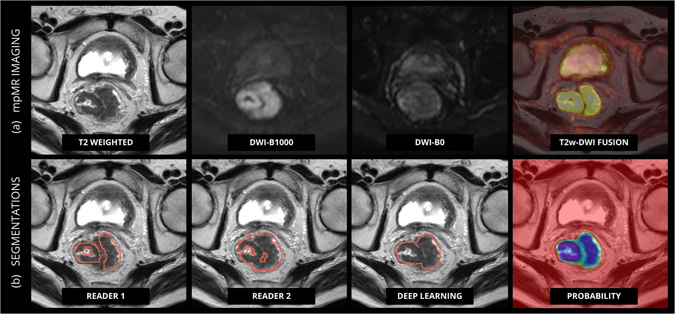
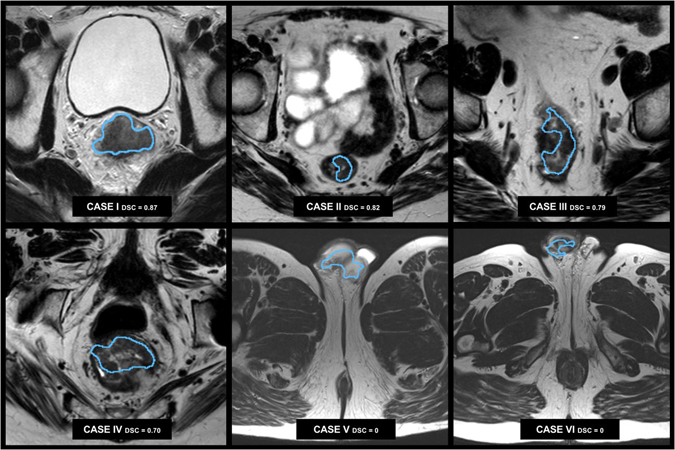
Multiparametric Magnetic Resonance Imaging (MRI) can provide detailed information of the physical characteristics of rectum tumours. Several investigations suggest that volumetric analyses on anatomical and functional MRI contain clinically valuable information. However, manual delineation of tumours is a time consuming procedure, as it requires a high level of expertise. Here, we evaluate deep learning methods for automatic localization and segmentation of rectal cancers on multiparametric MR imaging. MRI scans (1.5T, T2-weighted, and DWI) of 140 patients with locally advanced rectal cancer were included in our analysis, equally divided between discovery and validation datasets. Two expert radiologists segmented each tumor. A convolutional neural network (CNN) was trained on the multiparametric MRIs of the discovery set to classify each voxel into tumour or non-tumour. On the independent validation dataset, the CNN showed high segmentation accuracy for reader1 (Dice Similarity Coefficient (DSC = 0.68) and reader2 (DSC = 0.70). The area under the curve (AUC) of the resulting probability maps was very high for both readers, AUC = 0.99 (SD = 0.05). Our results demonstrate that deep learning can perform accurate localization and segmentation of rectal cancer in MR imaging in the majority of patients. Deep learning technologies have the potential to improve the speed and accuracy of MRI-based rectum segmentations.
多参数磁共振成像(MRI)可以提供直肠肿瘤物理特征的详细信息。多项研究表明,解剖和功能 MRI 的容积分析包含具有临床价值的信息。然而,肿瘤的手动勾画是一个耗时的过程,因为它需要高度的专业知识。在这里,我们评估了深度学习方法在多参数磁共振成像上自动定位和分割直肠肿瘤的性能。我们的分析纳入了 140 例局部晚期直肠癌患者的 MRI 扫描(1.5T、T2 加权和 DWI),在发现数据集和验证数据集中平均分配。两位专家放射科医生对每个肿瘤进行了分割。在发现集的多参数 MRI 上训练卷积神经网络(CNN),以将每个体素分类为肿瘤或非肿瘤。在独立的验证数据集上,CNN 对读者 1(Dice 相似系数(DSC=0.68)和读者 2(DSC=0.70)显示出很高的分割准确性。对于这两位读者,生成的概率图的曲线下面积(AUC)非常高,AUC=0.99(SD=0.05)。我们的结果表明,深度学习可以在大多数患者的 MRI 图像中准确地定位和分割直肠癌。深度学习技术有可能提高基于 MRI 的直肠分割的速度和准确性。