't Lam Gerard P, van der Kolk Jelmer A, Chordia Akshita, Vermuë Marian H, Olivieri Giuseppe, Eppink Michel H M, Wijffels René H
Bioprocess Engineering, AlgaePARC, Wageningen University, P.O. Box 16, 6700 AA Wageningen, The Netherlands.
Dipartimento di Ingeneria Chimica, dei Materiali e della Produzione Industriale, Università degli Studi di Napoli Federico II, Piazzale Vincenzo Tecchio, 80, 80125 Napoli, Italy.
ACS Sustain Chem Eng. 2017 Jul 3;5(7):6046-6053. doi: 10.1021/acssuschemeng.7b00892. Epub 2017 Jun 12.
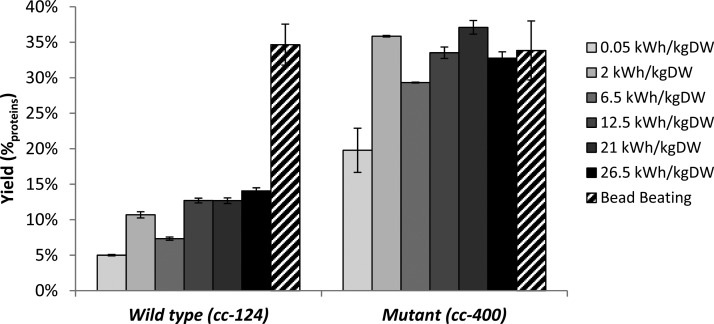
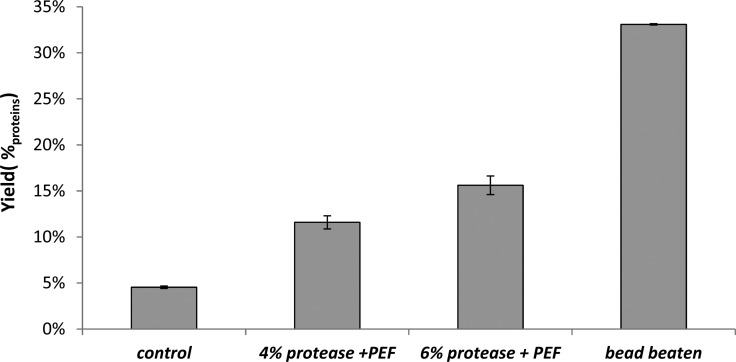
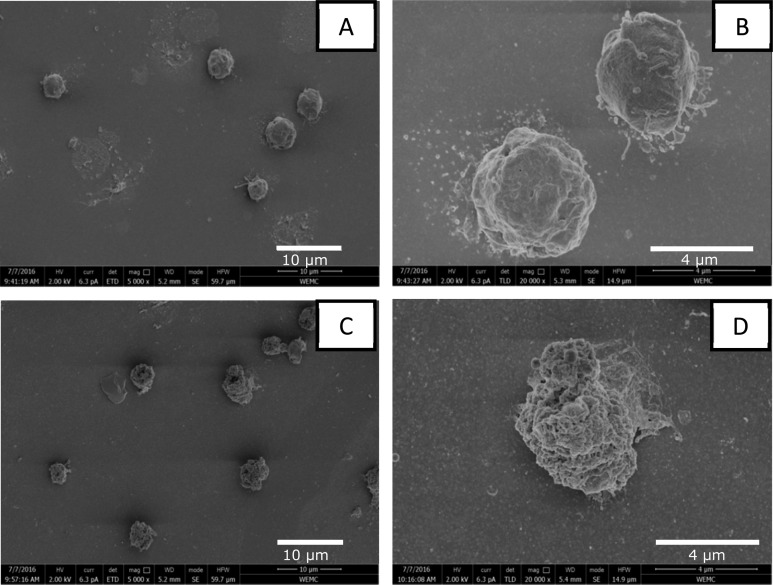
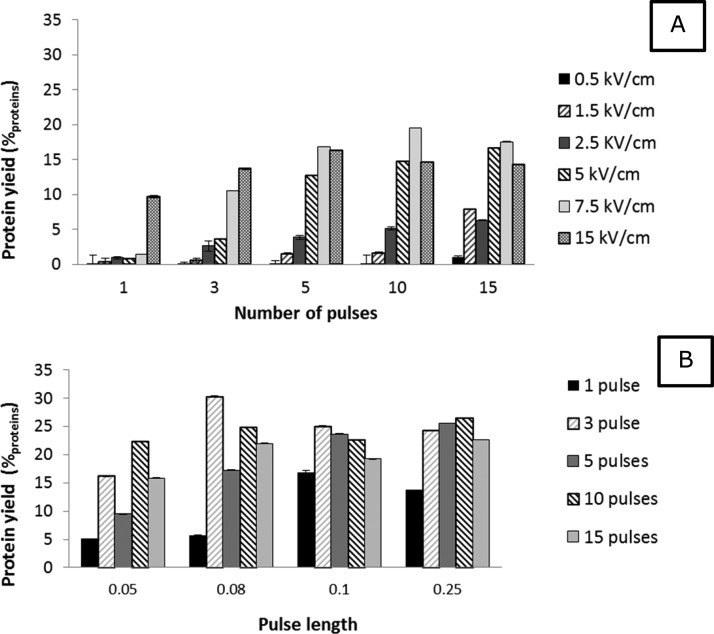
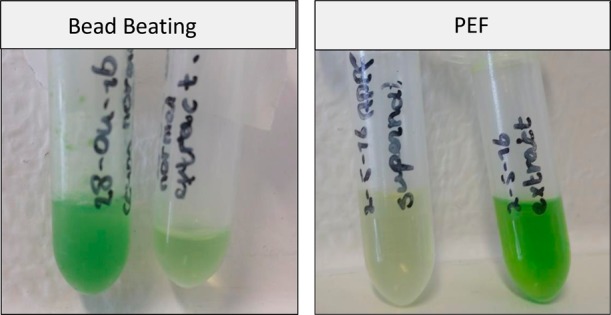
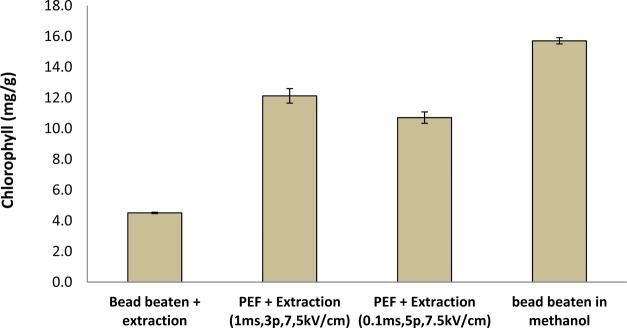
Pulsed electric field (PEF) is considered to be a very promising technology for mild cell disruption. The application of PEF for microalgae that have a rigid cell wall, however, is hampered by the presence of that rigid outer cell wall. A cell wall free mutant of was used to mimic pretreated microalgae with removed cell wall, to investigate the possibility of using PEF for protein release from microalgae. A complete release of hydrophilic proteins from the cell wall free mutants was observed whereas PEF treatment on the cell wall containing species resulted in substantially lower protein yields. Additional experiments showed that even at low energy input (0.05 kWh/kg), still about 70% of the proteins could be released with respect to bead beating as reference. These released proteins were water-soluble while the hydrophobic chlorophyll remained mainly entrapped in cell particles. SEM-analysis of these cell particles showed that PEF only opened the cells, instead of completely fragmenting them into smaller particles. These results indicate that PEF is an energy-efficient cell disruption method for selective release of water-soluble proteins, after the microalgal outer cell wall is removed. Enzymatic pretreatment to degrade the cell walls before PEF treatment was shown to be an efficient method to remove the cell wall.
脉冲电场(PEF)被认为是一种非常有前景的温和细胞破碎技术。然而,对于具有刚性细胞壁的微藻,PEF的应用受到该刚性外细胞壁的阻碍。使用一种无细胞壁突变体来模拟细胞壁已去除的预处理微藻,以研究使用PEF从微藻中释放蛋白质的可能性。观察到无细胞壁突变体中的亲水性蛋白质完全释放,而对含细胞壁的物种进行PEF处理导致蛋白质产量大幅降低。额外的实验表明,即使在低能量输入(0.05千瓦时/千克)下,相对于以珠磨法为参照,仍有约70%的蛋白质能够被释放。这些释放的蛋白质是水溶性的,而疏水性叶绿素主要仍包裹在细胞颗粒中。对这些细胞颗粒的扫描电子显微镜分析表明,PEF仅打开细胞,而不是将它们完全破碎成更小的颗粒。这些结果表明,在去除微藻外细胞壁后,PEF是一种用于选择性释放水溶性蛋白质的节能细胞破碎方法。在PEF处理之前进行酶预处理以降解细胞壁被证明是一种去除细胞壁的有效方法。