Levin Rachel A, Voolstra Christian R, Agrawal Shobhit, Steinberg Peter D, Suggett David J, van Oppen Madeleine J H
Centre for Marine Bio-Innovation, The University of New South Wales, SydneyNSW, Australia.
School of Biological, Earth and Environmental Sciences, The University of New South Wales, SydneyNSW, Australia.
Front Microbiol. 2017 Jun 30;8:1220. doi: 10.3389/fmicb.2017.01220. eCollection 2017.
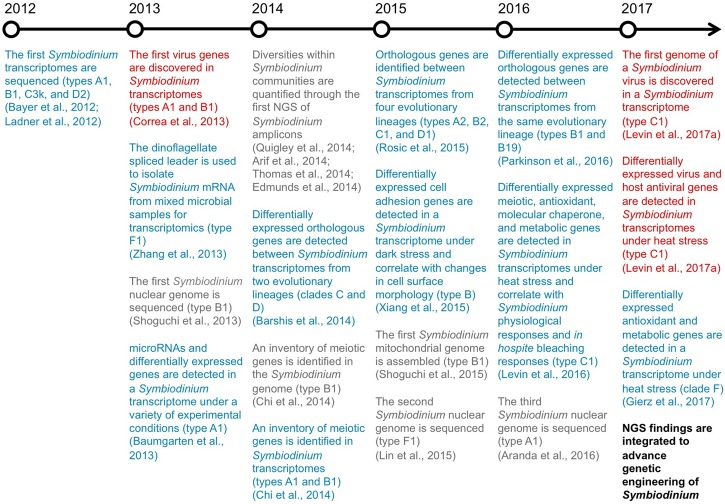
Elevated sea surface temperatures from a severe and prolonged El Niño event (2014-2016) fueled by climate change have resulted in mass coral bleaching (loss of dinoflagellate photosymbionts, spp., from coral tissues) and subsequent coral mortality, devastating reefs worldwide. Genetic variation within and between species strongly influences the bleaching tolerance of corals, thus recent papers have called for genetic engineering of to elucidate the genetic basis of bleaching-relevant traits. However, while has been intensively studied for over 50 years, genetic transformation of has seen little success likely due to the large evolutionary divergence between and other model eukaryotes rendering standard transformation systems incompatible. Here, we integrate the growing wealth of next-generation sequencing data to design tailored genetic engineering strategies. Specifically, we develop a testable expression construct model that incorporates endogenous promoters, terminators, and genes of interest, as well as an internal ribosomal entry site from a virus. Furthermore, we assess the potential for CRISPR/Cas9 genome editing through new analyses of the three currently available genomes. Finally, we discuss how genetic engineering could be applied to enhance the stress tolerance of , and in turn, coral reefs.
由气候变化引发的严重且持久的厄尔尼诺事件(2014 - 2016年)导致海面温度升高,进而引发了大规模珊瑚白化现象(珊瑚组织中虫黄藻光合共生体的丧失)以及随后的珊瑚死亡,对全球珊瑚礁造成了毁灭性打击。物种内部和物种之间的遗传变异强烈影响珊瑚的白化耐受性,因此近期的论文呼吁对珊瑚进行基因工程研究,以阐明与白化相关性状的遗传基础。然而,尽管珊瑚已经被深入研究了50多年,但由于珊瑚与其他模式真核生物之间存在巨大的进化差异,使得标准转化系统不兼容,珊瑚的遗传转化几乎没有取得成功。在此,我们整合了越来越多的下一代测序数据,以设计量身定制的基因工程策略。具体而言,我们开发了一种可测试的表达构建体模型,该模型包含内源性珊瑚启动子、终止子和感兴趣的基因,以及来自一种病毒的内部核糖体进入位点。此外,我们通过对目前可用的三种珊瑚基因组的新分析,评估了CRISPR/Cas9基因组编辑的潜力。最后,我们讨论了基因工程如何能够应用于增强珊瑚的胁迫耐受性,进而保护珊瑚礁。