Watad Abdulla, Bragazzi Nicola Luigi, Brigo Francesco, Sharif Kassem, Amital Howard, McGonagle Dennis, Shoenfeld Yehuda, Adawi Mohammad
Department of Medicine B, Sheba Medical Centre, Tel Aviv, Israel.
Sackler Faculty of Medicine, Tel Aviv University, Tel Aviv, Israel.
J Med Internet Res. 2017 Jul 18;19(7):e260. doi: 10.2196/jmir.8225.
In the era of new information and communication technologies, the Internet is being increasingly accessed for health-related information. Indeed, recently published patient surveys of people with autoimmune disorders confirmed that the Internet was reported as one of the most important health information sources. Wikipedia, a free online encyclopedia launched in 2001, is generally one of the most visited websites worldwide and is often consulted for health-related information.
The main objective of this investigation was to quantitatively assess whether the Wikipedia pages related to autoimmune disorders can be easily accessed by patients and their families, in terms of readability.
We obtained and downloaded a list of autoimmune disorders from the American Autoimmune Related Diseases Association (AARDA) website. We analyzed Wikipedia articles for their overall level of readability with 6 different quantitative readability scales: (1) the Flesch Reading Ease, (2) the Gunning Fog Index, (3) the Coleman-Liau Index, (4) the Flesch-Kincaid Grade Level, (5) the Automated Readability Index (ARI), and (6) the Simple Measure of Gobbledygook (SMOG). Further, we investigated the correlation between readability and clinical, pathological, and epidemiological parameters. Moreover, each Wikipedia analysis was assessed according to its content, breaking down the readability indices by main topic of each part (namely, pathogenesis, treatment, diagnosis, and prognosis plus a section containing paragraphs not falling into any of the previous categories).
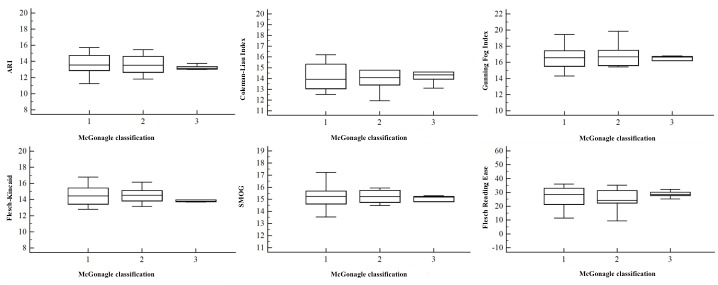
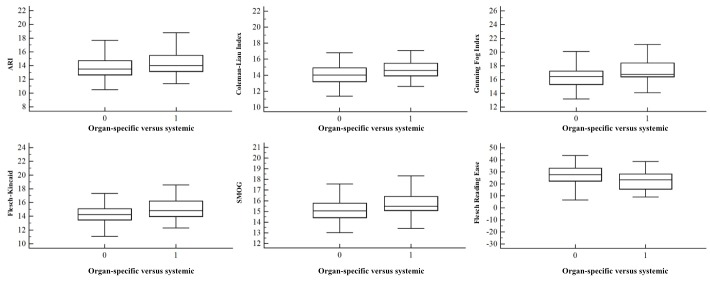
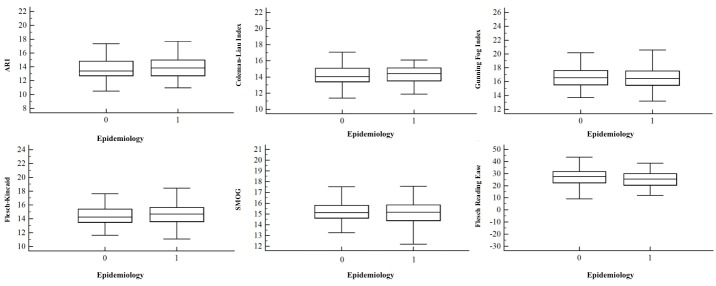
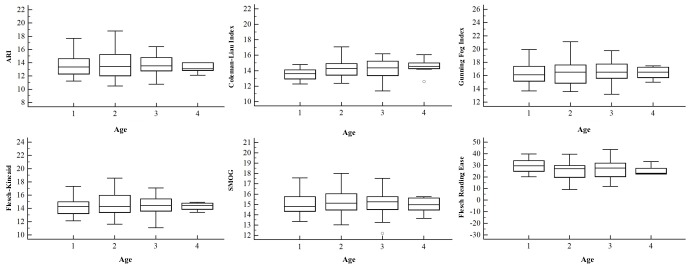
We retrieved 134 diseases from the AARDA website. The Flesch Reading Ease yielded a mean score of 24.34 (SD 10.73), indicating that the sites were very difficult to read and best understood by university graduates, while mean Gunning Fog Index and ARI scores were 16.87 (SD 2.03) and 14.06 (SD 2.12), respectively. The Coleman-Liau Index and the Flesch-Kincaid Grade Level yielded mean scores of 14.48 (SD 1.57) and 14.86 (1.95), respectively, while the mean SMOG score was 15.38 (SD 1.37). All the readability indices confirmed that the sites were suitable for a university graduate reading level. We found no correlation between readability and clinical, pathological, and epidemiological parameters. Differences among the different sections of the Wikipedia pages were statistically significant.
Wikipedia pages related to autoimmune disorders are characterized by a low level of readability. The onus is, therefore, on physicians and health authorities to improve the health literacy skills of patients and their families and to create, together with patients themselves, disease-specific readable sites, disseminating highly accessible health-related online information, in terms of both clarity and conciseness.
在新信息与通信技术时代,人们越来越多地通过互联网获取健康相关信息。事实上,最近发表的针对自身免疫性疾病患者的调查证实,互联网被报告为最重要的健康信息来源之一。维基百科是2001年推出的免费在线百科全书,通常是全球访问量最大的网站之一,人们常从中查阅健康相关信息。
本调查的主要目的是从可读性方面定量评估与自身免疫性疾病相关的维基百科页面是否能被患者及其家属轻松访问。
我们从美国自身免疫性相关疾病协会(AARDA)网站获取并下载了自身免疫性疾病列表。我们使用6种不同的定量可读性量表分析维基百科文章的整体可读性水平:(1)弗莱什易读性指数,(2)冈宁雾度指数,(3)科尔曼-廖指数,(4)弗莱什-金凯德年级水平指数,(5)自动可读性指数(ARI),以及(6)难词简易衡量法(SMOG)。此外,我们研究了可读性与临床、病理和流行病学参数之间的相关性。此外,根据内容对每个维基百科分析进行评估,按各部分的主要主题(即发病机制、治疗、诊断和预后,外加一个包含不属于上述任何类别的段落的部分)分解可读性指数。
我们从AARDA网站检索到134种疾病。弗莱什易读性指数的平均得分为24.34(标准差10.73),表明这些页面阅读难度很大,大学毕业生才能最好地理解,而冈宁雾度指数和ARI的平均得分分别为16.87(标准差2.03)和14.06(标准差2.12)。科尔曼-廖指数和弗莱什-金凯德年级水平指数的平均得分分别为14.48(标准差1.57)和14.86(1.95),而SMOG的平均得分为15.38(标准差1.37)。所有可读性指数均证实这些页面适合大学毕业生的阅读水平。我们发现可读性与临床、病理和流行病学参数之间无相关性。维基百科页面不同部分之间的差异具有统计学意义。
与自身免疫性疾病相关的维基百科页面可读性较低。因此,医生和卫生当局有责任提高患者及其家属的健康素养技能,并与患者自身共同创建特定疾病的可读网站,以清晰简洁的方式传播高度易获取的健康相关在线信息。