Camenen Etienne, Porté Annabel J, Benito Garzón Marta
BiogecoI NRA Université de Bordeaux 33615 Pessac France.
Ecol Evol. 2016 Sep 22;6(20):7263-7275. doi: 10.1002/ece3.2376. eCollection 2016 Oct.
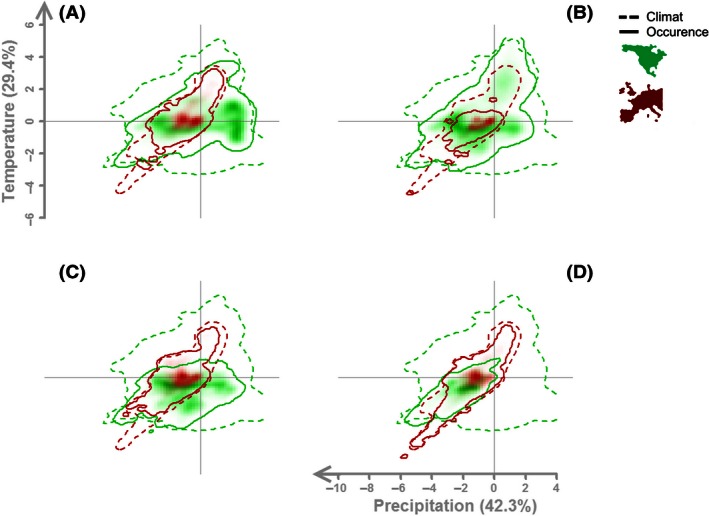
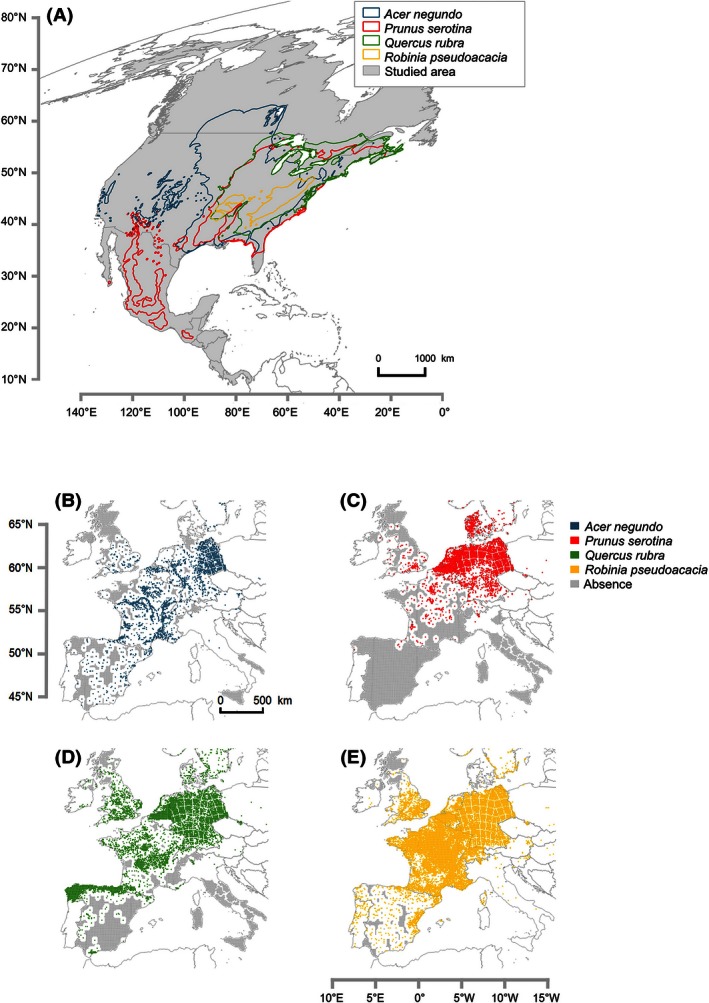
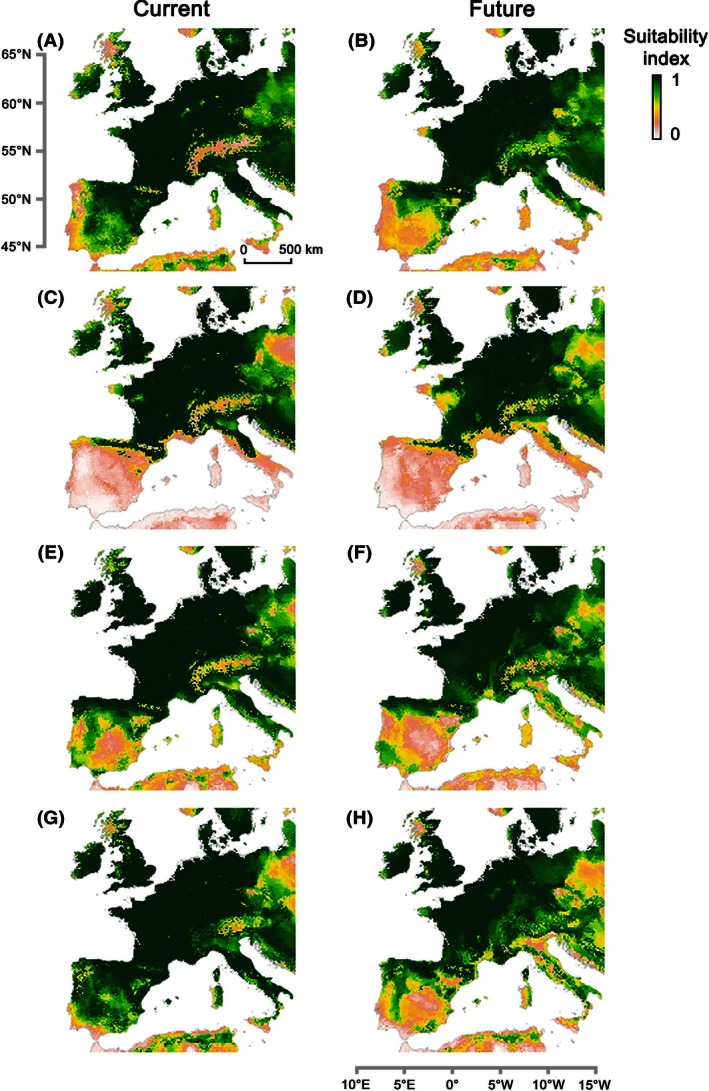
Four North American trees are becoming invasive species in Western Europe: , , , and . However, their present and future potential risks of invasion have not been yet evaluated. Here, we assess niche shifts between the native and invasive ranges and the potential invasion risk of these four trees in Western Europe. We estimated niche conservatism in a multidimensional climate space using niche overlap Schoener's , niche equivalence, and niche similarity tests. Niche unfilling and expansion were also estimated in analogous and nonanalogous climates. The capacity for predicting the opposite range between the native and invasive areas (transferability) was estimated by calibrating species distribution models (SDMs) on each range separately. Invasion risk was estimated using SDMs calibrated on both ranges and projected for 2050 climatic conditions. Our results showed that native and invasive niches were not equivalent with low niche overlap for all species. However, significant similarity was found between the invasive and native ranges of and . Niche expansion was lower than 15% for all species, whereas unfilling ranged from 7 to 56% when it was measured using the entire climatic space and between 5 and 38% when it was measured using analogous climate only. Transferability was low for all species. SDMs calibrated over both ranges projected high habitat suitability in Western Europe under current and future climates. Thus, the North American and Western European ranges are not interchangeable irrespective of the studied species, suggesting that other environmental and/or biological characteristics are shaping their invasive niches. The current climatic risk of invasion is especially high for and . In the future, the highest risks of invasion for all species are located in Central and Northern Europe, whereas the risk is likely to decrease in the Mediterranean basin.
、 、 和 。然而,它们目前和未来潜在的入侵风险尚未得到评估。在此,我们评估了这四种树木在原生范围和入侵范围之间的生态位转移以及在西欧的潜在入侵风险。我们在多维气候空间中使用生态位重叠(Schoener's )、生态位等效性和生态位相似性测试来估计生态位保守性。还在类似和非类似气候中估计了生态位未填充和扩张情况。通过分别在每个范围上校准物种分布模型(SDMs)来估计预测原生和入侵区域之间相反范围的能力(可转移性)。使用在两个范围上校准并针对2050年气候条件进行预测的SDMs来估计入侵风险。我们的结果表明,所有物种的原生和入侵生态位并不等效,生态位重叠较低。然而,在 和 的入侵范围与原生范围之间发现了显著的相似性。所有物种的生态位扩张均低于15%,而当使用整个气候空间进行测量时,未填充范围为7%至56%,仅使用类似气候进行测量时,未填充范围为5%至38%。所有物种的可转移性都很低。在两个范围上校准的SDMs预测在当前和未来气候条件下西欧具有较高的栖息地适宜性。因此,无论所研究的物种如何,北美和西欧的范围都不可互换,这表明其他环境和/或生物特征正在塑造它们的入侵生态位。对于 和 来说,当前的气候入侵风险尤其高。未来,所有物种最高的入侵风险位于中欧和北欧,而在地中海盆地风险可能会降低。