Teitsma Xavier M, Jacobs Johannes W G, Mokry Michal, Borm Michelle E A, Pethö-Schramm Attila, van Laar Jacob M, Bijlsma Johannes W J, Lafeber Floris P J
Department of Rheumatology & Clinical Immunology, University Medical Center Utrecht, Heidelberglaan 100, 3584, CX, Utrecht, Netherlands.
Epigenomics Facility, University Medical Center Utrecht, Heidelberglaan 100, 3584, CX, Utrecht, Netherlands.
Arthritis Res Ther. 2017 Jul 20;19(1):170. doi: 10.1186/s13075-017-1378-x.
Methotrexate is endorsed to be used as first-line treatment in rheumatoid arthritis (RA). However, a large proportion of patients need additional treatment with a biological disease-modifying anti-rheumatic drug (DMARD) to adequately suppress their disease activity. A better understanding of genotypes could help to distinguish between patients with different pathogenic mechanisms. The aim of this study was therefore to identify networks of genes within DMARD-naive early RA patients associated with achieving sustained drug-free remission (sDFR) after initiating tocilizumab plus methotrexate, tocilizumab, or methotrexate therapy.
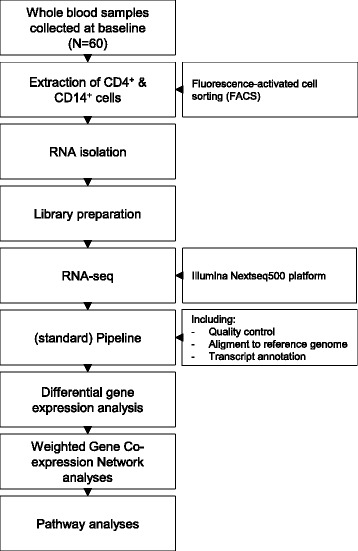
Samples were used from 60 patients from the U-Act-Early study who received tocilizumab plus methotrexate, tocilizumab, or methotrexate therapy, and who achieved sDFR (≥3 months in drug-free remission until the end of the study, n = 37) after therapy was tapered and subsequently stopped, or who were not able to discontinue the therapy as controls (n = 23). Whole blood samples were collected and ribonucleic acid (RNA) was isolated from positive cluster of differentiation 4 (CD4) and CD14 cells and analysed using high-throughput sequencing. Weighted gene co-expression network analyses were performed to identify clusters (i.e. modules) of differently expressed genes associated with achieving sDFR and which were subsequently used for pathway analyses.
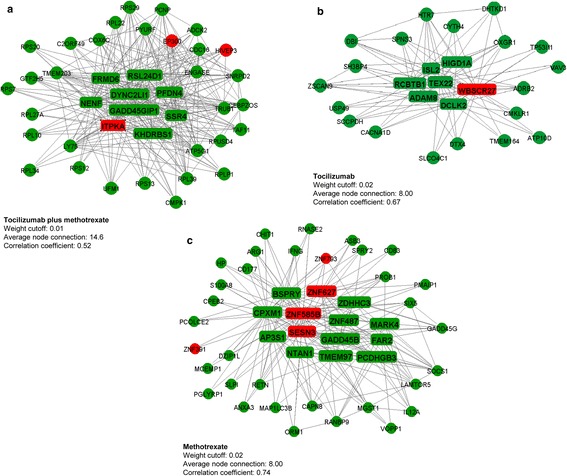
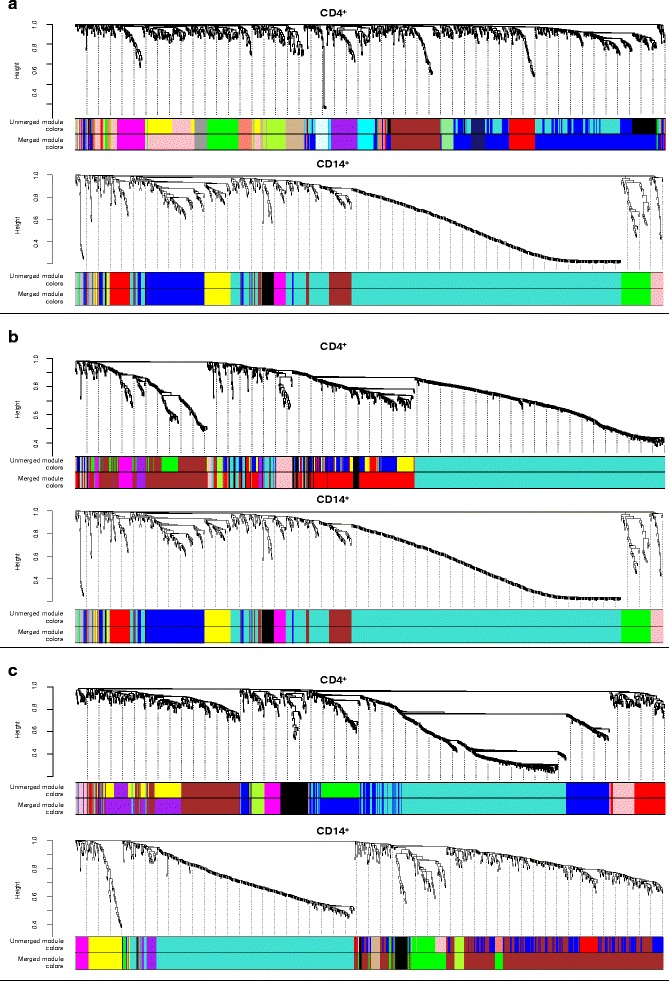
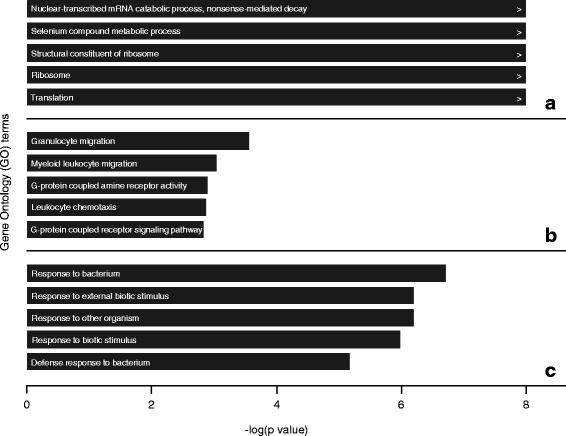
Network analyses within CD4 cells identified two significant modules in the tocilizumab plus methotrexate arm and four modules in the tocilizumab and methotrexate arms, respectively (p ≤ 0.039). Important pathways in the module best correlating with achieving sDFR were in the tocilizumab plus methotrexate arm related to processes involved with transcription and translation; in the tocilizumab arm, pathways were related to migration of white blood cells and G-protein coupled receptors, and in the methotrexate arm pathways were involved with the response to a bacterial or biotic (i.e. biological material)-related stimulus. No relevant networks could be identified in the sequenced CD14 cells.
Within networks of co-expressed genes, several pathways were found related to achieving sDFR after initiating therapy with tocilizumab, methotrexate, or the combination. Between the three strategy arms, we identified different networks of predisposing genes which indicates that specific gene expression profiles, depending on the treatment strategy chosen, are associated with a higher chance of achieving sDFR.
Clinicaltrials.gov, NCT01034137 . Registered on 16 December 2009.
甲氨蝶呤被认可用作类风湿关节炎(RA)的一线治疗药物。然而,很大一部分患者需要额外使用生物性改善病情抗风湿药(DMARD)进行治疗,以充分抑制疾病活动。更好地了解基因类型有助于区分具有不同致病机制的患者。因此,本研究的目的是在初治的早期类风湿关节炎患者中,识别与在开始使用托珠单抗加甲氨蝶呤、托珠单抗或甲氨蝶呤治疗后实现持续药物缓解(sDFR)相关的基因网络。
使用来自U-Act-Early研究的60例患者的样本,这些患者接受了托珠单抗加甲氨蝶呤、托珠单抗或甲氨蝶呤治疗,并且在治疗逐渐减量并随后停止后实现了sDFR(在无药物缓解状态下持续≥3个月直至研究结束,n = 37),或者作为对照未能停用治疗(n = 23)。采集全血样本,从分化簇4(CD4)阳性细胞和CD14细胞中分离核糖核酸(RNA),并使用高通量测序进行分析。进行加权基因共表达网络分析,以识别与实现sDFR相关的差异表达基因簇(即模块),随后用于通路分析。
CD4细胞内的网络分析在托珠单抗加甲氨蝶呤组中鉴定出两个显著模块,在托珠单抗组和甲氨蝶呤组中分别鉴定出四个模块(p≤0.039)。与实现sDFR相关性最佳的模块中的重要通路,在托珠单抗加甲氨蝶呤组中与转录和翻译相关过程有关;在托珠单抗组中,通路与白细胞迁移和G蛋白偶联受体有关,在甲氨蝶呤组中,通路与对细菌或生物(即生物材料)相关刺激的反应有关。在测序的CD14细胞中未鉴定出相关网络。
在共表达基因网络中,发现了几条与开始使用托珠单抗、甲氨蝶呤或联合治疗后实现sDFR相关的通路。在三个治疗策略组之间,我们识别出不同的易感基因网络,这表明根据所选治疗策略,特定的基因表达谱与实现sDFR的更高机会相关。
Clinicaltrials.gov,NCT01034137。于2009年12月16日注册。