Ceci Matteo, Viola Matteo, Rattalino Davide, Beltrami Riccardo, Colombo Marco, Poggio Claudio
Department of Clinical-Surgical, Diagnostic and Pediatric Sciences -Â Section of Dentistry, University of Pavia, Pavia, Italy.
Eur J Dent. 2017 Apr-Jun;11(2):149-156. doi: 10.4103/ejd.ejd_313_16.
A crucial property of esthetic restorative materials is their long-term color stability. The aim of this study was to evaluate the color stability of esthetic restorative materials (one microfilled flowable composite, one nanofilled composite, one nanoybrid composite, one microfilled composite, and one nanoybrid ormocer-based composite) after surface roughening with cola and exposure to different staining solutions (coffee and red wine).
All materials were polymerized into silicone rubber rings (2 mm × 6 mm × 8 mm) to obtain 150 specimens identical in size. Seventy-five specimens of Group A were first exposed to cola for 24 h, and then samples were immersed in coffee or red wine over a 28-day test period. A colorimetric evaluation, according to the CIE Lab* system, was performed at 7, 14, 21, 28 days. Shapiro-Wilk test and Kruskal-Wallis analysis of variance were applied to assess significant differences among restorative materials. Means were compared with Scheffe's multiple comparison test at the 0.05 level of significance.
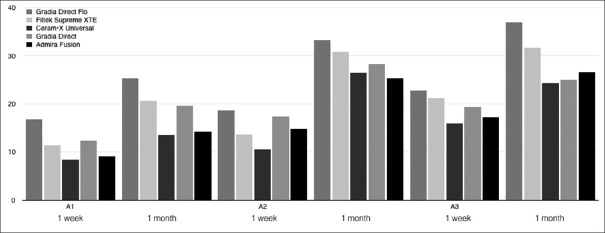
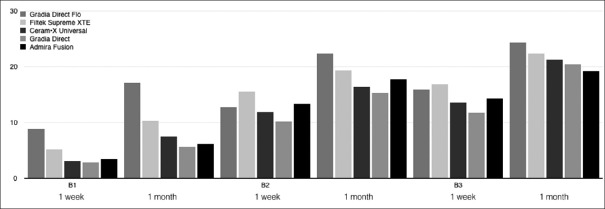
Specimens of Group A showed higher variations when compared with Group B's specimens ( < 0.05). After 28 days, the immersion protocols caused a clinically perceivable color change for all materials tested ( < 0.05). CeramX Universal and Admira Fusion showed the lowest ΔE variations ( < 0.05).
Staining beverages caused significant discolorations for all the materials tested. The first exposure to cola enhanced the subsequent staining with coffee or red wine. Nanohybrid composites reported the lowest color variations.
美学修复材料的一个关键特性是其长期颜色稳定性。本研究的目的是评估美学修复材料(一种微填料可流动复合树脂、一种纳米填料复合树脂、一种纳米混合复合树脂、一种微填料复合树脂和一种基于纳米混合有机陶瓷的复合树脂)在经可乐表面粗糙化处理并暴露于不同染色溶液(咖啡和红酒)后的颜色稳定性。
将所有材料聚合到硅橡胶环(2毫米×6毫米×8毫米)中,以获得150个尺寸相同的试样。A组的75个试样首先暴露于可乐中24小时,然后在28天的测试期内将样品浸入咖啡或红酒中。根据CIE Lab*系统进行比色评估,在第7、14、21、28天进行。应用Shapiro-Wilk检验和Kruskal-Wallis方差分析来评估修复材料之间的显著差异。在0.05的显著性水平下,采用Scheffe多重比较检验比较均值。
与B组试样相比,A组试样显示出更高的变化(<0.05)。28天后,所有测试材料的浸泡方案均导致临床上可察觉的颜色变化(<0.05)。CeramX Universal和Admira Fusion显示出最低的ΔE变化(<0.05)。
染色饮料导致所有测试材料出现显著变色。首次暴露于可乐会增强随后咖啡或红酒的染色效果。纳米混合复合树脂的颜色变化最小。