Kanai Mizue, Kamiya Hajime, Smith-Palmer Alison, Takahashi Hideyuki, Hachisu Yushi, Fukusumi Munehisa, Saitoh Takehito, Ohnishi Makoto, Sunagawa Tomimasa, Matsui Tamano, Oishi Kazunori
Field Epidemiology Training Program, National Institute of Infectious Diseases, Tokyo, Japan.
Division of Global infectious diseases, Department of Infection and Epidemiology, Graduate School of Medicine, Tohoku University, Miyagi, Japan.
Western Pac Surveill Response J. 2017 May 8;8(2):25-30. doi: 10.5365/WPSAR.2016.7.3.007. eCollection 2017 Apr-Jun.
Six invasive meningococcal disease cases occurred among Scottish and Swedish nationals associated with the World Scout Jamboree (WSJ), an international mass gathering, held in Japan. The index case developed symptoms while returning home. The strains from all six cases were identical and seldom seen in Japan.
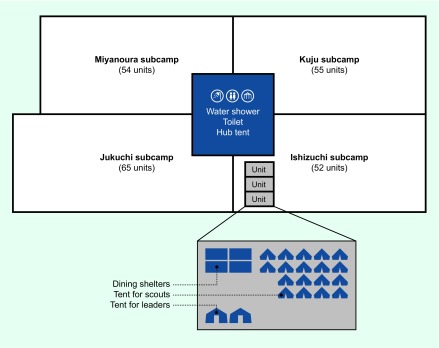
Over 33 000 participants from 155 countries attended WSJ. At the Jamboree site, participants of the North of Scotland's and Sweden's units camped within the same subcamp and kept the same schedule of events. No information was available about the Swedish and Scottish cases' close personal contact history.
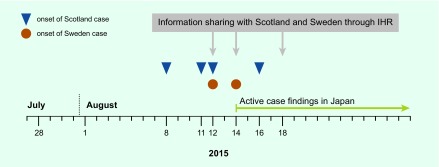
Health Protection Scotland investigated Scottish cases, conducted active case finding, provided chemoprophylaxis, vaccinated close contacts and advised Scottish WSJ participants and contacts to seek medical care if they developed symptoms. The Public Health Agency of Sweden recommended chemoprophylaxis to all participants in Sweden. In Japan, the Ministry of Health, Labour and Welfare (MHLW) requested the Scout Association of Japan advise all participants to seek medical attention if they developed symptoms. MHLW shared information about the event with local authorities, medical associations, and the Ministry of Education, Culture, Sports, Science and Technology.
No additional case related to WSJ has been reported. This outbreak highlighted the risk for international spread of invasive meningococcal disease at international mass gatherings.
Assessing risk, educating participants, enhancing surveillance and sharing timely information among related countries are significant for prevention and response against invasive meningococcal disease outbreaks at mass gatherings.
在日本举行的国际大型集会——世界童子军大会(WSJ)上,苏格兰和瑞典籍人员中出现了6例侵袭性脑膜炎球菌病病例。首例病例在回国途中出现症状。所有6例病例的菌株相同,在日本很少见。
来自155个国家的3.3万多名参与者参加了世界童子军大会。在童子军营地,苏格兰北部和瑞典分队的参与者在同一个分营地露营,活动日程相同。关于瑞典和苏格兰病例的密切个人接触史没有相关信息。
苏格兰卫生防护局对苏格兰病例展开调查,进行主动病例搜索,提供化学预防,为密切接触者接种疫苗,并建议参加世界童子军大会的苏格兰人员及其接触者如出现症状应寻求医疗救治。瑞典公共卫生机构向瑞典所有参与者推荐了化学预防措施。在日本,厚生劳动省要求日本童子军协会建议所有参与者如出现症状应寻求医疗关注。厚生劳动省与地方当局、医学协会以及文部科学省分享了有关该活动的信息。
未报告与世界童子军大会相关的其他病例。此次疫情凸显了侵袭性脑膜炎球菌病在国际大型集会中发生国际传播的风险。
评估风险、对参与者进行教育、加强监测以及在相关国家之间及时共享信息,对于预防和应对大型集会中侵袭性脑膜炎球菌病疫情至关重要。