Department of Infectious Diseases, Huashan Hospital, Fudan University, Shanghai 200040, P.R. China.
Mol Med Rep. 2017 Oct;16(4):3713-3719. doi: 10.3892/mmr.2017.7044. Epub 2017 Jul 21.
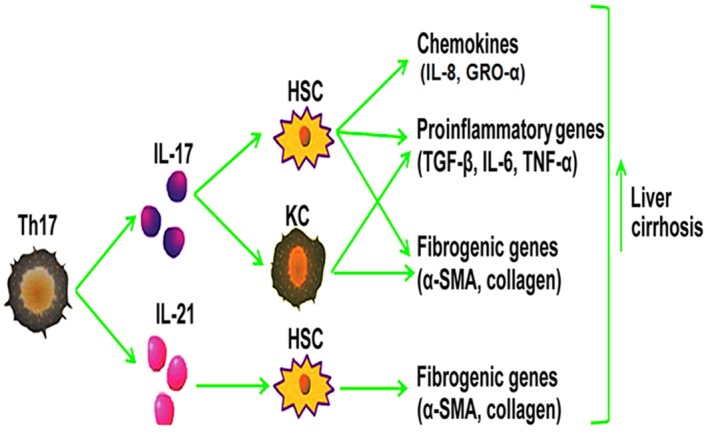
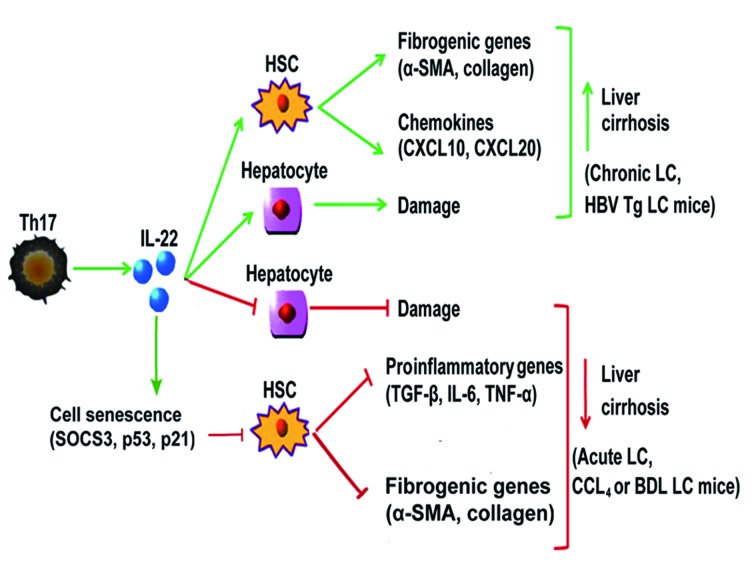
In chronic hepatitis B virus (HBV)-infected patients, T helper 17 (Th17) cells are significantly elevated. Th17 cells initiate immune‑mediated pathogenesis and have a critical role in the process of HBV‑related liver cirrhosis (HBV‑LC). The mechanisms underlying this process are attributed to Th17‑secreted cytokines, which include interleukin (IL)‑17, IL‑21 and IL‑22; however, a systemic analysis regarding these mechanisms has yet to be conducted. Therefore, the present study aimed to investigate the role of Th17 cells in the pathogenesis of HBV‑LC. All randomized clinical trials, case series, case reports and meta‑analyses that contained the aforementioned keywords were included in the review process. In addition, unpublished information from the Food and Drug Administration was included. The findings indicated that Th17‑secreted cytokines, including IL‑17, IL‑21 and IL‑22, function by activating or silencing hepatic stellate cells, modulating proinflammatory and pro‑ or antifibrogenic effectors, regulating extracellular matrix formation, upregulating chemokine expression, and inducing hepatocellular damage or hepatoprotection during the HBV‑LC process. In addition, Th17 cells and Th17‑secreted cytokines may be considered a potential tool in the diagnosis or treatment of HBV‑LC. The present review summarized the role of Th17 cells in the pathogenesis of HBV‑LC in order to deepen the clinical understanding of the role of Th17 cells and also to support the development of effective therapies for patients with HBV‑LC.
在慢性乙型肝炎病毒(HBV)感染患者中,辅助性 T 细胞 17(Th17)细胞显著升高。Th17 细胞启动免疫介导的发病机制,并在 HBV 相关肝硬化(HBV-LC)的发生过程中起关键作用。该过程的机制归因于 Th17 细胞分泌的细胞因子,包括白细胞介素(IL)-17、IL-21 和 IL-22;然而,尚未对这些机制进行系统分析。因此,本研究旨在探讨 Th17 细胞在 HBV-LC 发病机制中的作用。所有包含上述关键词的随机临床试验、病例系列、病例报告和荟萃分析均包含在综述过程中。此外,还包括食品和药物管理局未公布的信息。研究结果表明,Th17 细胞分泌的细胞因子,包括 IL-17、IL-21 和 IL-22,通过激活或沉默肝星状细胞、调节促炎和促纤维化或抗纤维化效应物、调节细胞外基质形成、上调趋化因子表达以及在 HBV-LC 过程中诱导肝细胞损伤或肝保护作用来发挥功能。此外,Th17 细胞和 Th17 细胞分泌的细胞因子可被视为诊断或治疗 HBV-LC 的潜在工具。本综述总结了 Th17 细胞在 HBV-LC 发病机制中的作用,以加深对 Th17 细胞作用的临床认识,并为 HBV-LC 患者的有效治疗提供支持。