Yang Bin, Wang Yuan, Shan Lanlan, Zou Jingtao, Wu Yuanyuan, Yang Feifan, Zhang Yani, Li Yubo, Zhang Yanjun
College of Traditional Chinese Materia Medica, Tianjin University of Traditional Chinese Medicine, 312 Anshan West Road, Tianjin 300193, China.
Tonghua Huaxia Pharmaceutical Co., Ltd., 3333 Tuanjie Road, Tonghua 134100, China.
Molecules. 2017 Jul 23;22(7):1237. doi: 10.3390/molecules22071237.
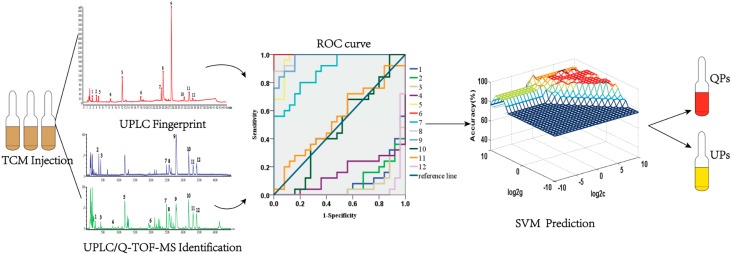
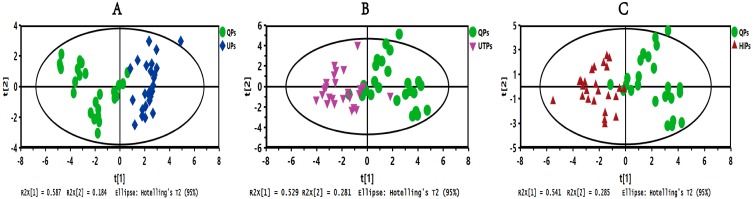
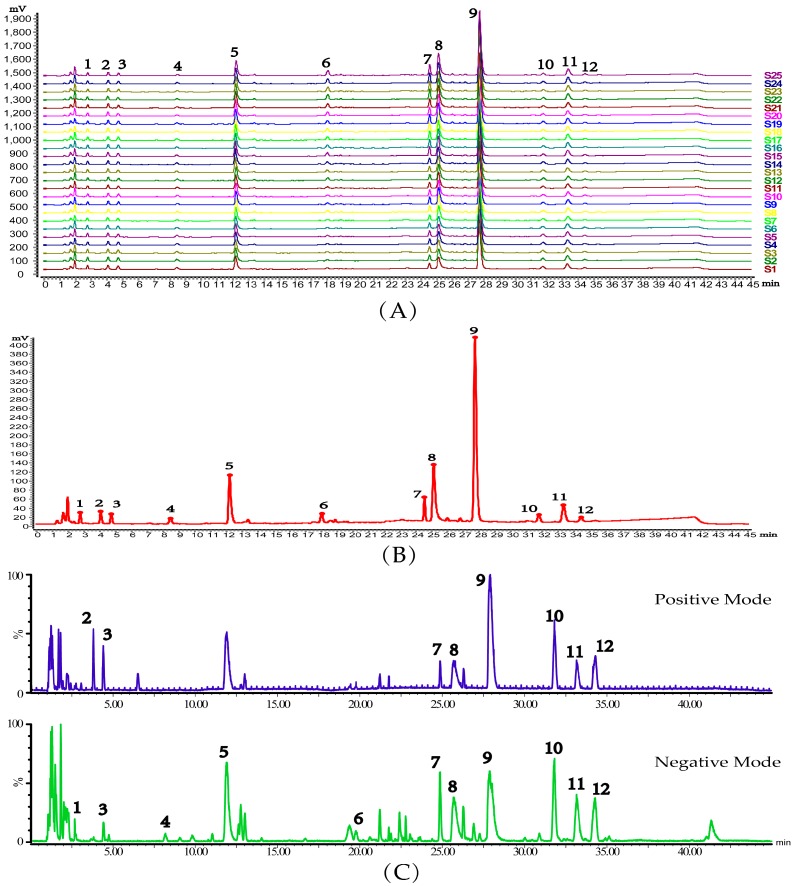
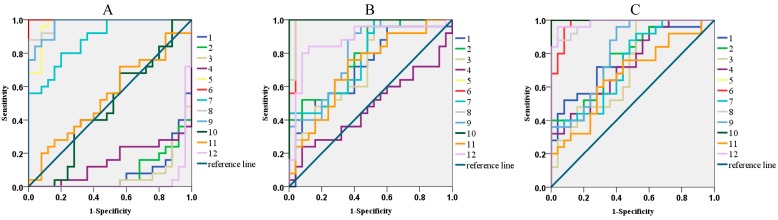
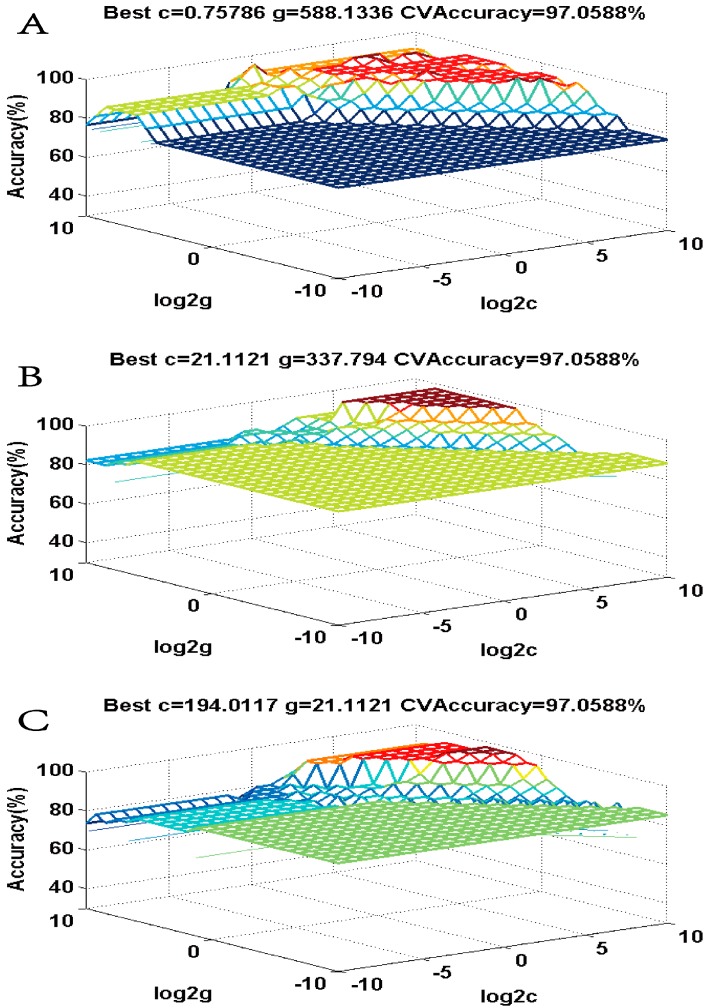
Fingerprinting is widely and commonly used in the quality control of traditional Chinese medicine (TCM) injections. However, current studies informed that the fingerprint similarity evaluation was less sensitive and easily generated false positive results. For this reason, a novel and practical chromatographic "Fingerprint-ROC-SVM" strategy was established by using KuDieZi (KDZ) injection as a case study in the present article. Firstly, the chromatographic fingerprints of KDZ injection were obtained by UPLC and the common characteristic peaks were identified with UPLC/Q-TOF-MS under the same chromatographic conditions. Then, the receiver operating characteristic (ROC) curve was used to optimize common characteristic peaks by the AUCs value greater than 0.7. Finally, a support vector machine (SVM) model, with the accuracy of 97.06%, was established by the optimized characteristic peaks and applied to monitor the quality of KDZ injection. As a result, the established model could sensitively and accurately distinguish the qualified products (QPs) with the unqualified products (UPs), high-temperature processed samples (HTPs) and high-illumination processed samples (HIPs) of KDZ injection, and the prediction accuracy was 100.00%, 93.75% and 100.00%, respectively. Furthermore, through the comparison with other chemometrics methods, the superiority of the novel analytical strategy was more prominent. It indicated that the novel and practical chromatographic "Fingerprint-ROC-SVM" strategy could be further applied to facilitate the development of the quality analysis of TCM injections.
指纹图谱在中药注射剂的质量控制中被广泛且普遍应用。然而,目前的研究表明,指纹图谱相似度评价的敏感性较低,且容易产生假阳性结果。因此,本文以苦碟子注射液为例,建立了一种新颖实用的色谱“指纹图谱 - ROC - 支持向量机”策略。首先,采用超高效液相色谱法(UPLC)获得苦碟子注射液的色谱指纹图谱,并在相同色谱条件下通过UPLC/Q - TOF - MS鉴定共同特征峰。然后,利用受试者工作特征(ROC)曲线,通过大于0.7的曲线下面积(AUCs)值优化共同特征峰。最后,以优化后的特征峰建立支持向量机(SVM)模型,其准确率为97.06%,并将其应用于苦碟子注射液的质量监测。结果表明,所建立的模型能够灵敏且准确地区分苦碟子注射液的合格产品(QPs)与不合格产品(UPs)、高温处理样品(HTPs)和高光照处理样品(HIPs),预测准确率分别为100.00%、93.75%和100.00%。此外,通过与其他化学计量学方法比较,该新型分析策略的优势更加突出。这表明新颖实用的色谱“指纹图谱 - ROC - SVM”策略可进一步应用于促进中药注射剂质量分析的发展。