Systemomics Center, College of Pharmacy, and Genomics Research Center (State-Province Key Laboratories of Biomedicine-Pharmaceutics of China), Harbin Medical University, Harbin, 150081, China.
HMU-UCFM Centre for Infection and Genomics, Harbin, China.
J Ovarian Res. 2017 Jul 24;10(1):49. doi: 10.1186/s13048-017-0346-z.
Ovarian cancer is one of the three leading gynecological malignancies, characterized by insidious growth, highly frequent metastasis, and quick development of drug resistance. As a result, this disease has low 5-year survival rates. Estrogen receptor inhibitors were commonly used for the treatment, but only 7% to 18% of patients respond to anti-estrogen therapies. Therefore, more effective therapies to inhibit estrogen-related tumors are urgently needed. Recently, phytoestrogens, such as lignans with estrogen-like biological activities, have attracted attention for their potential effects in the prevention or treatment of estrogen-related diseases. Enterodiol (END) and enterolactone (ENL) are mammalian lignans, which can reduce the risk of various cancers. However, the effects of END and ENL on ovarian cancer are not adequately documented.
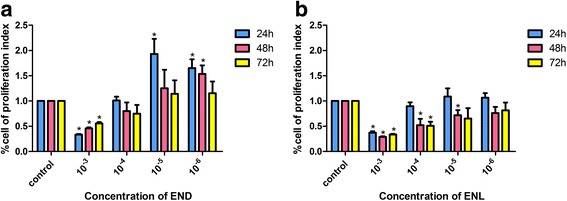
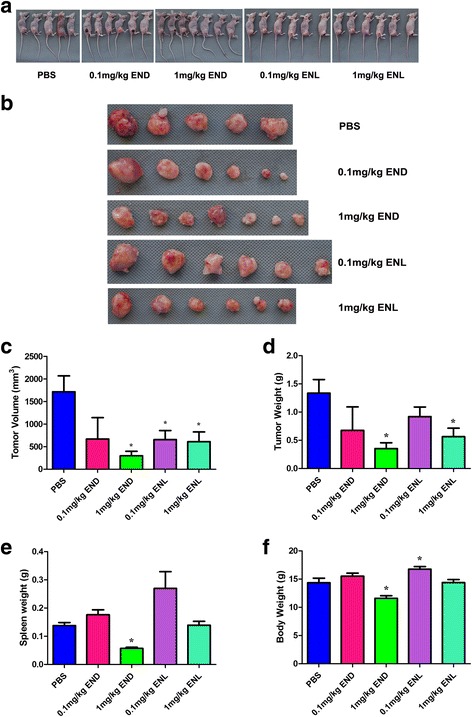
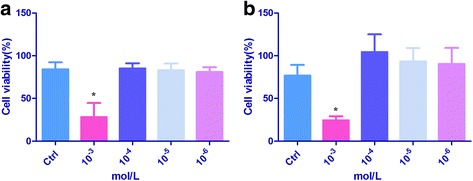
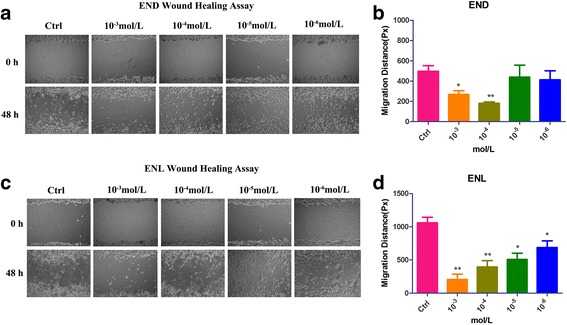
We used in vitro assays on the ES-2 cell line to evaluate the inhibiting effects of END and ENL on ovarian cancer cell proliferation, invasion and migration ability and in vivo xenograft experiments on nude mice to validate the anticancer effects of END and ENL.
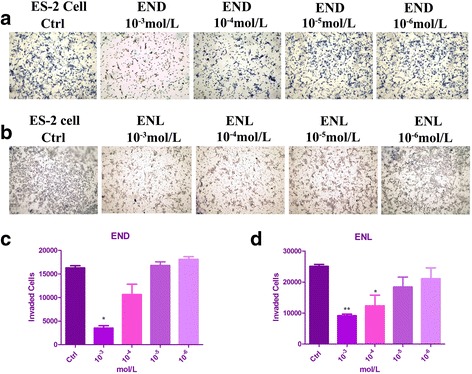
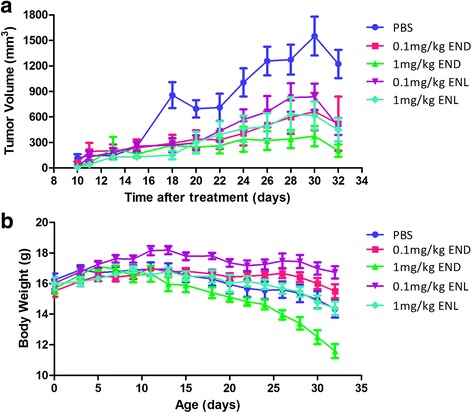
The in vitro assays demonstrated that high-dose END and ENL could obviously inhibit ovarian malignant properties, including cancerous proliferation, invasion, and metastasis. Compared to END, ENL behaved in a better time-dose dependent manner on the cancer cells. The in vivo experiments showed that END (1 mg/kg), ENL (1 mg/kg) and ENL (0.1 mg/kg) suppressed tumor markedly, and there were statistically significant differences between the experimental and control groups in tumor weight and volume. Compared to END, which have serious side effects to the animals at high concentration such as 1 mg/kg, ENL had higher anticancer activities and less side effects in the animals than END at the same concentrations, so it would be a better candidate for drug development.
END and ENL both have potent inhibitory effects on ovarian cancer but ENL possesses a more effective anti-cancer capability and less side effects than END. Findings in this work provide novel insights into ovarian cancer therapeutics with phytoestrogens and encourage their clinical applications.
卵巢癌是妇科三大恶性肿瘤之一,其具有生长隐匿、转移复发率高、耐药发生快等特点,导致患者 5 年生存率较低。雌激素受体抑制剂是常用的治疗药物,但只有 7%~18%的患者对抗雌激素治疗有反应。因此,需要更有效的抑制雌激素相关肿瘤的治疗方法。最近,植物雌激素如具有类雌激素生物活性的木脂素,因其在预防或治疗雌激素相关疾病方面的潜在作用而受到关注。肠二醇(END)和肠内酯(ENL)是哺乳动物木脂素,可降低各种癌症的风险。然而,END 和 ENL 对卵巢癌的作用尚未得到充分证实。
我们使用 ES-2 细胞系进行体外试验,评估 END 和 ENL 对卵巢癌细胞增殖、侵袭和迁移能力的抑制作用,并在裸鼠体内异种移植实验中验证 END 和 ENL 的抗癌作用。
体外试验表明,高剂量的 END 和 ENL 可明显抑制卵巢恶性特性,包括癌细胞增殖、侵袭和转移。与 END 相比,ENL 对癌细胞的作用表现出更好的时间-剂量依赖性。体内实验表明,END(1mg/kg)、ENL(1mg/kg)和 ENL(0.1mg/kg)显著抑制肿瘤生长,实验组与对照组在肿瘤重量和体积方面有统计学差异。与 END 相比,在高浓度(如 1mg/kg)时,END 对动物有严重的副作用,而在相同浓度下,ENL 对动物的抗癌活性更高,副作用更小,因此它将是一种更好的药物开发候选物。
END 和 ENL 对卵巢癌均有较强的抑制作用,但 ENL 的抗癌效果优于 END,且副作用较小。本研究为植物雌激素治疗卵巢癌提供了新的思路,并鼓励其临床应用。