
恒河猴的自动人脸识别。
Automated face recognition of rhesus macaques.
机构信息
Institute of Neuroscience, Newcastle University, Newcastle-upon-Tyne, UK; Centre for Macaques, Medical Research Council, UK.
出版信息
J Neurosci Methods. 2018 Apr 15;300:157-165. doi: 10.1016/j.jneumeth.2017.07.020. Epub 2017 Jul 21.
BACKGROUND
Rhesus macaques are widely used in biomedical research. Automated behavior monitoring can be useful in various fields (including neuroscience), as well as having applications to animal welfare but current technology lags behind that developed for other species. One difficulty facing developers is the reliable identification of individual macaques within a group especially as pair- and group-housing of macaques becomes standard. Current published methods require either implantation or wearing of a tracking device.
NEW METHOD
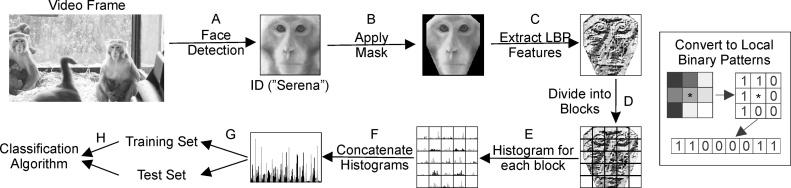
I present face recognition, in combination with face detection, as a method to non-invasively identify individual rhesus macaques in videos. The face recognition method utilizes local-binary patterns in combination with a local discriminant classification algorithm.
RESULTS
A classification accuracy of between 90 and 96% was achieved for four different groups. Group size, number of training images and challenging image conditions such as high contrast all had an impact on classification accuracy. I demonstrate that these methods can be applied in real time using standard affordable hardware and a potential application to studies of social structure.
COMPARISON WITH EXISTING METHOD(S): Face recognition methods have been reported for humans and other primate species such as chimpanzees but not rhesus macaques. The classification accuracy with this method is comparable to that for chimpanzees. Face recognition has the advantage over other methods for identifying rhesus macaques such as tags and collars of being non-invasive.
CONCLUSIONS
This is the first reported method for face recognition of rhesus macaques, has high classification accuracy and can be implemented in real time.
背景
恒河猴广泛应用于生物医学研究。自动化行为监测在多个领域(包括神经科学)都很有用,也适用于动物福利,但目前的技术落后于其他物种的技术。开发人员面临的一个困难是在群体中可靠地识别个体恒河猴,尤其是当对恒河猴进行成对和群体饲养成为标准时。目前已发表的方法要么需要植入追踪装置,要么需要佩戴追踪装置。
新方法
我提出了一种使用人脸识别,结合面部检测,来对视频中的个体恒河猴进行非侵入式识别的方法。人脸识别方法利用局部二值模式(Local Binary Patterns,LBP)结合局部判别分类算法。
结果
对于四个不同的群体,分类准确率达到了 90%至 96%。群体大小、训练图像数量以及高对比度等具有挑战性的图像条件都会对分类准确率产生影响。我证明了这些方法可以使用标准的、负担得起的硬件实时应用,并且可以应用于研究社会结构。
与现有方法的比较
人脸识别方法已经在人类和其他灵长类动物(如黑猩猩)中得到了报道,但在恒河猴中尚未报道。这种方法的分类准确率与黑猩猩相当。与标签和项圈等用于识别恒河猴的其他方法相比,人脸识别具有非侵入性的优势。
结论
这是第一个用于恒河猴人脸识别的报道方法,具有较高的分类准确率,可以实时实现。




 Zotero 插件