1st Department of Medicine, University Medical Centre Mannheim, Mannheim, Germany.
DZHK (German Centre for Cardiovascular Research) partner site, Mannheim, Germany.
Sci Rep. 2017 Jul 24;7(1):6336. doi: 10.1038/s41598-017-06533-0.
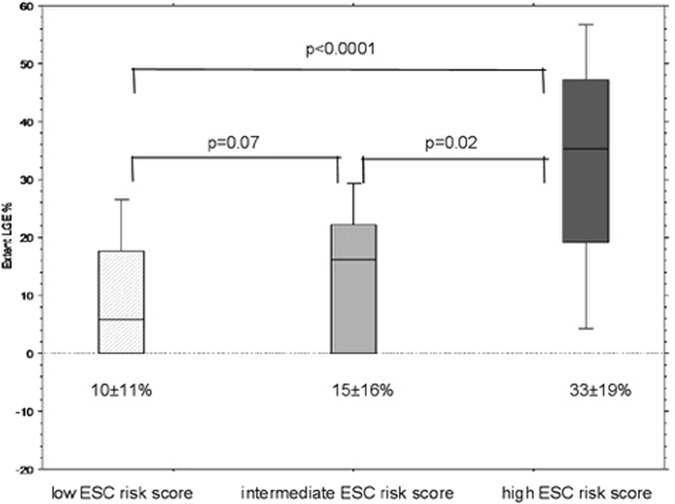
Hypertrophic cardiomyopathy (HCM) has a low risk for sudden cardiac death (SCD). The ESC clinical risk prediction model estimates the risk of SCD using clinical and echocardiographical parameters without taking into account cardiac magnetic resonance (CMR) parameters. Therefore, we compared the CMR characteristics of 149 patients with low, intermediate and high ESC risk scores. In these patients left and right ventricular ejection fraction and volumes were comparable. Patients with a high ESC risk score revealed a significantly higher extent of late gadolinium enhancement (LGE) compared to patients with intermediate or a low risk scores. During follow-up of 4 years an extent of LGE ≥20% identified patients at a higher risk for major adverse cardiac arrhythmic events in the low and intermediate ESC risk group whereas an extent of LGE <20% was associated with a low risk of major adverse cardiac arrhythmic events despite a high ESC risk score ≥6%. Hence, we hypothesize that the extent of fibrosis might be an additional risk marker.
肥厚型心肌病(HCM)发生心源性猝死(SCD)的风险较低。ESC 临床风险预测模型使用临床和超声心动图参数来估计 SCD 风险,而不考虑心脏磁共振(CMR)参数。因此,我们比较了低、中、高 ESC 风险评分患者的 CMR 特征。在这些患者中,左、右心室射血分数和容量相当。与中危或低危评分患者相比,高危 ESC 评分患者的晚期钆增强(LGE)程度显著更高。在 4 年的随访中,LGE 程度≥20%可识别低危和中危 ESC 风险组中发生主要不良心脏心律失常事件的高危患者,而 LGE 程度<20%与 ESC 风险评分≥6%的低危患者发生主要不良心脏心律失常事件的风险较低相关。因此,我们假设纤维化程度可能是另一个风险标志物。