Wakefield Jennifer, Hassan Hossam M, Jaspars Marcel, Ebel Rainer, Rateb Mostafa E
Marine Biodiscovery Centre, Department of Chemistry, University of AberdeenAberdeen, United Kingdom.
Pharmacognosy Department, Faculty of Pharmacy, Beni-Suef UniversityBeni Suef, Egypt.
Front Microbiol. 2017 Jul 11;8:1284. doi: 10.3389/fmicb.2017.01284. eCollection 2017.
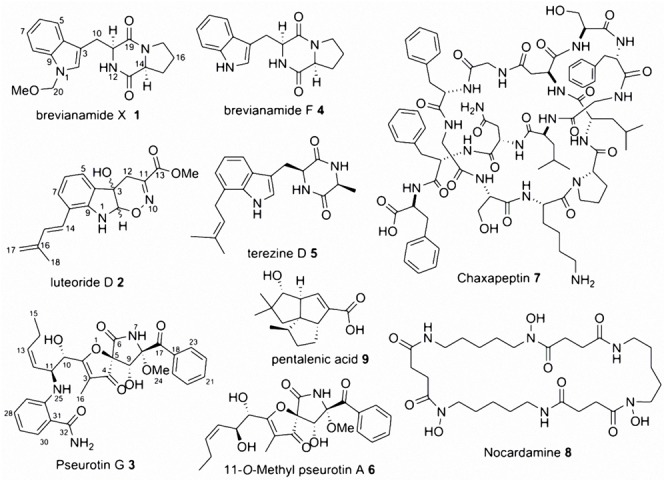
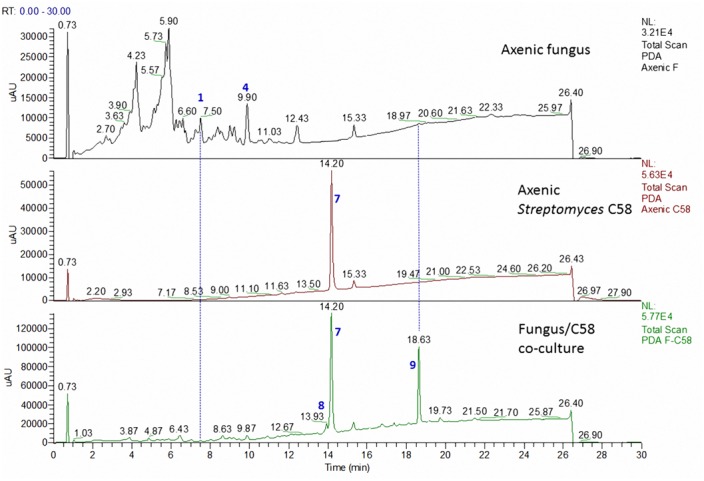
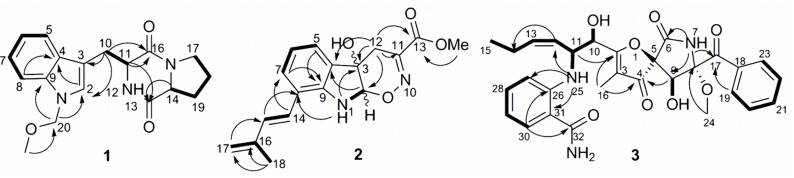
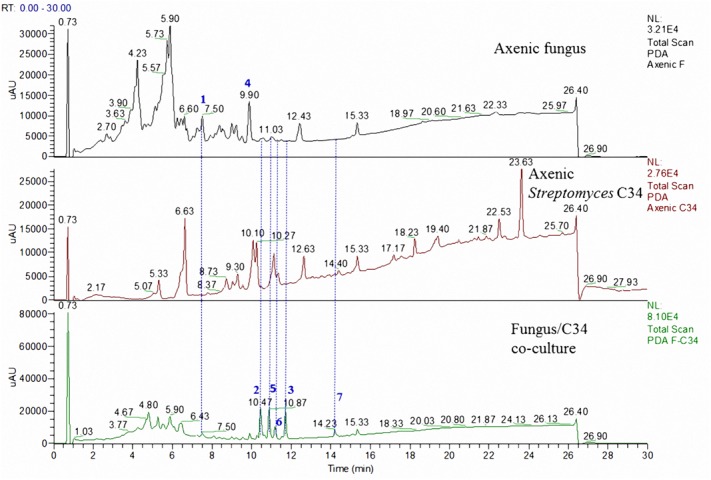
The frequent re-isolation of known compounds is one of the major challenges in drug discovery. Many biosynthetic genes are not expressed under standard culture conditions, thus limiting the chemical diversity of microbial compounds that can be obtained through fermentation. On the other hand, the competition during co-cultivation of two or more different microorganisms in most cases leads to an enhanced production of constitutively present compounds or an accumulation of cryptic compounds that are not detected in axenic cultures of the producing strain under different fermentation conditions. Herein, we report the dual induction of newly detected bacterial and fungal metabolites by the co-cultivation of the marine-derived fungal isolate MR2012 and two hyper-arid desert bacterial isolates strain C34 and strain C58. Co-cultivation of the fungal isolate MR2012 with the bacterial strain C34 led to the production of luteoride D, a new luteoride derivative and pseurotin G, a new pseurotin derivative in addition to the production of terezine D and 11--methylpseurotin A which were not traced before from this fungal strain under different fermentation conditions. In addition to the previously detected metabolites in strain C34, the lasso peptide chaxapeptin was isolated under co-culture conditions. The gene cluster for the latter compound had been identified through genome scanning, but it had never been detected before in the axenic culture of strain C34. Furthermore, when the fungus MR2012 was co-cultivated with the bacterial strain C58, the main producer of chaxapeptin, the titre of this metabolite was doubled, while additionally the bacterial metabolite pentalenic acid was detected and isolated for the first time from this strain, whereas the major fungal metabolites that were produced under axenic culture were suppressed. Finally, fermentation of the MR2012 by itself led to the isolation of the new diketopiperazine metabolite named brevianamide X.
已知化合物的频繁重新分离是药物发现中的主要挑战之一。许多生物合成基因在标准培养条件下不表达,从而限制了可通过发酵获得的微生物化合物的化学多样性。另一方面,在两种或更多种不同微生物共培养期间的竞争在大多数情况下会导致组成型存在的化合物产量增加或隐秘化合物的积累,这些隐秘化合物在生产菌株的无菌培养物中在不同发酵条件下未被检测到。在此,我们报告了通过海洋来源的真菌分离株MR2012与两种高干旱沙漠细菌分离株C34和C58的共培养对新检测到的细菌和真菌代谢物的双重诱导。真菌分离株MR2012与细菌菌株C34共培养导致了luteoride D(一种新的luteoride衍生物)和pseurotin G(一种新的pseurotin衍生物)的产生,此外还产生了terezine D和11-甲基pseurotin A,在不同发酵条件下此前从未从该真菌菌株中追踪到这些化合物。除了在菌株C34中先前检测到的代谢物外,在共培养条件下分离出了套索肽chaxapeptin。后一种化合物的基因簇已通过基因组扫描鉴定,但此前在菌株C34的无菌培养物中从未检测到。此外,当真菌MR2012与chaxapeptin的主要生产者细菌菌株C58共培养时,这种代谢物的产量增加了一倍,同时还首次从该菌株中检测到并分离出细菌代谢物戊烯酸,而在无菌培养下产生的主要真菌代谢物受到抑制。最后,MR2012单独发酵导致分离出名为短杆菌酰胺X的新二酮哌嗪代谢物。