Wu Mao-Jun, Chen Min, Sang Sang, Hou Long-Long, Tian Mao-Lang, Li Kuang, Lv Fang-Qi
Department of Pediatric Surgery, Affiliated Hospital of Taishan Medical University, Tai'an, Shandong Province, China.
Department of Emergency, Cancer Hospital of Tai'an city, Tai'an, Shandong Province, China.
Med Gas Res. 2017 Jun 30;7(2):101-106. doi: 10.4103/2045-9912.208515. eCollection 2017 Apr-Jun.
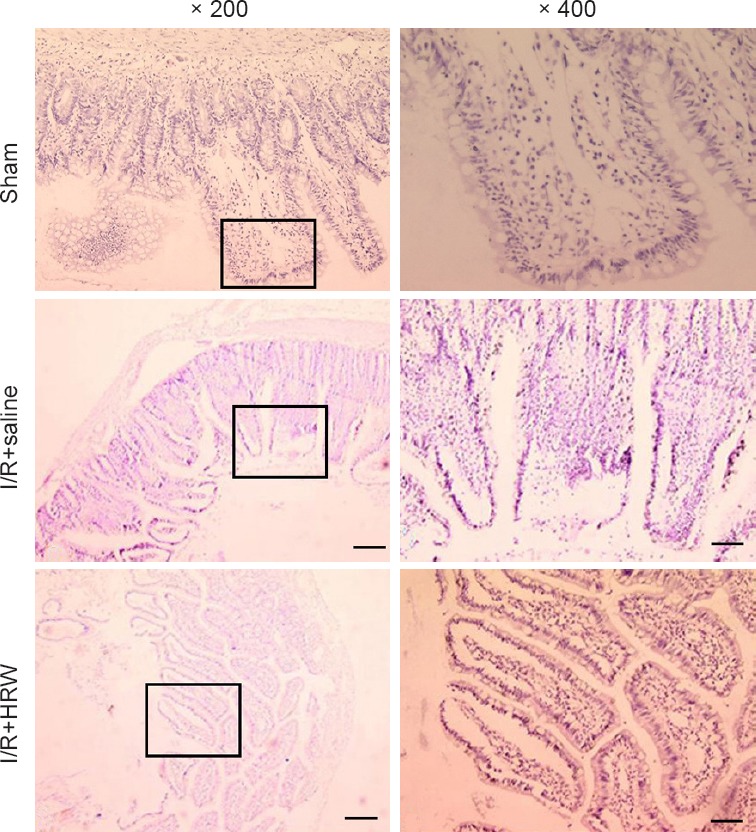
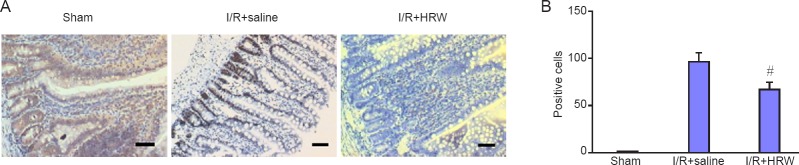
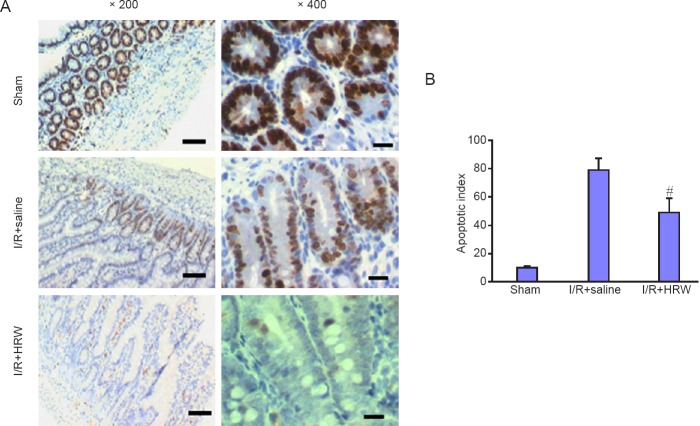
This study aimed to investigate the protective effects of hydrogen rich water on the intestinal ischemia/reperfusion (I/R) injury in a rat intestinal intussusception (II) model. Ninety Sprague-Dawley rats were randomly assigned into three groups ( = 30 per group). In sham group, rats received laparotomy, and the intestine was exposed for 15 minutes without II. In I/R + saline group and I/R + hydrogen group, rats received II after laparotomy and then intestine was relocated 8 hours later, followed by immediately intraperitoneal injection of normal saline and hydrogen rich water (HRW) (5 mL/kg), respectively. One hour later, the intestine was collected for hematoxylin-eosin staining and immunohistochemistry for apoptotic cells and 8-oxo-deoxyguanosine, and blood was harvested for detection of tumor necrosis factor-α, malondialdehyde and superoxide dismutase. Hematoxylin-eosin staining showed the intestinal mucosa was significantly damaged in I/R + saline group, which was markedly attenuated after HRW treatment. The serum tumor necrosis factor-α content increased significantly in I/R + saline group, but HRW treatment reduced serum tumor necrosis factor-α content as compared to I/R + saline group ( < 0.05). Serum malondialdehyde content and 8-oxo-deoxyguanosine positive cells in the intestine increased dramatically after II, but HRW significantly reduced them in I/R+hydrogen group ( < 0.05). In addition, superoxide dismutase activity reduced markedly and apoptotic cells increased in I/R + saline group as compared to sham group, but they HRW increased superoxide dismutase activity and reduced apoptotic cells significantly in I/R + hydrogen group ( < 0.05). Our results indicate hydrogen rich water is able to attenuate II induced intestinal I/R injury inhibiting intestinal inflammation, attenuating intestinal/serum oxidative stress and reducing apoptotic intestinal cells.
本研究旨在探讨富氢水对大鼠肠套叠(II)模型中肠缺血/再灌注(I/R)损伤的保护作用。90只Sprague-Dawley大鼠随机分为三组(每组n = 30)。假手术组大鼠接受剖腹手术,暴露肠管15分钟但不进行肠套叠。在I/R + 生理盐水组和I/R + 氢气组中,大鼠剖腹手术后接受肠套叠,8小时后将肠管复位,然后分别立即腹腔注射生理盐水和富氢水(HRW)(5 mL/kg)。1小时后,收集肠管进行苏木精-伊红染色以及对凋亡细胞和8-氧代脱氧鸟苷进行免疫组织化学检测,并采集血液检测肿瘤坏死因子-α、丙二醛和超氧化物歧化酶。苏木精-伊红染色显示,I/R + 生理盐水组肠黏膜明显受损,而HRW处理后损伤明显减轻。I/R + 生理盐水组血清肿瘤坏死因子-α含量显著增加,但与I/R + 生理盐水组相比,HRW处理降低了血清肿瘤坏死因子-α含量(P < 0.05)。肠套叠后血清丙二醛含量和肠内8-氧代脱氧鸟苷阳性细胞显著增加,但HRW在I/R + 氢气组中显著降低了它们的含量(P < 0.05)。此外,与假手术组相比,I/R + 生理盐水组超氧化物歧化酶活性显著降低且凋亡细胞增加,但HRW在I/R + 氢气组中显著增加了超氧化物歧化酶活性并减少了凋亡细胞(P < 0.05)。我们的结果表明,富氢水能够减轻II诱导的肠I/R损伤,其机制可能是通过抑制肠道炎症、减轻肠道/血清氧化应激以及减少肠道凋亡细胞。