Perichart-Perera Otilia, Muñoz-Manrique Cinthya, Reyes-López Angélica, Tolentino-Dolores Maricruz, Espino Y Sosa Salvador, Ramírez-González Ma Cristina
Nutrition and Bioprogramming Department, Instituto Nacional de Perinatología Isidro Espinosa de los Reyes, Mexico City, Mexico.
Clinical Research Subdirection, Instituto Nacional de Perinatología, Mexico City, Mexico.
PLoS One. 2017 Jul 27;12(7):e0180874. doi: 10.1371/journal.pone.0180874. eCollection 2017.
BACKGROUND/AIMS: Obesity during pregnancy increases the risk of adverse clinical outcomes and is associated with low-grade chronic inflammation. We describe maternal metabolic risk and inflammation by maternal weight status, and evaluate the association of metabolic and inflammatory markers with birthweight in a group of pregnant Mexican women.
This study derived from a prospective cohort of healthy pregnant women <14 weeks of gestation, receiving prenatal care at National Institute of Perinatology (Mexico, 2009-2013). Metabolic and inflammatory markers were measured in maternal serum in all three pregnancy trimesters (1st: 11.42±1.7; 2nd: 21.06±2.4; 3rd: 32.74±2.3 weeks). Pregestational weight was self-reported, and body mass index (BMI) was calculated. Gestational weight gain was evaluated in the third trimester. Newborn´s weight was measured at birth. We carried out correlations, general mixed linear model and regression analyses, based on pregestational weight (self-reported), body mass index (BMI), gestational weight gain (evaluated in the third trimester) and newborn weight (measured at birth).
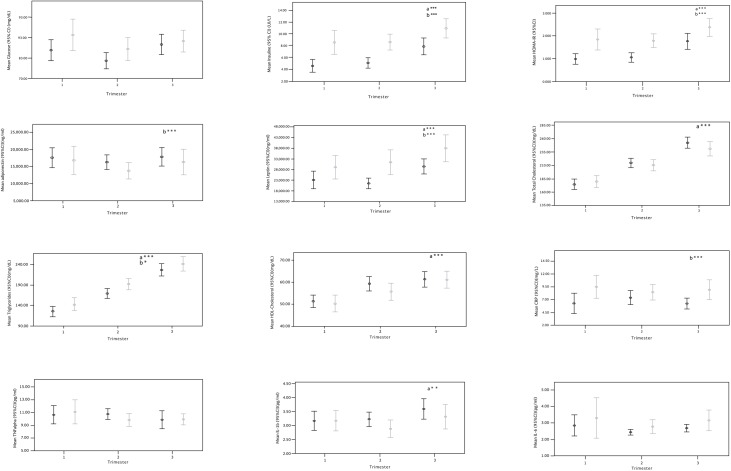
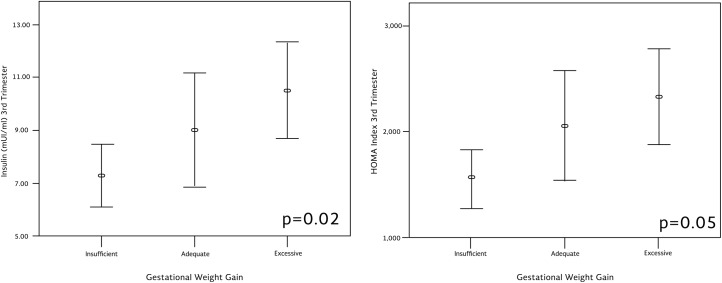
Of the 177 women included in the study (mean age = 26.93±8.49), thirty-eight percent (n = 67) were overweight or had obesity, and 32.8% (n = 58) showed excessive gestational weight gain. We found insulin, lipids (including total cholesterol, LDL-cholesterol, HDL-cholesterol, and triglycerides-TG), leptin and interleukin 1b (IL-1b) all increased significantly (p<0.05) during pregnancy. Pregestational maternal weight status altered longitudinal concentrations of insulin, leptin, adiponectin, TG and C reactive protein. Excessive gestational weight gain was associated with higher maternal insulin in the third trimester (p<0.05). Early pregnancy leptin and TNFα were determinants of birthweight in women with normal weight, but not in overweight or obese women.
Maternal weight status affected the concentrations of insulin, leptin, adiponectin, triglycerides and C reactive protein throughout pregnancy. The role of early leptin and TNFα in fetal growth need further study given the association was only observed in normal weight women. This study presents data distribution of metabolic and inflammatory markers of normal weight and overweight/obese women that did not develop GDM, preeclampsia nor macrosomia.
背景/目的:孕期肥胖会增加不良临床结局的风险,并与低度慢性炎症相关。我们根据孕妇体重状况描述其代谢风险和炎症情况,并评估一组墨西哥孕妇中代谢和炎症标志物与出生体重之间的关联。
本研究源自一个前瞻性队列,该队列由妊娠<14周、在国立围产医学研究所(墨西哥,2009 - 2013年)接受产前护理的健康孕妇组成。在妊娠的三个阶段(第一阶段:11.42±1.7周;第二阶段:21.06±2.4周;第三阶段:32.74±2.3周)均检测孕妇血清中的代谢和炎症标志物。孕前体重通过自我报告获取,并计算体重指数(BMI)。在孕晚期评估孕期体重增加情况。在出生时测量新生儿体重。我们基于孕前体重(自我报告)、体重指数(BMI)、孕期体重增加(在孕晚期评估)和新生儿体重(出生时测量)进行相关性分析、一般混合线性模型分析和回归分析。
在纳入研究的177名女性(平均年龄 = 26.93±8.49)中,38%(n = 67)超重或肥胖,32.8%(n = 58)孕期体重增加过多。我们发现胰岛素、脂质(包括总胆固醇、低密度脂蛋白胆固醇、高密度脂蛋白胆固醇和甘油三酯 - TG)、瘦素和白细胞介素1β(IL - 1β)在孕期均显著升高(p<0.05)。孕前孕妇体重状况改变了胰岛素、瘦素、脂联素、TG和C反应蛋白的纵向浓度。孕期体重增加过多与孕晚期孕妇胰岛素水平较高相关(p<0.05)。孕早期瘦素和TNFα是体重正常女性出生体重的决定因素,但在超重或肥胖女性中并非如此。
孕妇体重状况在整个孕期影响胰岛素、瘦素、脂联素、甘油三酯和C反应蛋白的浓度。鉴于仅在体重正常女性中观察到这种关联,孕早期瘦素和TNFα在胎儿生长中的作用需要进一步研究。本研究呈现了未发生妊娠期糖尿病、先兆子痫或巨大儿的体重正常和超重/肥胖女性的代谢和炎症标志物的数据分布情况。