Salem Christine, Atallah David, Safi Joelle, Chahine Georges, Haddad Antoine, El Kassis Nadine, Maalouly Laura-Maria, Moubarak Malak, Dib Mary, Ghossain Michel
Department of Radiology, Hôtel-Dieu de France University Hospital, Saint Joseph University, Beirut, Lebanon.
Department of Gynecology and Obstetrics, Hôtel-Dieu de France University Hospital, Saint Joseph University, Beirut, Lebanon.
Biomed Res Int. 2017;2017:7594953. doi: 10.1155/2017/7594953. Epub 2017 Jul 2.
To study the distribution of breast mammogram density in Lebanese women and correlate it with breast cancer (BC) incidence.
Data from 1,049 women who had screening or diagnostic mammography were retrospectively reviewed. Age, menopausal status, contraceptives or hormonal replacement therapy (HRT), parity, breastfeeding, history of BC, breast mammogram density, and final BI-RADS assessment were collected. Breast density was analyzed in each age category and compared according to factors that could influence breast density and BC incidence.
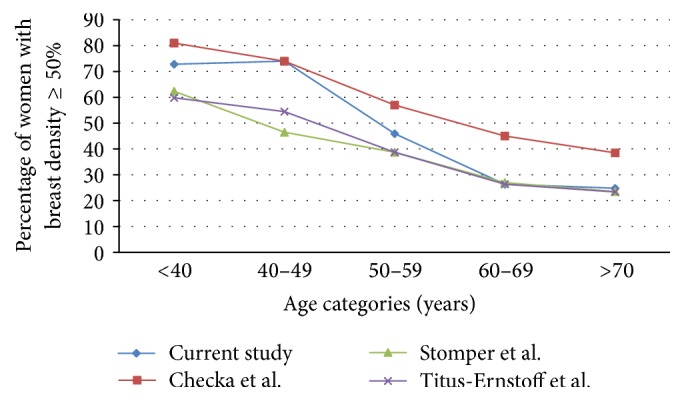
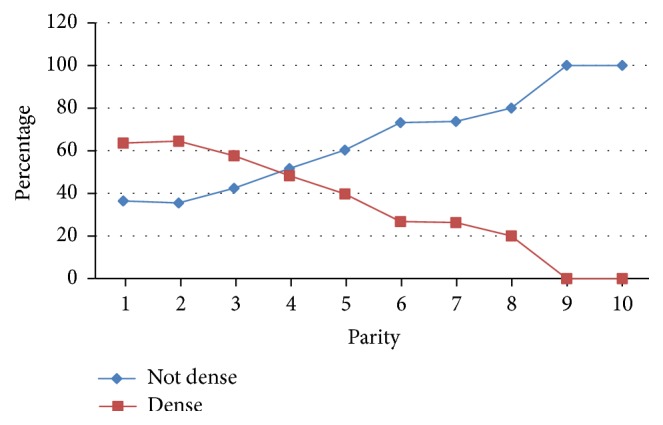
120 (11.4%) patients had BC personal history with radiation and/or chemotherapy; 66 patients were postmenopausal under HRT. Mean age was 52.58 ± 11.90 years. 76.4% of the patients (30-39 years) had dense breasts. Parity, age, and menopausal status were correlated to breast density whereas breastfeeding and personal/family history of BC and HRT were not. In multivariate analysis, it was shown that the risk of breast cancer significantly increases 3.3% with age ( = 0.005), 2.5 times in case of menopause ( = 0.004), and 1.4 times when breast density increases ( = 0.014).
Breast density distribution in Lebanon is similar to the western society. Similarly to other studies, it was shown that high breast density was statistically related to breast cancer, especially in older and menopausal women.
研究黎巴嫩女性乳房钼靶密度分布情况,并将其与乳腺癌(BC)发病率相关联。
对1049例接受筛查或诊断性钼靶检查的女性数据进行回顾性分析。收集年龄、绝经状态、避孕药或激素替代疗法(HRT)、产次、母乳喂养、BC病史、乳房钼靶密度以及最终的BI-RADS评估结果。分析各年龄组的乳房密度,并根据可能影响乳房密度和BC发病率的因素进行比较。
120例(11.4%)患者有BC个人放疗和/或化疗史;66例患者在HRT下处于绝经后状态。平均年龄为52.58±11.90岁。76.4%的患者(30 - 39岁)乳房致密。产次、年龄和绝经状态与乳房密度相关,而母乳喂养、BC个人/家族史和HRT则无关。多因素分析显示,乳腺癌风险随年龄显著增加3.3%(P = 0.005),绝经时增加2.5倍(P = 0.004),乳房密度增加时增加1.4倍(P = 0.014)。
黎巴嫩的乳房密度分布与西方社会相似。与其他研究一样,结果表明高乳房密度与乳腺癌在统计学上相关,尤其是在老年和绝经后女性中。