Sharifi Iraj, Aflatoonian Mohammad Reza, Daei Parizi Mohammad Hossein, Hosseininasab Ali, Mostafavi Mahshid, Bamorovat Mehdi, Aghaei Afshar Abass, Mohebali Mehdi, Keshavarz Hossein, Daneshvar Hamid, Babaei Zahra, Mahmoudvand Hossein, Mohammadi Mohammad Ali, Sharifi Fatemeh, Barati Mohammad, Kamiabi Hossein, Khaleghi Tabandeh
Leishmaniasis Research Center, Kerman University of Medical Sciences, Kerman, Iran.
Tropical and Infectious Diseases Research Center, Kerman University of Medical Sciences, Kerman, Iran.
Iran J Parasitol. 2017 Jan-Mar;12(1):1-11.
Visceral leishmaniasis (VL) has strong links with poverty, substantial medical and veterinary impacts. This review aimed to focus in studies published during 1994-2016 on VL in southeastern Iran.
The present review is based on expert knowledge and historical studies published during the past 23 yr (1994-2016) on VL in southeastern Iran. In addition, related literature found in PubMed by using the keywords such as visceral leishmaniasis, kala-azar, and are included.
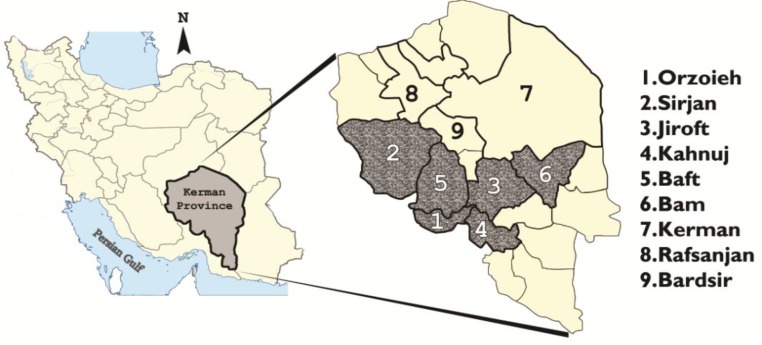
Overall, 118 children aged 4.2 yr were detected as infected with human VL (HVL). The majority of the cases were from Orzoieh district (37.1%) in southwest of Kerman Province, followed by Sirjan (15.7%), Jiroft (14.8%), Kahnuj (9.3%) and to lesser extent from other areas. The male to female ratio was 1.7. The three most frequent clinical features were represented by fever (100.0%), anemia (95.0%) and splenomegaly (91.5%). Altogether, 42.0% of the VL cases developed secondary bacterial infections, the overall case-fatality rate was 3.4%, and majorities (88.0%) of the VL patients were undernourished. Overall, 733 dogs and wild canines were examined by different techniques with various seroprevalence ranges.
In southeastern Iran, VL is endemic in Orzoieh district in Kerman Province. While the dogs are implicated as the main domestic reservoir of VL, wide range of wild canines can serve as a secondary potential reservoir host.
内脏利什曼病(VL)与贫困密切相关,对医学和兽医领域都有重大影响。本综述旨在聚焦1994年至2016年期间发表的关于伊朗东南部VL的研究。
本综述基于过去23年(1994年至2016年)发表的关于伊朗东南部VL的专家知识和历史研究。此外,还纳入了在PubMed中通过使用内脏利什曼病、黑热病等关键词找到的相关文献。
总体而言,检测到118名4.2岁儿童感染了人类VL(HVL)。大多数病例来自克尔曼省西南部的奥尔佐伊区(37.1%),其次是锡尔詹(15.7%)、吉罗夫特(14.8%)、卡努季(9.3%),其他地区的比例较小。男女比例为1.7。最常见的三种临床特征是发热(100.0%)、贫血(95.0%)和脾肿大(91.5%)。共有42.0%的VL病例发生了继发性细菌感染,总体病死率为3.4%,大多数(88.0%)VL患者营养不良。总体而言,通过不同技术对733只狗和野生犬科动物进行了检查,血清阳性率范围各不相同。
在伊朗东南部,VL在克尔曼省的奥尔佐伊区为地方病。虽然狗被认为是VL的主要家养宿主,但多种野生犬科动物可作为次要的潜在宿主。