Department of Pediatrics, Johns Hopkins University School of Medicine, Baltimore, MD, 21287, USA.
Center for Promotion of Child Development through Primary Care, Baltimore, MD, 21210, USA.
J Autism Dev Disord. 2017 Oct;47(10):3296-3310. doi: 10.1007/s10803-017-3231-0.
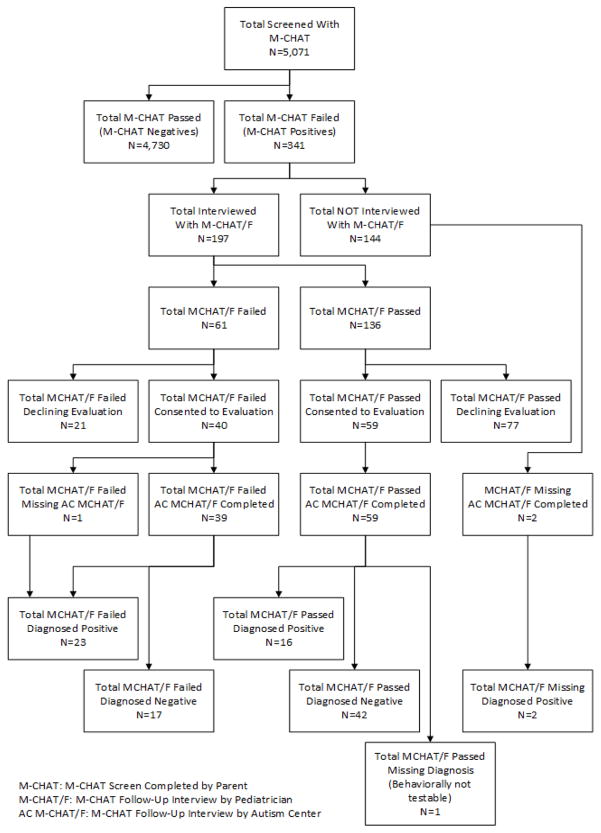
Accuracy of autism screening using M-CHAT plus the follow-up interview (M-CHAT/F) for children screened positive at 18-months was compared to screening at 24-months. Formal ASD testing was criterion for a community sample of M-CHAT positive children (n = 98), positive predictive value (PPV) was 0.40 for the M-CHAT and 0.58 for the M-CHAT/F. MCHAT/F PPV was 0.69 among children 20+ months compared to 0.36 for <20 months. Multivariate analyses incorporating data from the Ages and Stages Questionnaire, MacArthur-Bates Communicative Development Inventory, M-CHAT and M-CHAT/F results, and M-CHAT items suggest language variables carry greatest relative importance in contributing to an age-based algorithm with potential to improve PPV for toddlers <20 months to the same level as observed in older toddlers.
使用 M-CHAT 加随访访谈(M-CHAT/F)对 18 个月筛查阳性的儿童进行自闭症筛查的准确性与 24 个月筛查进行了比较。对 M-CHAT 阳性儿童(n=98)进行了社区样本的正式 ASD 测试,M-CHAT 的阳性预测值(PPV)为 0.40,M-CHAT/F 的阳性预测值为 0.58。与 <20 个月的儿童相比,20+个月的儿童的 MCHAT/F 的阳性预测值为 0.69。纳入来自年龄和阶段问卷、麦克阿瑟 - 贝茨交际发展量表、M-CHAT 和 M-CHAT/F 结果以及 M-CHAT 项目的数据的多变量分析表明,语言变量在根据年龄制定算法方面具有最大的相对重要性,有可能将 <20 个月的幼儿的阳性预测值提高到与较大年龄组相同的水平。