Henke Antje, Thuss-Patience Peter, Behzadi Asita, Henke Oliver
Department of Hematology and Oncology, Division of Palliative Medicine, Virchow Campus, Charité University Hospital, Berlin, Germany.
Berlin School of Public Health, Charité University Hospital, Berlin, Germany.
PLoS One. 2017 Aug 1;12(8):e0182033. doi: 10.1371/journal.pone.0182033. eCollection 2017.
Since the late 1950's, a steadily increasing immigrant population in Germany is resulting in a subpopulation of aging immigrants. The German health care system needs to adjust its services-linguistically, culturally, and medically-for this subpopulation of patients. Immigrants make up over 20% of the population in Germany, yet the majority receive inadequate medical care. As many of the labor immigrants of the 1960s and 1970s are in need of hospice and palliative care (HPC), little is known about this specialized care for immigrants. This epidemiological study presents utilization of HPC facilities in Berlin with a focus on different immigrant groups.
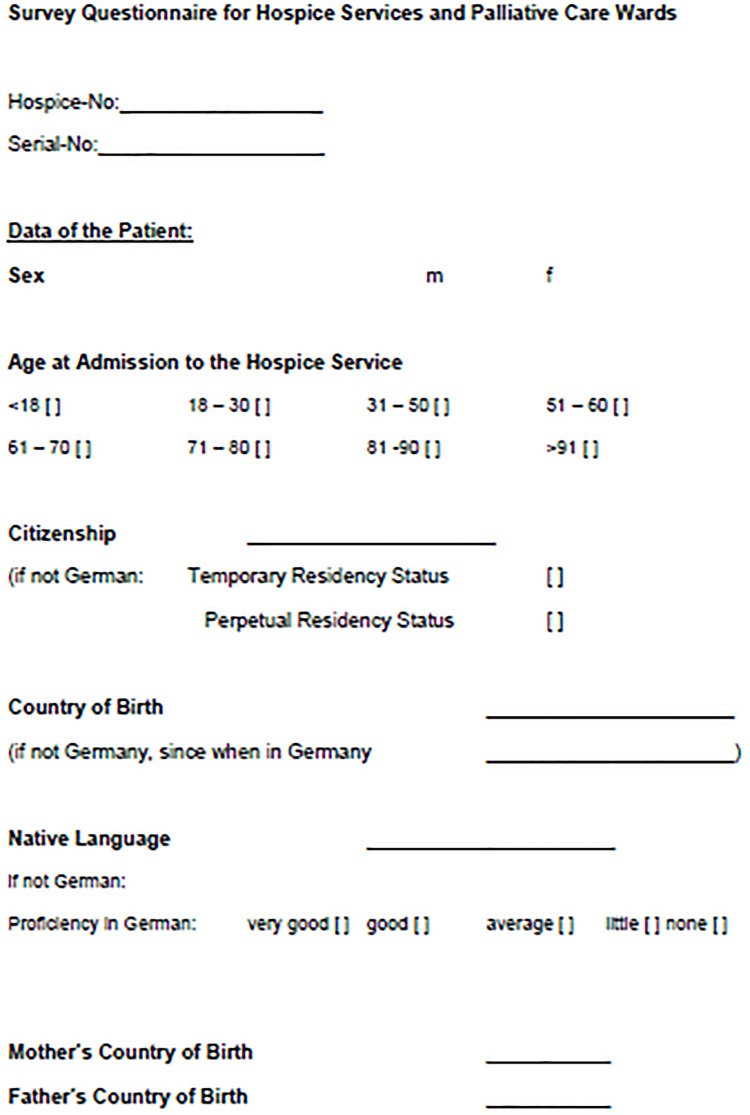
A validated questionnaire was used to collect data from patients at 34 HPC institutions in Berlin over 20 months. All newly admitted patients were recruited. Anonymized data were coded and analyzed by using SPSS and compared with the population statistics of Berlin.
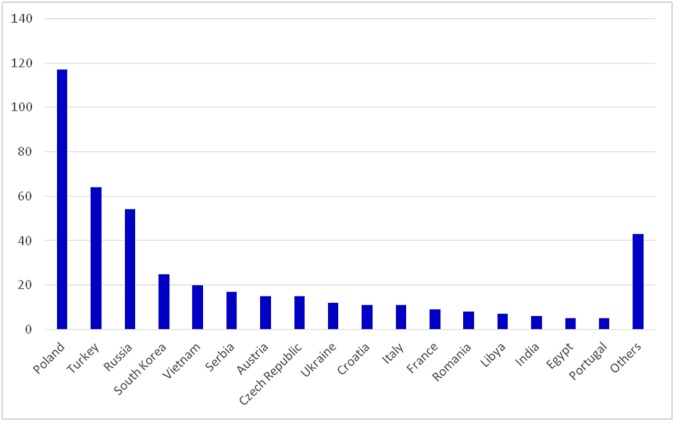
4118 questionnaires were completed and included in the analysis. At 11.4% the proportion of immigrants accessing HPC was significantly (p<0,001) below their proportion in the general Berlin population. This difference was especially seen in the age groups of 51-60 (21.46% immigrants in Berlin population, 17.7% immigrants in HPC population) and 61-70 years (16,9% vs. 13,1%). The largest ethnic groups are Turks, Russians, and Poles, with a different weighting than in the general population: Turkish immigrants were 24% of all Berlin immigrants, but only 13.6% of the study immigrant population (OR: 0.23, 95%CI: 0.18-0.29, p<0.001). Russian and Polish immigrants account for 5.6% and 9.2% in the population, but 11.5% and 24.8% in the study population respectively (Russian: OR 0.88, 95%CI: 0.66-1.16; Polish: OR 1.17, 95%CI: 0.97-1.42). Palliative care wards (PC) were used most often (16.7% immigrants of all PC patients); outpatient hospice services were used least often by immigrants (11.4%). Median age at first admission to HPC was younger in immigrants than non-immigrants: 61-70 vs. 71-80, p = 0.03.
Immigrants are underrepresented in Berlin´s HPC and immigrants on average make use of care at a younger age than non-immigrants. In this regard, Turkish immigrants in particular have the poorest utilization of HPC. These results should prompt research on Turkish immigrants, regarding access barriers, since they represent the largest immigrant group. This may be due to a lack of cultural sensitivity of the care-providers and a lack of knowledge about HPC among immigrants. In the comparison of the kinds of institutions, immigrants are less likely to access outpatient hospice services compared to PC. Apparently, PC appear to be a smaller hurdle for utilization. These results show a non-existent, but oft-cited "healthy immigrant effect" of the first generation of work immigrants, now entering old age. These findings correspond with studies suggesting increased health concerns in immigrants. Focused research is needed to promote efforts in providing adequate and fair access to HPC for all people in Berlin.
自20世纪50年代末以来,德国移民人口稳步增加,形成了一个老年移民亚群体。德国医疗保健系统需要在语言、文化和医疗方面为这一患者亚群体调整其服务。移民占德国人口的20%以上,但大多数人获得的医疗护理不足。由于20世纪60年代和70年代的许多劳工移民需要临终关怀和姑息治疗(HPC),对于移民的这种专业护理了解甚少。这项流行病学研究介绍了柏林HPC设施的使用情况,重点关注不同的移民群体。
使用经过验证的问卷,在20个月内从柏林34家HPC机构的患者中收集数据。招募所有新入院的患者。对匿名数据进行编码,并使用SPSS进行分析,然后与柏林的人口统计数据进行比较。
共完成4118份问卷并纳入分析。使用HPC的移民比例为11.4%,显著低于他们在柏林总人口中的比例(p<0.001)。这种差异在51 - 60岁年龄组(柏林人口中移民占21.46%,HPC人口中移民占17.7%)和61 - 70岁年龄组(分别为16.9%和13.1%)尤为明显。最大的族群是土耳其人、俄罗斯人和波兰人,其权重与总人口不同:土耳其移民占柏林所有移民的24%,但仅占研究移民人口的13.6%(比值比:0.23,95%置信区间:0.18 - 0.29,p<0.001)。俄罗斯和波兰移民在人口中分别占5.6%和9.2%,但在研究人群中分别占11.5%和24.8%(俄罗斯:比值比0.88,95%置信区间:0.66 - 1.16;波兰:比值比1.17,95%置信区间:0.97 - 1.42)。姑息治疗病房(PC)使用最为频繁(所有PC患者中移民占16.7%);移民使用门诊临终关怀服务最少(11.4%)。移民首次入住HPC的中位年龄比非移民年轻:61 - 70岁对71 - 80岁,p = 0.03。
在柏林的HPC中,移民的代表性不足,而且移民平均比非移民在更年轻的时候就开始接受护理。在这方面,土耳其移民对HPC的利用率尤其低。这些结果应促使对土耳其移民在获取HPC方面的障碍进行研究,因为他们是最大的移民群体。这可能是由于护理人员缺乏文化敏感性以及移民对HPC缺乏了解。在机构类型的比较中,与PC相比,移民获得门诊临终关怀服务的可能性较小。显然,PC似乎是利用方面较小的障碍。这些结果显示第一代工作移民(现步入老年)不存在但常被提及的“健康移民效应”。这些发现与表明移民健康问题增加的研究一致。需要进行有针对性的研究,以推动为柏林所有人提供充分和公平的HPC服务。