Department of Chemistry, Yale University , P.O. Box 208107, New Haven, Connecticut 06520-8107, United States.
Department of Biochemistry, University of Zürich , Winterthurerstrasse 190, CH-8057 Zürich, Switzerland.
J Am Chem Soc. 2017 Nov 15;139(45):16028-16031. doi: 10.1021/jacs.7b05313. Epub 2017 Aug 7.
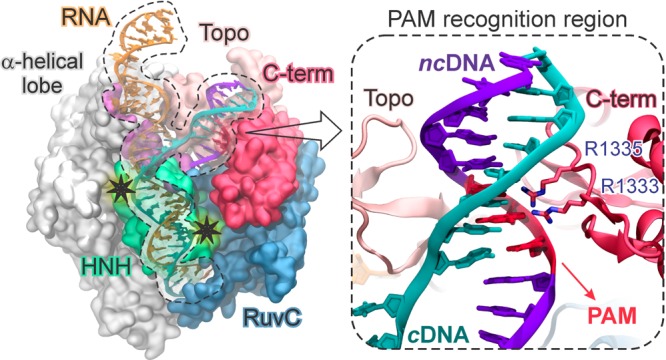
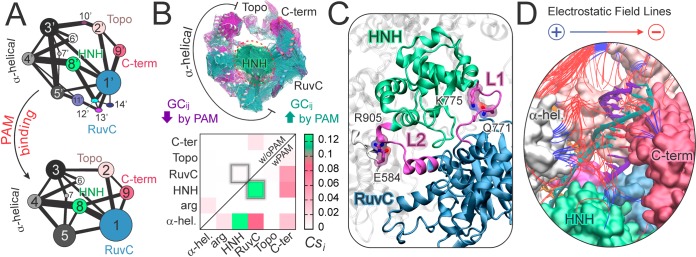
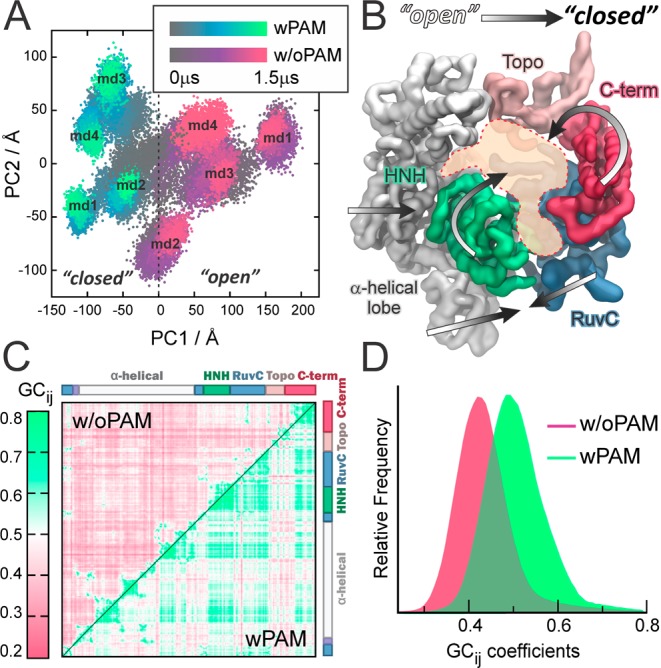
CRISPR-Cas9 is a genome editing technology with major impact in life sciences. In this system, the endonuclease Cas9 generates double strand breaks in DNA upon RNA-guided recognition of a complementary DNA sequence, which strictly requires the presence of a protospacer adjacent motif (PAM) next to the target site. Although PAM recognition is essential for cleavage, it is unknown whether and how PAM binding activates Cas9 for DNA cleavage at spatially distant sites. Here, we find evidence of a PAM-induced allosteric mechanism revealed by microsecond molecular dynamics simulations. PAM acts as an allosteric effector and triggers the interdependent conformational dynamics of the Cas9 catalytic domains (HNH and RuvC), responsible for concerted cleavage of the two DNA strands. Targeting such an allosteric mechanism should enable control of CRISPR-Cas9 functionality.
CRISPR-Cas9 是一种具有重大影响的基因组编辑技术。在该系统中,内切酶 Cas9 在 RNA 引导下识别互补的 DNA 序列时会在 DNA 上产生双链断裂,这严格要求靶位点旁边存在邻近基序(PAM)。尽管 PAM 识别对于切割至关重要,但尚不清楚 PAM 结合是否以及如何激活 Cas9 以在空间上远离的位点进行 DNA 切割。在这里,我们通过微秒分子动力学模拟找到了 PAM 诱导的变构机制的证据。PAM 充当变构效应物,并触发 Cas9 催化结构域(HNH 和 RuvC)的相互依赖的构象动力学,负责协同切割两条 DNA 链。针对这种变构机制应该能够控制 CRISPR-Cas9 的功能。