Ahn Hwa Young, Chung Yun Jae, Cho Bo Youn
Department of Internal Medicine, Chung-Ang University College of Medicine, Seoul, Korea.
Medicine (Baltimore). 2017 Aug;96(31):e7700. doi: 10.1097/MD.0000000000007700.
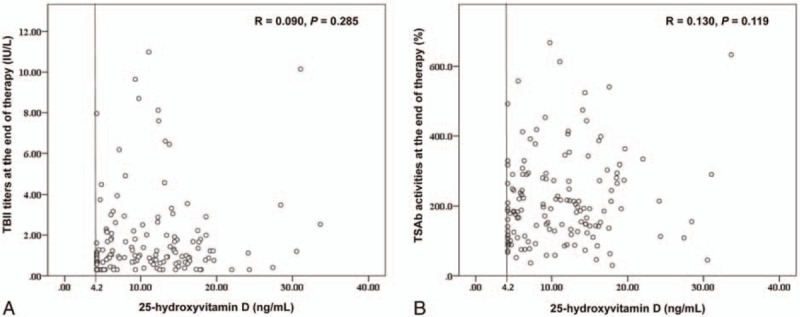
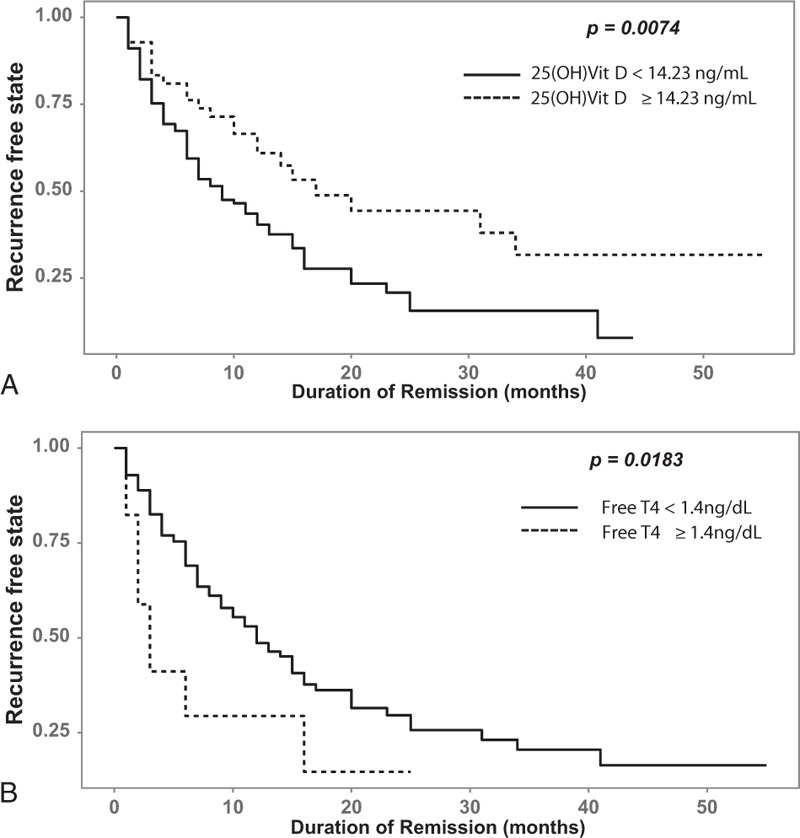
Graves disease is the most common cause of thyrotoxicosis. Although medical intervention with antithyroid drugs (ATDs) is commonly the first choice of treatment in Korea, the remission rate associated with this approach is not satisfactory. During ATD therapy, low or undetectable serum levels of thyroid-stimulating hormone (TSH) receptor antibodies (TRAbs) have been reported to affect the incidence of Graves disease remission. This study evaluated the correlation between serum 25-hydroxyvitamin D levels and TRAb levels, as well as the effect of 25-hydroxyvitamin D on the recurrence of Graves disease.A total of 143 patients, who were diagnosed with Graves disease and treated with ATDs, were retrospectively included in our observational study. These patients were followed for more than 1 year after ATD discontinuation. The levels of serum 25-hydroxyvitamin D and TRAb (ie, thyroid-stimulating antibody [TSAb], as detected by bioassay, and TSH-binding inhibitory immunoglobulins [TBIIs]) were measured, and a thyroid function test was performed upon ATD discontinuation. Recurrence was evaluated every 3 months, and was defined as an occurrence of overt thyrotoxicosis during the follow-up period.A total of 95 patients (66.4%) experienced recurrence with a median latency period of 182 days (ranging 28-1219 days). The serum 25-hydroxyvitamin D levels at the time of ATD discontinuation were not correlated with either TBII or TSAb. In the Cox proportional hazard regression analysis, higher free T4 levels (>1.4 ng/dL; hazard ratio [HR], 3.252; 95% confidence interval [CI], 1.022-10.347) and low levels of 25-hydroxyvitamin D (≤14.23 ng/mL) were associated with a higher probability of Graves disease recurrence (HR, 3.016; 95% CI, 1.163-7.819).Lower serum 25-hydroxyvitamin D levels were associated with a higher incidence of Graves disease recurrence. Therefore, serum 25-hydroxyvitamin D might be an independent risk factor for predicting Graves disease recurrence after ATD discontinuation.
格雷夫斯病是甲状腺毒症最常见的病因。尽管在韩国,使用抗甲状腺药物(ATD)进行药物干预通常是首选治疗方法,但这种方法的缓解率并不理想。在ATD治疗期间,据报道血清甲状腺刺激激素(TSH)受体抗体(TRAb)水平低或检测不到会影响格雷夫斯病缓解的发生率。本研究评估了血清25-羟基维生素D水平与TRAb水平之间的相关性,以及25-羟基维生素D对格雷夫斯病复发的影响。
共有143例被诊断为格雷夫斯病并接受ATD治疗的患者被回顾性纳入我们的观察性研究。这些患者在停用ATD后随访超过1年。测量血清25-羟基维生素D和TRAb(即生物测定法检测的甲状腺刺激抗体[TSAb]和促甲状腺激素结合抑制性免疫球蛋白[TBII])水平,并在停用ATD时进行甲状腺功能测试。每3个月评估一次复发情况,复发定义为随访期间出现明显的甲状腺毒症。
共有95例患者(66.4%)复发,中位潜伏期为182天(范围28 - 1219天)。停用ATD时的血清25-羟基维生素D水平与TBII或TSAb均无相关性。在Cox比例风险回归分析中,较高的游离T4水平(>1.4 ng/dL;风险比[HR],3.252;95%置信区间[CI],1.022 - 10.347)和低水平的25-羟基维生素D(≤14.23 ng/mL)与格雷夫斯病复发的较高概率相关(HR,3.016;95% CI,1.163 - 7.819)。
较低的血清25-羟基维生素D水平与格雷夫斯病复发的较高发生率相关。因此,血清25-羟基维生素D可能是预测停用ATD后格雷夫斯病复发的独立危险因素。