Division of Nursing, Midwifery and Social Work, School of Health Sciences, Faculty of Biology, Medicine and Health, University of Manchester, Manchester, UK.
Manchester Academic Health Sciences Centre, Manchester, UK.
Health Expect. 2018 Feb;21(1):239-248. doi: 10.1111/hex.12608. Epub 2017 Aug 2.
Evidence of the benefits of engaging in physical activity (PA) is strong, yet the number of older adults meeting the recommended 150 min/wk is low. Policy to increase uptake and adherence has focussed on the health benefits of PA, but may not be the most successful approach.
This qualitative study sought to ask older adults what the components of a successful intervention to promote PA would be, by asking active older adults what motivated them to be active and asking inactive older adults what might encourage them to change.
DESIGN, SETTING AND PARTICIPANTS: Focus groups and semi-structured interviews were held with 60 community-dwelling older adults, aged 50-87 years. Framework analysis was used to analyse the data, and themes congruent with a social ecological model of behaviour change were developed.
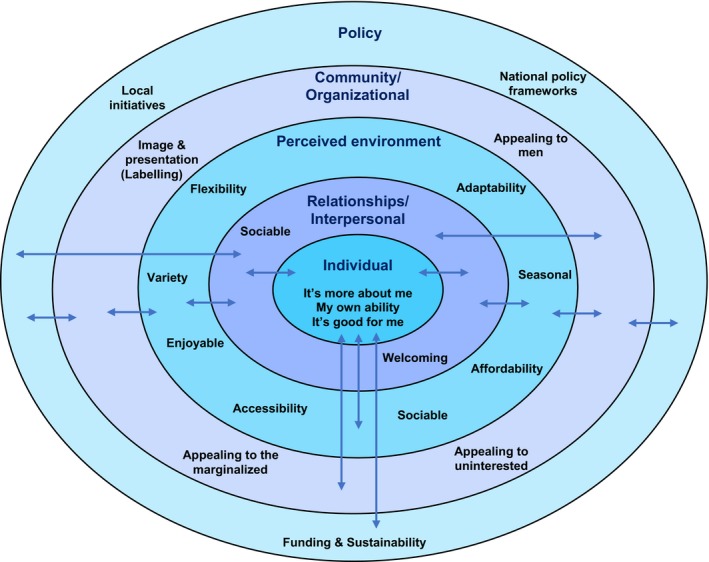
Five themes emerged that influenced PA engagement at multiple levels: individual; interpersonal; perceived environment; community or organizational; and policy. PA engagement was determined by attitude or health status for some participants, but for the majority, PA being enjoyable, sociable, affordable, accessible, flexible and seasonal were more important than the health benefits.
A social ecological model is presented, highlighting the fact that both motivated and unmotivated older adults need to have a range of appropriately labelled, appealing and accessible activities to choose from when thinking about engaging in PA. Policymakers and practitioners need to ensure that their offers of activity sessions are easy to access and easy to remain involved in.
有充分证据表明,进行身体活动(PA)有益健康,但达到建议的每周 150 分钟运动量的老年人数量仍然较少。为了提高参与度和坚持度,相关政策主要关注 PA 的健康益处,但这可能不是最成功的方法。
本定性研究旨在通过询问积极锻炼的老年人是什么促使他们积极锻炼,以及询问不积极锻炼的老年人是什么可能鼓励他们改变,从而了解促进身体活动的成功干预措施的组成部分。
设计、地点和参与者:对 60 名年龄在 50-87 岁之间、居住在社区的老年人进行了焦点小组和半结构化访谈。采用框架分析法对数据进行分析,并开发出与行为变化的社会生态模型一致的主题。
有五个主题出现在多个层面上影响 PA 参与:个体;人际;感知环境;社区或组织;和政策。对于一些参与者来说,PA 的参与是由态度或健康状况决定的,但对于大多数参与者来说,PA 是令人愉快的、社交性的、负担得起的、可及的、灵活的和季节性的,这比健康益处更重要。
提出了一个社会生态模型,强调了这样一个事实,即有动机和没有动机的老年人在考虑参与 PA 时,都需要有一系列合适的、吸引人的和可及的活动可供选择。政策制定者和从业者需要确保他们提供的活动课程易于参与,并且易于继续参与。