Yeo Si-Ning, Zainal Hani, Tang Catherine S, Tong Eddie M, Ho Cyrus S, Ho Roger C
Duke-NUS Medical School, Neuroscience and Behavioral Disorders Program, 8 College Road, Singapore, 169857, Singapore.
Pennsylvania State University, 378 Moore Building, University Park, PA, 16801, USA.
BMC Psychiatry. 2017 Aug 2;17(1):285. doi: 10.1186/s12888-017-1451-7.
There remains a paucity of research on control attribution and depression within Asian populations. This study examines: (1) Success/Failure condition as a moderator between depression and negative affect or shame, and (2) differences in control attribution between patients with depression and healthy controls in Singapore.
Seventy one patients with depression and 71 healthy controls went through a digit-span memory task where they were randomized into either the Success or Failure condition. Participants in the Success condition had to memorize and recall 5-digit strings, while participants in the Failure condition did the same for 12-digit strings. They then completed self-report measures of negative affect, shame, and attribution of control. One-way ANCOVA was performed to examine task condition as a moderator of association between mental health status and post-task negative affect or shame. Test of simple effects was carried out on significant interactions. Sign test and Mann-Whitney U test were employed to investigate differences in attribution of control.
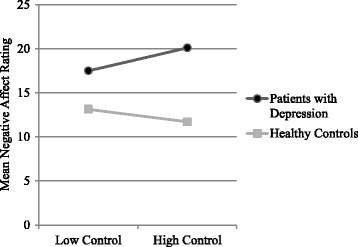
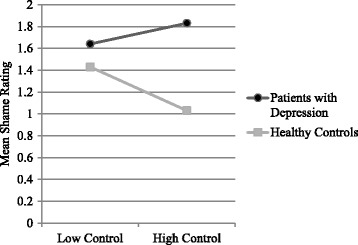
Mental health status and Success/Failure condition had significant effects on reported negative affect and shame. Healthy controls reported less post-task negative affect and shame in the Success than in the Failure condition while patients with depression reported similar levels of post-task negative affect and shame in both conditions. However, these differences were not significant in the test of simple effects. In addition, healthy controls felt a stronger sense of personal control in success than in failure and were more likely to blame external factors in failure than in success. Conversely, patients with depression were more inclined to credit external factors in success than in failure and ascribed greater personal control in failure than in success.
The results suggest that successful conditions may not necessitate the reduction of negative affect in Asians with depression, indicating possible cultural variation in affective states as a result of control attribution and the importance of attending to these variations in designing psychological intervention for Asians. Further studies are required to gather more evidence on control attributions in different contexts and study other cognitive mechanisms related to depression in the Asian population.
针对亚洲人群中控制归因与抑郁的研究仍然匮乏。本研究旨在探讨:(1)成功/失败条件作为抑郁与消极情绪或羞耻感之间的调节变量;(2)新加坡抑郁症患者与健康对照者在控制归因方面的差异。
71名抑郁症患者和71名健康对照者参与了一项数字广度记忆任务,他们被随机分为成功组或失败组。成功组的参与者需要记忆并回忆5位数字字符串,而失败组的参与者则要记忆并回忆12位数字字符串。然后,他们完成了关于消极情绪、羞耻感和控制归因的自我报告测量。采用单因素协方差分析来检验任务条件作为心理健康状况与任务后消极情绪或羞耻感之间关联的调节变量。对显著的交互作用进行简单效应检验。采用符号检验和曼-惠特尼U检验来研究控制归因的差异。
心理健康状况和成功/失败条件对报告的消极情绪和羞耻感有显著影响。健康对照者在成功条件下报告的任务后消极情绪和羞耻感低于失败条件,而抑郁症患者在两种条件下报告的任务后消极情绪和羞耻感水平相似。然而,在简单效应检验中,这些差异并不显著。此外,健康对照者在成功时比失败时感受到更强的个人控制感,并且在失败时比成功时更倾向于将原因归咎于外部因素。相反,抑郁症患者在成功时比失败时更倾向于将原因归功于外部因素,并且在失败时比成功时归因于更大的个人控制感。
结果表明,成功条件未必能减少亚洲抑郁症患者的消极情绪,这表明由于控制归因可能存在情感状态的文化差异,以及在为亚洲人设计心理干预时关注这些差异的重要性。需要进一步的研究来收集更多关于不同背景下控制归因的证据,并研究亚洲人群中与抑郁相关的其他认知机制。