Zimmerman Ofer, Rosen Lindsey B, Swamydas Muthulekha, Ferre Elise M N, Natarajan Mukil, van de Veerdonk Frank, Holland Steven M, Lionakis Michail S
Laboratory of Clinical Infectious Diseases, National Institute of Allergy and Immunology, National Institutes of Health, Bethesda, MD, United States.
Department of Internal Medicine, Radboud University Medical Center, Radboud Institute for Molecular Life Sciences (RILMS), Nijmegen, Netherlands.
Front Immunol. 2017 Jul 14;8:820. doi: 10.3389/fimmu.2017.00820. eCollection 2017.
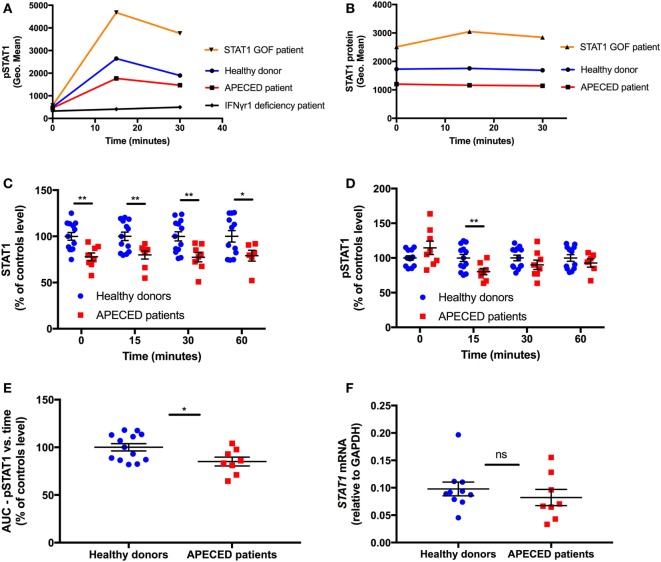
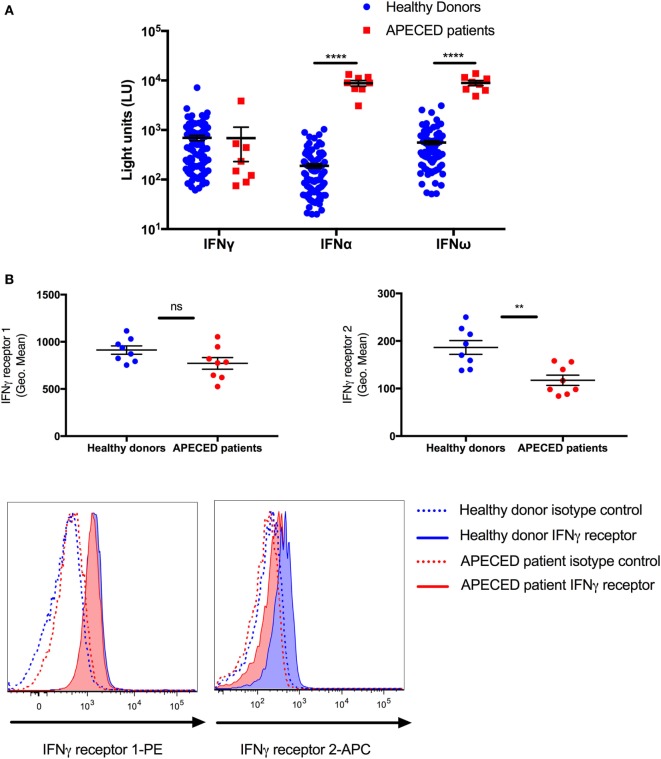
Autoimmune polyendocrinopathy-candidiasis-ectodermal dystrophy (APECED) is a rare primary immunodeficiency disorder typically caused by biallelic autoimmune regulator () mutations that manifests with chronic mucocutaneous candidiasis (CMC) and autoimmunity. Patients with gain-of-function (GOF) mutations also develop CMC and autoimmunity; they exhibit increased STAT1 protein levels at baseline and STAT1 phosphorylation (pSTAT1) upon interferon (IFN)-γ stimulation relative to healthy controls. AIRE interacts functionally with a protein that directly regulates STAT1, namely protein inhibitor of activated STAT1, which inhibits STAT1 activation. Given the common clinical features between patients with and GOF mutations, we sought to determine whether APECED patients also exhibit increased levels of STAT1 protein and phosphorylation in CD14 monocytes. We obtained peripheral blood mononuclear cells from 8 APECED patients and 13 healthy controls and assessed the levels of STAT1 protein and STAT1 tyrosine phosphorylation at rest and following IFN-γ stimulation, as well as the levels of mRNA. The mean STAT1 protein levels in CD14 monocytes exhibited a ~20% significant decrease in APECED patients both at rest and after IFN-γ stimulation relative to that of healthy donors. Similarly, the mean peak value of IFN-γ-induced pSTAT1 level was ~20% significantly lower in APECED patients compared to that in healthy controls. The decrease in STAT1 and peak pSTAT1 in APECED patients was not accompanied by decreased mRNA or anti-IFN-γ autoantibodies; instead, it correlated with the presence of autoantibodies to type I IFN and decreased monocyte surface expression of IFN-γ receptor 2. Our data show that, in contrast to patients with GOF mutations, APECED patients show a moderate but consistent and significant decrease in total STAT1 protein levels, associated with lower peak levels of pSTAT1 molecules after IFN-γ stimulation.
自身免疫性多内分泌腺病-念珠菌病-外胚层营养不良(APECED)是一种罕见的原发性免疫缺陷疾病,通常由双等位基因自身免疫调节因子(AIRE)突变引起,表现为慢性黏膜皮肤念珠菌病(CMC)和自身免疫。具有功能获得性(GOF)突变的患者也会发生CMC和自身免疫;相对于健康对照,他们在基线时STAT1蛋白水平升高,且在干扰素(IFN)-γ刺激后STAT1发生磷酸化(pSTAT1)。AIRE在功能上与一种直接调节STAT1的蛋白相互作用,即活化STAT1蛋白抑制剂,其可抑制STAT1激活。鉴于AIRE和STAT1 GOF突变患者具有共同的临床特征,我们试图确定APECED患者的CD14单核细胞中STAT1蛋白水平和磷酸化水平是否也升高。我们从8例APECED患者和13名健康对照中获取外周血单核细胞,并评估静息状态下以及IFN-γ刺激后STAT1蛋白水平、STAT1酪氨酸磷酸化水平以及AIRE mRNA水平。与健康供体相比,APECED患者CD14单核细胞中的平均STAT1蛋白水平在静息状态下和IFN-γ刺激后均显著降低约20%。同样,与健康对照相比,APECED患者中IFN-γ诱导的pSTAT1水平的平均峰值显著降低约20%。APECED患者中STAT1和pSTAT1峰值的降低并非伴随着AIRE mRNA或抗IFN-γ自身抗体的减少;相反,它与I型干扰素自身抗体的存在以及IFN-γ受体2单核细胞表面表达的降低相关。我们的数据表明,与STAT1 GOF突变患者相反,APECED患者的总STAT1蛋白水平出现中度但一致且显著的降低,这与IFN-γ刺激后pSTAT1分子的较低峰值水平相关。