Hraiech Sami, Forel Jean-Marie, Guervilly Christophe, Rambaud Romain, Lehingue Samuel, Adda Mélanie, Sylla Pierre, Valera Sabine, Carvelli Julien, Gainnier Marc, Papazian Laurent, Bourenne Jérémy
APHM, URMITE UMR CNRS 7278, Hôpital Nord, Réanimation des Détresses Respiratoires et Infections Sévères, Aix-Marseille Univ, Marseille, France.
Réanimation- Détresses Respiratoires et Infections Sévères, CHU Nord, Chemin des Bourrely, 13015, Marseille, France.
Ann Intensive Care. 2017 Dec;7(1):79. doi: 10.1186/s13613-017-0305-2. Epub 2017 Aug 2.
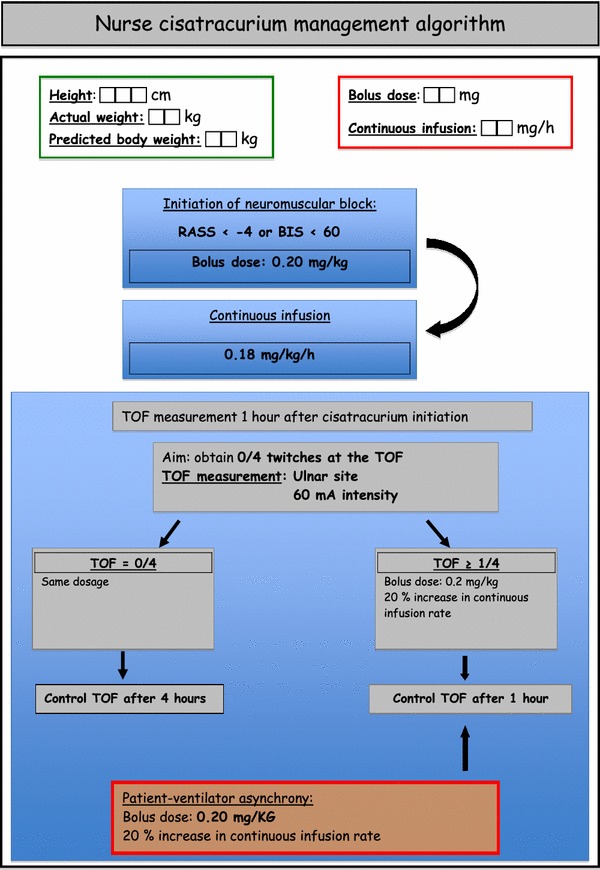
Neuromuscular blocking agents (NMBAs) have been shown to improve the outcome of the most severely hypoxemic, acute respiratory distress syndrome (ARDS) patients. However, the recommended dosage as well as the necessity of monitoring the neuromuscular block is unknown. We aimed to evaluate the efficiency of a nurse-directed protocol of NMBA administration based on a train-of-four (TOF) assessment to ensure a profound neuromuscular block and decrease cisatracurium consumption compared to an elevated and constant dose regimen. A prospective open labeled study was conducted in two medical intensive care units of two French university hospitals. Consecutive ARDS patients with a PaO/FiO ratio less than 120 with a PEEP ≥5 cm HO were included. Cisatracurium administration was driven by the nurses according to an algorithm based on TOF monitoring. The primary endpoint was cisatracurium consumption. The secondary endpoints included the quality of the neuromuscular block, the occurrence of adverse events, and the evolution of ventilatory and blood gas parameters.
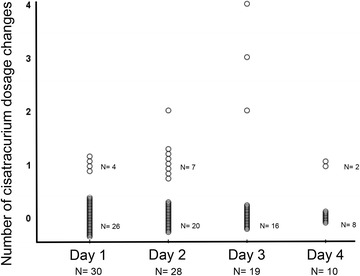
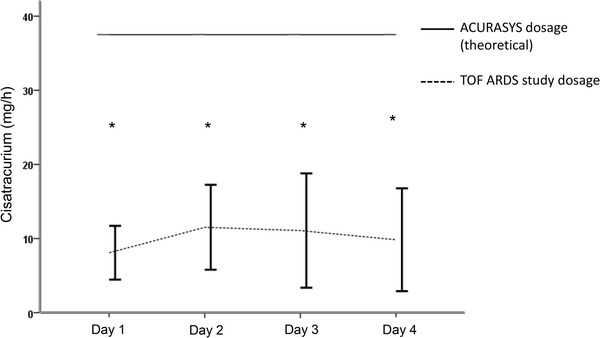
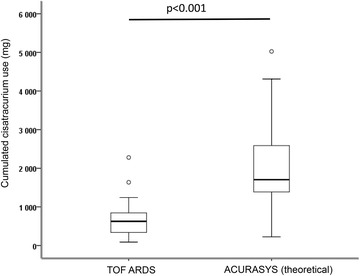
Thirty patients were included. NMBAs were used for 54 ± 30 h. According to this new algorithm, the initial dosage of cisatracurium was 11.8 ± 2 mg/h, and the final dosage was 14 ± 4 mg/h, which was significantly lower than in the ACURASYS study protocol (37.5 mg/h with a constant infusion rate (p < 0.001). The overall cisatracurium dose used was 700 ± 470 mg in comparison with 2040 ± 1119 mg for patients had received the ACURASYS dosage for the same period (p < 0.001). A profound neuromuscular block (TOF = 0, twitches at the ulnar site) was obtained from the first hour in 70% of patients. Modification of the cisatracurium dosage was not performed from the beginning to the end of the study in 60% of patients. Patient-ventilator asynchronies occurred in 4 patients.
A nurse-driven protocol based on TOF monitoring for NMBA administration in ARDS patients was able to decrease cisatracurium consumption without significantly affecting the quality of the neuromuscular block.
神经肌肉阻滞剂(NMBAs)已被证明可改善最严重低氧血症的急性呼吸窘迫综合征(ARDS)患者的预后。然而,推荐剂量以及监测神经肌肉阻滞的必要性尚不清楚。我们旨在评估基于四个成串刺激(TOF)评估的护士指导的NMBA给药方案的有效性,以确保深度神经肌肉阻滞,并与高剂量且恒定的给药方案相比,减少顺式阿曲库铵的用量。在法国两所大学医院的两个医学重症监护病房进行了一项前瞻性开放标签研究。纳入连续的ARDS患者,其动脉血氧分压/吸入氧分数值(PaO₂/FiO₂)小于120且呼气末正压(PEEP)≥5 cmH₂O。顺式阿曲库铵的给药由护士根据基于TOF监测的算法进行。主要终点是顺式阿曲库铵的用量。次要终点包括神经肌肉阻滞的质量、不良事件的发生以及通气和血气参数的变化。
纳入30例患者。NMBAs使用时间为54±30小时。根据这一新算法,顺式阿曲库铵的初始剂量为11.8±2mg/h,最终剂量为14±4mg/h,显著低于ACURASYS研究方案中的剂量(持续输注速率为37.5mg/h,p<0.001)。同期接受ACURASYS剂量的患者顺式阿曲库铵总用量为2040±1119mg,而本研究中患者的总用量为700±470mg(p<0.001)。70%的患者在第1小时即获得了深度神经肌肉阻滞(TOF = 0,尺侧部位无抽搐)。60%的患者在研究开始至结束时未调整顺式阿曲库铵剂量。4例患者出现人机不同步。
基于TOF监测的护士驱动的ARDS患者NMBA给药方案能够减少顺式阿曲库铵的用量,而不会显著影响神经肌肉阻滞的质量。