Yuan Ziming, Pan Lei, Wang Yang, Wang Wei
Department of Critical Care Medicine, Shanghai Jiao Tong University Affiliated Sixth People's Hospital, 600 Yishan Road, Shanghai, 200233, China.
Department of Respiratory Diseases, Shanghai Public Health Clinical Center, 2901 Caolang Road, Shanghai, 201508, China.
Ann Med Surg (Lond). 2022 May 2;77:103718. doi: 10.1016/j.amsu.2022.103718. eCollection 2022 May.
Acute respiratory distress syndrome (ARDS) is still associated with significant mortality, especially the elderly and those with comorbidities are at highest risk of death. Neuromuscular blocking agents (NMBAs) are used in a large but highly variable proportion of patients with ARDS.
We describe the case of one critically ill patient with serious ARDS, because of virus pneumonia. In spite of the reduced tidal volume to 4-6 mL/kg of predicted body weight (PBW) and prone position were applied timely, the irresistible progress of disease leaded to an amazing prolonged application of deep sedation and analgesia, as well as NMBA, for the purpose of lung-protective mechanical ventilation.
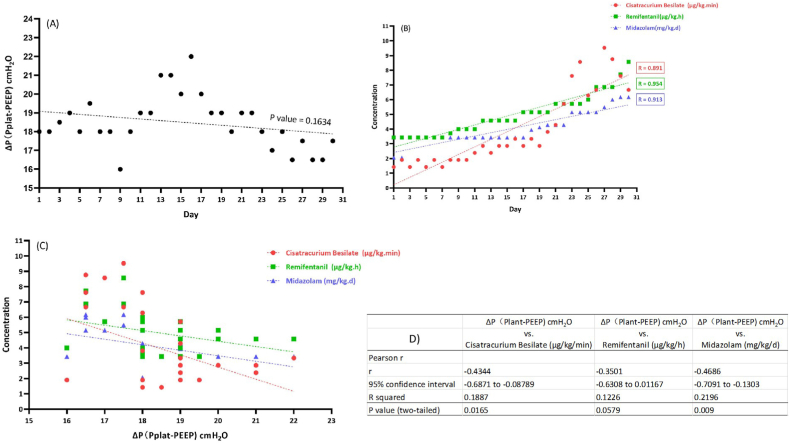
The clinical and biochemical parameters guided us toward the recognition that cisatracurium, bolus of 0.1 mg/kg followed by a median infusion rate of 1.91 (1.43-9.52) μg/kg.min, combined with continuous infusion of midazolam 3.43 (2.06-6.17) mg/kg.d and remifentanil 3.79 (3.43-8.57) μg/kg.h is efficacious and suitable for continuous muscle paralysis.
The intensive care unit (ICU)-acquired weakness (ICU-AW) was inevitable. Besides, an increased demand on drug concentration with the extension of medication time was observed as well.
急性呼吸窘迫综合征(ARDS)的死亡率仍然很高,尤其是老年人和患有合并症的患者死亡风险最高。神经肌肉阻滞剂(NMBAs)在很大比例但差异很大的ARDS患者中使用。
我们描述了一例因病毒性肺炎导致严重ARDS的重症患者。尽管潮气量降至预测体重(PBW)的4-6 mL/kg并及时采用俯卧位,但疾病的不可阻挡进展导致为了肺保护性机械通气而令人惊讶地长时间应用深度镇静、镇痛以及NMBA。
临床和生化参数引导我们认识到,顺式阿曲库铵,静脉推注0.1 mg/kg,随后中位输注速率为1.91(1.43-9.52)μg/kg·min,联合持续输注咪达唑仑3.43(2.06-6.17)mg/kg·d和瑞芬太尼3.79(3.43-8.57)μg/kg·h,对于持续肌肉麻痹是有效且合适的。
重症监护病房(ICU)获得性肌无力(ICU-AW)是不可避免的。此外,还观察到随着用药时间延长对药物浓度的需求增加。