
既往黄病毒免疫对恒河猴寨卡病毒感染的影响。
Impact of prior flavivirus immunity on Zika virus infection in rhesus macaques.
作者信息
McCracken Michael K, Gromowski Gregory D, Friberg Heather L, Lin Xiaoxu, Abbink Peter, De La Barrera Rafael, Eckles Kenneth H, Garver Lindsey S, Boyd Michael, Jetton David, Barouch Dan H, Wise Matthew C, Lewis Bridget S, Currier Jeffrey R, Modjarrad Kayvon, Milazzo Mark, Liu Michelle, Mullins Anna B, Putnak J Robert, Michael Nelson L, Jarman Richard G, Thomas Stephen J
机构信息
Viral Diseases Branch, Walter Reed Army Institute of Research, Silver Spring, Maryland, United States of America.
Center for Virology and Vaccine Research, Beth Israel Deaconess Medical Center, Harvard Medical School, Boston, Massachusetts, United States of America.
出版信息
PLoS Pathog. 2017 Aug 3;13(8):e1006487. doi: 10.1371/journal.ppat.1006487. eCollection 2017 Aug.
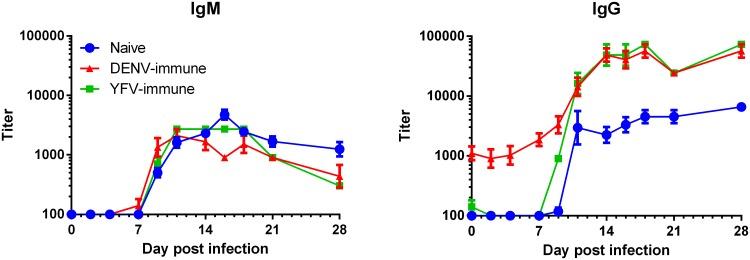
Studies have demonstrated cross-reactivity of anti-dengue virus (DENV) antibodies in human sera against Zika virus (ZIKV), promoting increased ZIKV infection in vitro. However, the correlation between in vitro and in vivo findings is not well characterized. Thus, we evaluated the impact of heterotypic flavivirus immunity on ZIKV titers in biofluids of rhesus macaques. Animals previously infected (≥420 days) with DENV2, DENV4, or yellow fever virus were compared to flavivirus-naïve animals following infection with a Brazilian ZIKV strain. Sera from DENV-immune macaques demonstrated cross-reactivity with ZIKV by antibody-binding and neutralization assays prior to ZIKV infection, and promoted increased ZIKV infection in cell culture assays. Despite these findings, no significant differences between flavivirus-naïve and immune animals were observed in viral titers, neutralizing antibody levels, or immune cell kinetics following ZIKV infection. These results indicate that prior infection with heterologous flaviviruses neither conferred protection nor increased observed ZIKV titers in this non-human primate ZIKV infection model.
研究已证明人血清中抗登革病毒(DENV)抗体与寨卡病毒(ZIKV)存在交叉反应,在体外可促进ZIKV感染增加。然而,体外和体内研究结果之间的相关性尚未得到充分表征。因此,我们评估了异型黄病毒免疫对恒河猴生物体液中ZIKV滴度的影响。将先前感染(≥420天)DENV2、DENV4或黄热病毒的动物与感染巴西ZIKV毒株后的未感染黄病毒的动物进行比较。在ZIKV感染前,通过抗体结合和中和试验,DENV免疫猕猴的血清显示出与ZIKV的交叉反应,并在细胞培养试验中促进了ZIKV感染增加。尽管有这些发现,但在ZIKV感染后,未感染黄病毒和免疫动物在病毒滴度、中和抗体水平或免疫细胞动力学方面未观察到显著差异。这些结果表明,在这个非人灵长类ZIKV感染模型中,先前感染异源黄病毒既没有提供保护,也没有增加观察到的ZIKV滴度。



 Zotero 插件