University of Waterloo, Department of Applied Mathematics, Waterloo, N2L 3G1, Canada.
University of Guelph, School of Environmental Sciences, Guelph, N1G 2W1, Canada.
Sci Rep. 2017 Aug 3;7(1):7177. doi: 10.1038/s41598-017-07202-y.
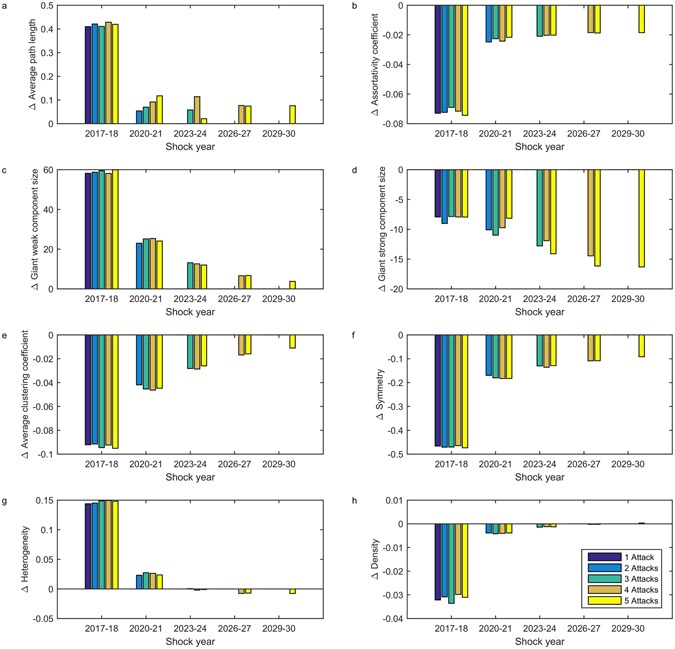
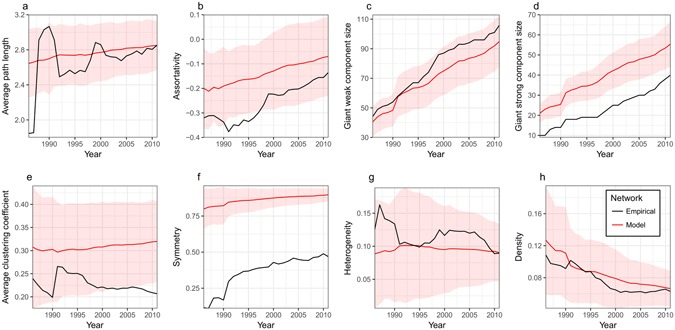
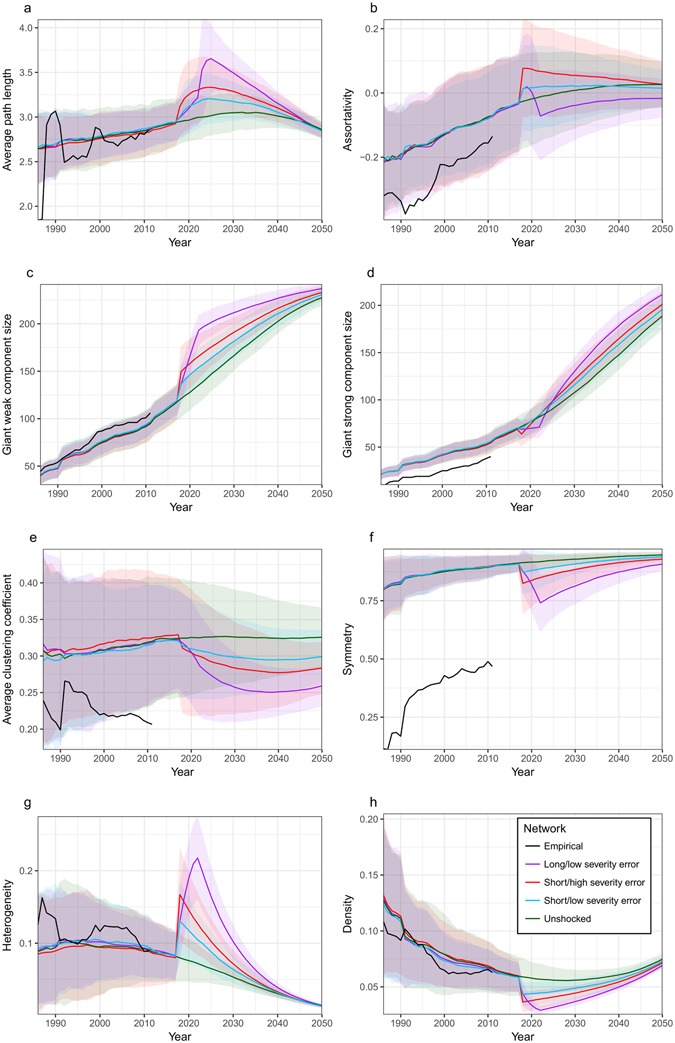
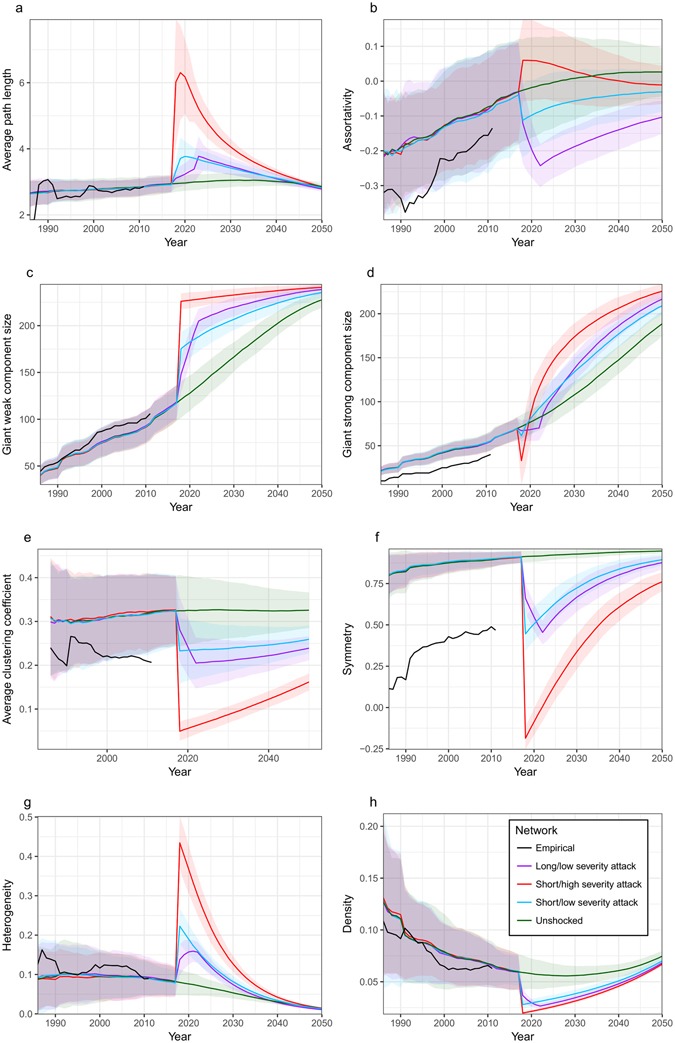
Agri-food trade networks are increasingly vital to human well-being in a globalising world. Models can help us gain insights into trade network dynamics and predict how they might respond to future disturbances such as extreme weather events. Here we develop a preferential attachment (PA) network model of the global wheat trade network. We find that the PA model can replicate the time evolution of crucial wheat trade network metrics from 1986 to 2011. We use the calibrated PA model to predict the response of wheat trade network metrics to shocks of differing length and severity, including both attacks (outward edge removal on high degree nodes) and errors (outward edge removal on randomly selected nodes). We predict that the network will become less vulnerable to attacks but will continue to exhibit low resilience until 2050. Even short-term shocks strongly increase link diversity and cause long-term structural changes that influence the network's response to subsequent shocks. Attacks have a greater impact than errors. However, with repeated attacks, each attack has a lesser impact than the previous attack. We conclude that dynamic models of multi-annual, commodity-specific networks should be further developed to gain insight into possible futures of global agri-food trade networks.
在全球化的世界中,农业食品贸易网络对人类福祉越来越重要。模型可以帮助我们深入了解贸易网络的动态,并预测它们如何应对未来的干扰,如极端天气事件。在这里,我们开发了一个全球小麦贸易网络的优先连接(PA)网络模型。我们发现,PA 模型可以复制 1986 年至 2011 年期间关键小麦贸易网络指标的时间演变。我们使用校准的 PA 模型来预测小麦贸易网络指标对不同长度和严重程度的冲击的反应,包括攻击(高节点的外向边删除)和错误(随机选择节点的外向边删除)。我们预测,该网络将变得不那么容易受到攻击,但将继续表现出低弹性,直到 2050 年。即使是短期冲击也会强烈增加链路多样性,并导致长期的结构变化,从而影响网络对后续冲击的反应。攻击比错误的影响更大。然而,随着多次攻击,每次攻击的影响都比前一次攻击小。我们得出结论,应该进一步开发多年、特定商品的动态网络模型,以深入了解全球农业食品贸易网络的未来可能。