Son Chang Nam, Bang So Young, Kim Sang Hyon, Sung Yoon Kyoung, Bae Sang Cheol, Jun Jae Bum
Division of Rheumatology, Department of Internal Medicine, School of Medicine and Institute for Medical Science, Keimyung University, Daegu, Korea.
Department of Rheumatology, Hanyang University Hospital for Rheumatic Diseases, Seoul, Korea.
J Korean Med Sci. 2017 Sep;32(9):1451-1459. doi: 10.3346/jkms.2017.32.9.1451.
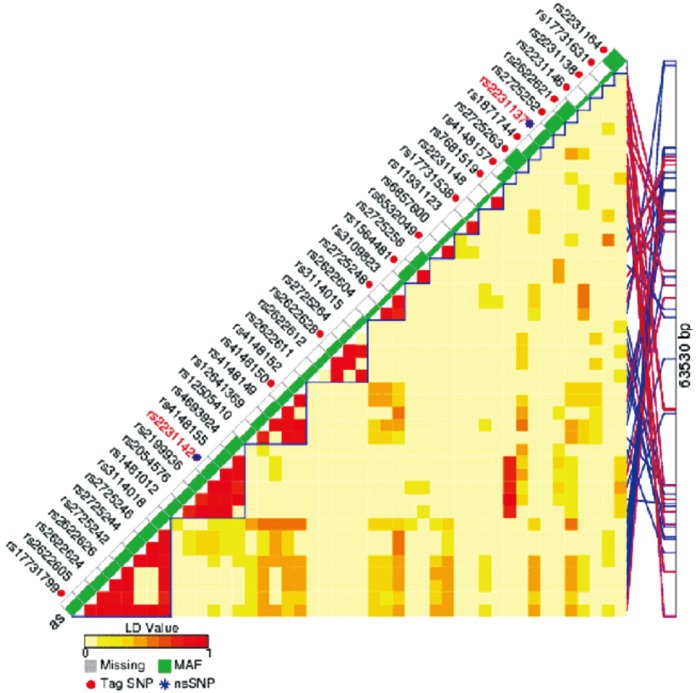
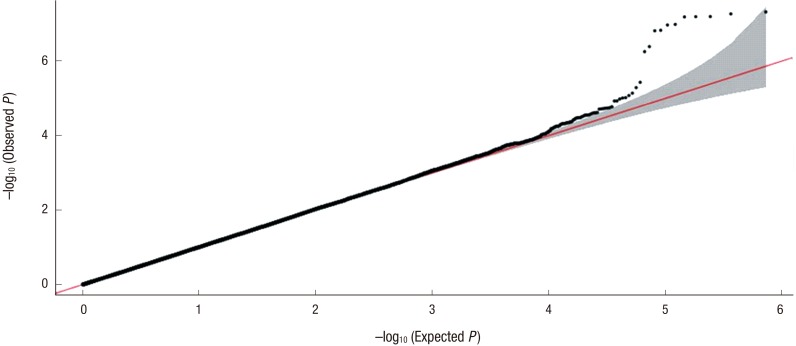
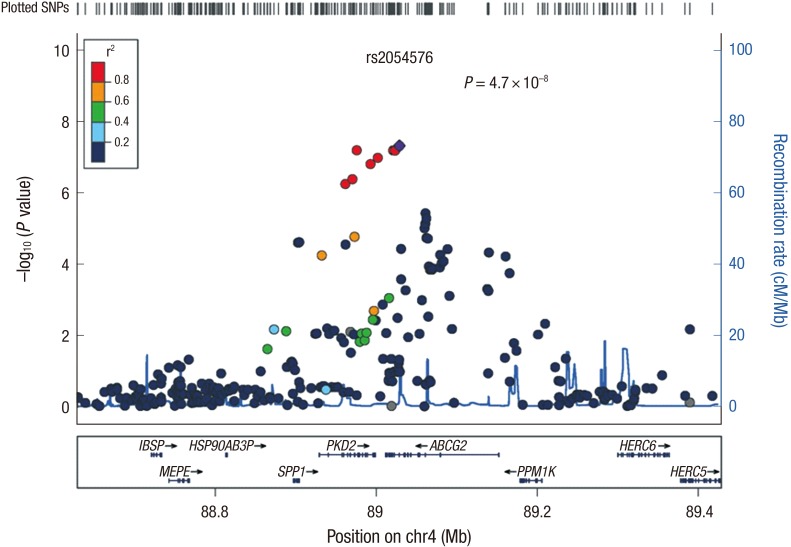
The purpose of the present study was to find novel loci associated with hyperuricemia using data from a genome-wide association study (GWAS) conducted on healthy Koreans. We conducted a GWAS using data from a community-based cohort study where 3,647 subjects aged 40-89 were recruited by the Korea National Institute of Health (KNIH). The community-based cohort consisted of subjects who did not suffer from any of 6 major diseases (hypertension, hyperlipidemia, diabetes, heart diseases, brain diseases, and cancers). Epidemiologic information includes 249 traits such as epidemiological surveys, physical examinations, and laboratory tests. A total of 3,647 participants, including 234 hyperuricemia cases (serum uric acid [SUA] level was 7 mg/dL or higher) and 3,413 controls, were genotyped by Illumina HumanOmni1-Quad BeadChip GWAS array at KNIH. In the multivariate regression analysis of clinical variables, significant variables associated with hyperuricemia were male gender (odds ratio [OR], 5.526; P = 3.2 × 10⁻¹⁰), old age (OR, 1.017; P = 0.040), high body mass index (BMI) (OR, 1.147; P = 5.4 × 10⁻⁷), current alcohol intake (OR, 2.413; P = 4.7 × 10⁻⁷), and high creatinine (OR, 1.647; P = 1.6 × 10⁻¹³). We identified a hyperuricemia susceptible loci (rs2054576 in ABCG2, OR, 1.883; P = 4.7 × 10⁻⁸) that passed a genome-wide significance threshold, adjusted by clinical variables (male, age, BMI, current alcohol, and creatinine). It was first identified that rs2054576 in ABCG2 is associated with hyperuricemia. Our results should be validated through replication studies among other Korean subjects or various ethnic groups.
本研究的目的是利用对健康韩国人进行的全基因组关联研究(GWAS)数据,寻找与高尿酸血症相关的新基因座。我们使用了一项基于社区的队列研究数据进行GWAS,韩国国立卫生研究院(KNIH)招募了3647名年龄在40 - 89岁的受试者。该基于社区的队列由未患6种主要疾病(高血压、高脂血症、糖尿病、心脏病、脑部疾病和癌症)中的任何一种的受试者组成。流行病学信息包括249种特征,如流行病学调查、体格检查和实验室检查。共有3647名参与者,包括234例高尿酸血症病例(血清尿酸[SUA]水平为7mg/dL或更高)和3413名对照,在KNIH通过Illumina HumanOmni1 - Quad BeadChip GWAS阵列进行基因分型。在临床变量的多变量回归分析中,与高尿酸血症相关的显著变量为男性(优势比[OR],5.526;P = 3.2×10⁻¹⁰)、老年(OR,1.017;P = 0.040)、高体重指数(BMI)(OR,1.147;P = 5.4×10⁻⁷)、当前饮酒情况(OR,2.413;P = 4.7×10⁻⁷)和高肌酐水平(OR,1.647;P = 1.6×10⁻¹³)。我们确定了一个通过临床变量(男性、年龄、BMI、当前饮酒情况和肌酐水平)调整后达到全基因组显著性阈值的高尿酸血症易感基因座(ABCG2中的rs2054576,OR,1.883;P = 4.7×10⁻⁸)。首次发现ABCG2中的rs2054576与高尿酸血症相关。我们的结果应通过在其他韩国受试者或不同种族群体中的重复研究进行验证。