McIntyre Cecily, Harris Meredith G, Baxter Amanda J, Leske Stuart, Diminic Sandra, Gone Joseph P, Hunter Ernest, Whiteford Harvey
School of Public Health, The University of Queensland, Herston, Queensland, Australia.
Yale University, New Haven, CT, United States of America.
Health Res Policy Syst. 2017 Aug 4;15(1):67. doi: 10.1186/s12961-017-0233-5.
Indigenous people in Australia, Canada, New Zealand and the United States of America experience disproportionately poor mental health compared to their non-Indigenous counterparts. To optimally allocate resources, health planners require information about the services Indigenous people use for mental health, their unmet treatment needs and the barriers to care. We reviewed population surveys of Indigenous people to determine whether the information needed to guide service development is being collected.
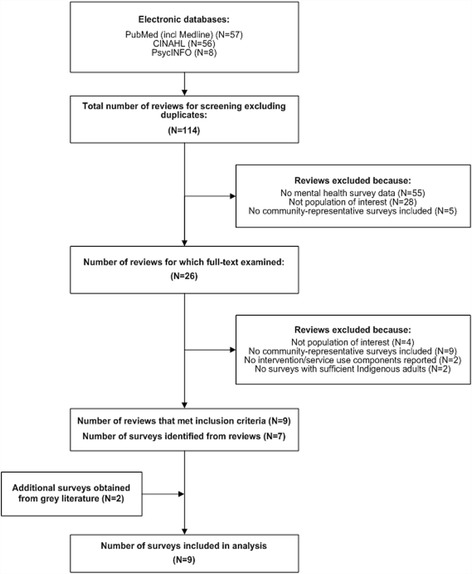
We sought national- or state-level epidemiological surveys of Indigenous populations conducted in each of the four selected countries since 1990 that asked about service use for mental health. Surveys were identified from literature reviews and web searches. We developed a framework for categorising the content of each survey. Using this framework, we compared the service use content of the surveys of Indigenous people to each other and to general population mental health surveys. We focused on identifying gaps in information coverage and topics that may require Indigenous-specific questions or response options.
Nine surveys met our inclusion criteria. More than half of these included questions about health professionals consulted, barriers to care, perceived need for care, medications taken, number, duration, location and payment of health professional visits or use of support services or self-management. Less than half included questions about interventions received, hospital admissions or treatment dropout. Indigenous-specific content was most common in questions regarding use of support services or self-management, types of health professionals consulted, barriers to care and interventions received.
Epidemiological surveys measuring service use for mental health among Indigenous populations have been less comprehensive and less standardised than surveys of the general population, despite having assessed similar content. To better understand the gaps in mental health service systems for Indigenous people, systematically-collected subjective and objective indicators of the quality of care being delivered are needed.
与非原住民相比,澳大利亚、加拿大、新西兰和美利坚合众国的原住民心理健康状况差得不成比例。为了优化资源分配,卫生规划者需要了解原住民用于心理健康的服务信息、他们未满足的治疗需求以及护理障碍。我们回顾了原住民的人口调查,以确定是否正在收集指导服务发展所需的信息。
我们查找了自1990年以来在四个选定国家中每个国家进行的关于心理健康服务使用情况的国家级或州级原住民流行病学调查。通过文献综述和网络搜索确定调查。我们制定了一个框架来对每项调查的内容进行分类。使用这个框架,我们将原住民调查的服务使用内容相互比较,并与一般人群心理健康调查进行比较。我们专注于找出信息覆盖方面的差距以及可能需要特定于原住民的问题或回答选项的主题。
九项调查符合我们的纳入标准。其中一半以上的调查包括关于咨询过的卫生专业人员、护理障碍、感知到的护理需求、服用的药物、卫生专业人员就诊的次数、持续时间、地点和费用,或支持服务的使用或自我管理的问题。不到一半的调查包括关于接受的干预措施、住院情况或治疗退出的问题。特定于原住民的内容在关于支持服务或自我管理的使用、咨询的卫生专业人员类型、护理障碍和接受的干预措施的问题中最为常见。
尽管评估的内容相似,但衡量原住民心理健康服务使用情况的流行病学调查比一般人群调查的全面性和标准化程度更低。为了更好地了解原住民心理健康服务系统中的差距,需要系统收集所提供护理质量的主观和客观指标。