• 文献检索
  • 文档翻译
  • 深度研究
  • 学术资讯
  • Suppr Zotero 插件Zotero 插件
  • 邀请有礼
  • 套餐&价格
  • 历史记录
应用&插件
Suppr Zotero 插件Zotero 插件浏览器插件Mac 客户端Windows 客户端微信小程序
定价
高级版会员购买积分包购买API积分包
服务
文献检索文档翻译深度研究API 文档MCP 服务
关于我们
关于 Suppr公司介绍联系我们用户协议隐私条款
关注我们

Suppr 超能文献

核心技术专利:CN118964589B侵权必究
粤ICP备2023148730 号-1Suppr @ 2026

文献检索

告别复杂PubMed语法,用中文像聊天一样搜索,搜遍4000万医学文献。AI智能推荐,让科研检索更轻松。

立即免费搜索

文件翻译

保留排版,准确专业,支持PDF/Word/PPT等文件格式,支持 12+语言互译。

免费翻译文档

深度研究

AI帮你快速写综述,25分钟生成高质量综述,智能提取关键信息,辅助科研写作。

立即免费体验

用于提高串联效率的纳米级背接触钙钛矿太阳能电池设计。

Nanoscale Back Contact Perovskite Solar Cell Design for Improved Tandem Efficiency.

机构信息

Center for Nanophotonics, AMOLF , Science Park 104, 1098 XG Amsterdam, The Netherlands.

出版信息

Nano Lett. 2017 Sep 13;17(9):5206-5212. doi: 10.1021/acs.nanolett.7b01092. Epub 2017 Aug 16.

DOI:10.1021/acs.nanolett.7b01092
PMID:28782965
原文链接:https://pmc.ncbi.nlm.nih.gov/articles/PMC5599876/
Abstract

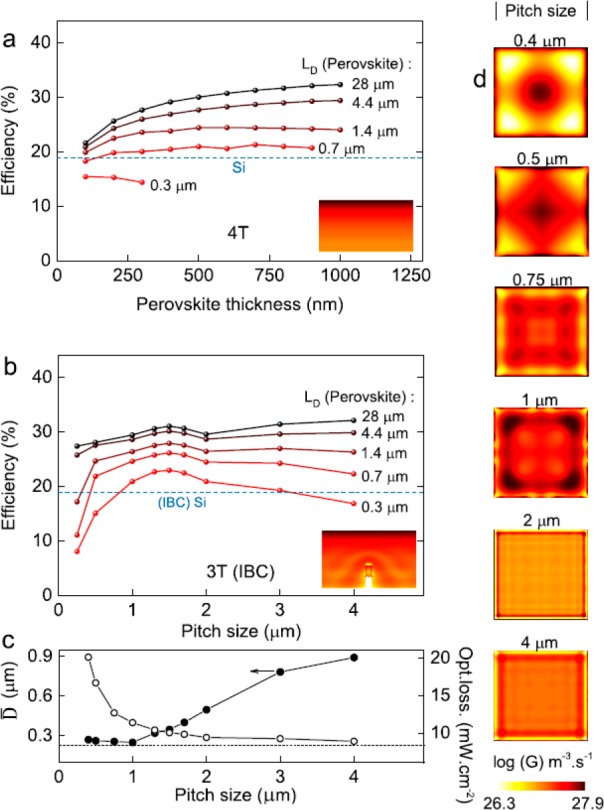
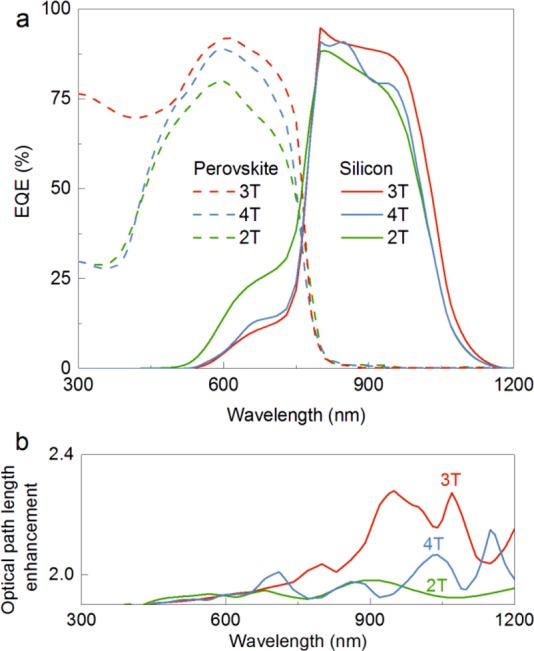
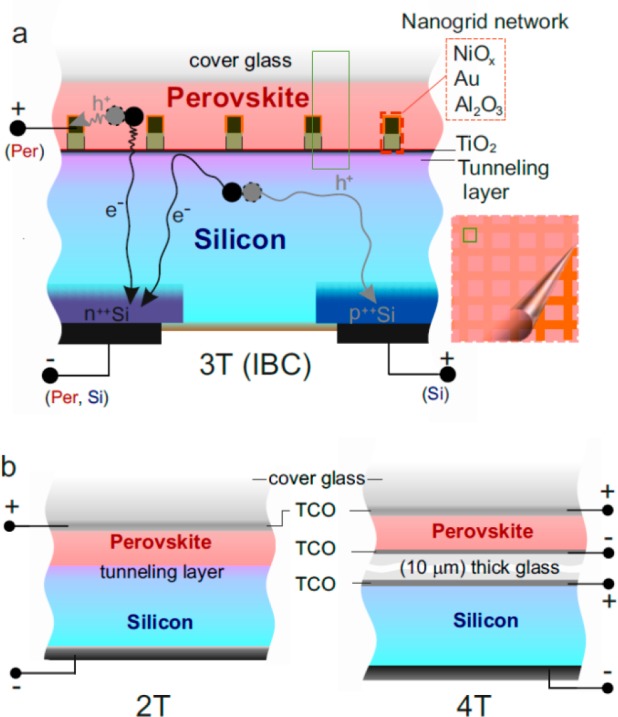
Tandem photovoltaics, combining absorber layers with two distinct band gap energies into a single device, provide a practical solution to reduce thermalization losses in solar energy conversion. Traditionally, tandem devices have been assembled using two-terminal (2-T) or four-terminal (4-T) configurations; the 2-T limits the tandem performance due to the series connection requiring current matching, while the standard 4-T configuration requires at least three transparent electrical contacts, which reduce the total collected power due to unavoidable parasitic absorption. Here, we introduce a novel architecture based on a nanoscale back-contact for a thin-film top cell in a three terminal (3-T) configuration. Using coupled optical-electrical modeling, we optimize this architecture for a planar perovskite-silicon tandem, highlighting the roles of nanoscale contacts to reduce the required perovskite electronic quality. For example, with an 18% planar silicon base cell, the 3-T back contact design can reach a 32.9% tandem efficiency with a 10 μm diffusion length perovskite material. Using the same perovskite quality, the 4-T and 2-T configurations only reach 30.2% and 24.8%, respectively. We also confirm that the same 3-T efficiency advantage applies when using 25% efficient textured silicon base cells, where the tandems reach 35.2% and 32.8% efficiency for the 3-T, and 4-T configurations, respectively. Furthermore, because our design is based on the individual subcells being back-contacted, further improvements can be readily made by optimizing the front surface, which is left free for additional antireflective coating, light trapping, surface passivation, and photoluminescence outcoupling enhancements.

摘要

串联光伏,将具有两个不同带隙能量的吸收层组合到单个器件中,为减少太阳能转换中的热化损失提供了一种实用的解决方案。传统上,串联器件采用二端(2-T)或四端(4-T)配置进行组装;由于串联需要电流匹配,2-T 限制了串联性能,而标准的 4-T 配置至少需要三个透明电接触,由于不可避免的寄生吸收,这会降低总收集功率。在这里,我们引入了一种基于纳米级背接触的新型架构,用于三端(3-T)配置的薄膜顶电池。使用耦合光电建模,我们针对平面钙钛矿-硅串联结构对该架构进行了优化,强调了纳米级接触在降低所需钙钛矿电子质量方面的作用。例如,对于 18%的平面硅基电池,3-T 背接触设计可以使用 10 μm 扩散长度的钙钛矿材料达到 32.9%的串联效率。使用相同的钙钛矿质量,4-T 和 2-T 配置分别只能达到 30.2%和 24.8%。我们还证实,当使用 25%效率的织构化硅基电池时,相同的 3-T 效率优势也适用,其中 3-T 和 4-T 配置的串联效率分别达到 35.2%和 32.8%。此外,由于我们的设计基于各个子电池的背接触,因此可以通过优化前表面轻松实现进一步改进,前表面可自由用于额外的抗反射涂层、光捕获、表面钝化和光致发光外耦合增强。
https://cdn.ncbi.nlm.nih.gov/pmc/blobs/ef4d/5599876/c2d04d936f85/nl-2017-010927_0005.jpg
https://cdn.ncbi.nlm.nih.gov/pmc/blobs/ef4d/5599876/03d5d6849062/nl-2017-010927_0001.jpg
https://cdn.ncbi.nlm.nih.gov/pmc/blobs/ef4d/5599876/a46d9d853f83/nl-2017-010927_0002.jpg
https://cdn.ncbi.nlm.nih.gov/pmc/blobs/ef4d/5599876/39d7ae513f1e/nl-2017-010927_0003.jpg
https://cdn.ncbi.nlm.nih.gov/pmc/blobs/ef4d/5599876/f593d110b878/nl-2017-010927_0004.jpg
https://cdn.ncbi.nlm.nih.gov/pmc/blobs/ef4d/5599876/c2d04d936f85/nl-2017-010927_0005.jpg
https://cdn.ncbi.nlm.nih.gov/pmc/blobs/ef4d/5599876/03d5d6849062/nl-2017-010927_0001.jpg
https://cdn.ncbi.nlm.nih.gov/pmc/blobs/ef4d/5599876/a46d9d853f83/nl-2017-010927_0002.jpg
https://cdn.ncbi.nlm.nih.gov/pmc/blobs/ef4d/5599876/39d7ae513f1e/nl-2017-010927_0003.jpg
https://cdn.ncbi.nlm.nih.gov/pmc/blobs/ef4d/5599876/f593d110b878/nl-2017-010927_0004.jpg
https://cdn.ncbi.nlm.nih.gov/pmc/blobs/ef4d/5599876/c2d04d936f85/nl-2017-010927_0005.jpg

相似文献

1
Nanoscale Back Contact Perovskite Solar Cell Design for Improved Tandem Efficiency.用于提高串联效率的纳米级背接触钙钛矿太阳能电池设计。
Nano Lett. 2017 Sep 13;17(9):5206-5212. doi: 10.1021/acs.nanolett.7b01092. Epub 2017 Aug 16.
2
Light Management Enhancement for Four-Terminal Perovskite-Silicon Tandem Solar Cells: The Impact of the Optical Properties and Thickness of the Spacer Layer between Sub-Cells.四端钙钛矿-硅串联太阳能电池的光管理增强:子电池间间隔层光学性质和厚度的影响
Materials (Basel). 2018 Dec 17;11(12):2570. doi: 10.3390/ma11122570.
3
Perovskite Solar Cells with Large-Area CVD-Graphene for Tandem Solar Cells.用于串联太阳能电池的大面积化学气相沉积石墨烯钙钛矿太阳能电池
J Phys Chem Lett. 2015 Jul 16;6(14):2745-50. doi: 10.1021/acs.jpclett.5b01177. Epub 2015 Jun 29.
4
Comprehensive device simulation of 23.36% efficient two-terminal perovskite-PbS CQD tandem solar cell for low-cost applications.用于低成本应用的 23.36% 高效双端钙钛矿 - 硫化铅量子点串联太阳能电池的综合器件模拟
Sci Rep. 2021 Oct 6;11(1):19829. doi: 10.1038/s41598-021-99098-y.
5
Design and optimization of four-terminal mechanically stacked and optically coupled silicon/perovskite tandem solar cells with over 28% efficiency.效率超过28%的四端机械堆叠和光学耦合硅/钙钛矿串联太阳能电池的设计与优化
Heliyon. 2023 Feb 3;9(2):e13477. doi: 10.1016/j.heliyon.2023.e13477. eCollection 2023 Feb.
6
Nano-optical designs for high-efficiency monolithic perovskite-silicon tandem solar cells.用于高效单片钙钛矿-硅串联太阳能电池的纳米光学设计。
Nat Nanotechnol. 2022 Nov;17(11):1214-1221. doi: 10.1038/s41565-022-01228-8. Epub 2022 Oct 24.
7
Optical and Electronic Losses Arising from Physically Mixed Interfacial Layers in Perovskite Solar Cells.钙钛矿太阳能电池中物理混合界面层引起的光学和电子损耗
ACS Appl Mater Interfaces. 2021 Feb 3;13(4):4923-4934. doi: 10.1021/acsami.0c16364. Epub 2021 Jan 20.
8
Enhanced optoelectronic coupling for perovskite/silicon tandem solar cells.钙钛矿/硅串联太阳能电池的光电耦合增强。
Nature. 2023 Nov;623(7988):732-738. doi: 10.1038/s41586-023-06667-4. Epub 2023 Sep 28.
9
Comparing optical performance of a wide range of perovskite/silicon tandem architectures under real-world conditions.在实际条件下比较多种钙钛矿/硅串联结构的光学性能。
Nanophotonics. 2021 Mar 17;10(8):2043-2057. doi: 10.1515/nanoph-2020-0643. eCollection 2020 Jun.
10
Optical optimization of double-side-textured monolithic perovskite-silicon tandem solar cells for improved light management.用于改善光管理的双面纹理化单片钙钛矿-硅串联太阳能电池的光学优化
RSC Adv. 2020 Jul 16;10(45):26631-26638. doi: 10.1039/d0ra04634e. eCollection 2020 Jul 15.

引用本文的文献

1
Perovskite/silicon tandem solar cells with bilayer interface passivation.钙钛矿/硅串联太阳能电池具有双层界面钝化。
Nature. 2024 Nov;635(8039):596-603. doi: 10.1038/s41586-024-07997-7. Epub 2024 Sep 5.
2
A Taxonomy for Three-Terminal Tandem Solar Cells.三端串联太阳能电池的分类法。
ACS Energy Lett. 2020 Mar 23;5(4):1233-1242. doi: 10.1021/acsenergylett.0c00068. eCollection 2020 Apr 10.
3
Stability of perovskite solar cells: issues and prospects.钙钛矿太阳能电池的稳定性:问题与前景

本文引用的文献

1
Boosting Solar Cell Photovoltage via Nanophotonic Engineering.通过纳米光子学工程提高太阳能电池光电势。
Nano Lett. 2016 Oct 12;16(10):6467-6471. doi: 10.1021/acs.nanolett.6b02971. Epub 2016 Sep 12.
2
Opportunities and Limitations for Nanophotonic Structures To Exceed the Shockley-Queisser Limit.纳米光子结构超越肖克利-奎瑟极限的机会与限制。
ACS Nano. 2016 Sep 27;10(9):8620-31. doi: 10.1021/acsnano.6b03950. Epub 2016 Sep 9.
3
A vacuum flash-assisted solution process for high-efficiency large-area perovskite solar cells.真空闪蒸辅助溶液法制备高效大面积钙钛矿太阳能电池。
RSC Adv. 2023 Jan 9;13(3):1787-1810. doi: 10.1039/d2ra05903g. eCollection 2023 Jan 6.
4
A performance comparison between GaInP-on-Si and GaAs-on-Si 3-terminal tandem solar cells.硅基上铟镓磷和硅基上砷化镓三端串联太阳能电池的性能比较。
iScience. 2022 Aug 19;25(9):104950. doi: 10.1016/j.isci.2022.104950. eCollection 2022 Sep 16.
5
Photonics for Photovoltaics: Advances and Opportunities.用于光伏的光子学:进展与机遇
ACS Photonics. 2021 Jan 20;8(1):61-70. doi: 10.1021/acsphotonics.0c01045. Epub 2020 Sep 12.
6
Modeling the Performance Limitations and Prospects of Perovskite/Si Tandem Solar Cells under Realistic Operating Conditions.模拟实际工作条件下钙钛矿/硅串联太阳能电池的性能限制与前景
ACS Energy Lett. 2017 Sep 8;2(9):2089-2095. doi: 10.1021/acsenergylett.7b00596. Epub 2017 Aug 22.
Science. 2016 Jul 1;353(6294):58-62. doi: 10.1126/science.aaf8060. Epub 2016 Jun 9.
4
Photovoltaic materials: Present efficiencies and future challenges.光伏材料:当前效率与未来挑战。
Science. 2016 Apr 15;352(6283):aad4424. doi: 10.1126/science.aad4424.
5
A mixed-cation lead mixed-halide perovskite absorber for tandem solar cells.用于串联太阳能电池的混合阳离子铅混合卤化物钙钛矿吸收剂。
Science. 2016 Jan 8;351(6269):151-5. doi: 10.1126/science.aad5845.
6
Efficient Monolithic Perovskite/Silicon Tandem Solar Cell with Cell Area >1 cm(2).高效单片钙钛矿/硅串联太阳能电池,电池面积>1平方厘米。
J Phys Chem Lett. 2016 Jan 7;7(1):161-6. doi: 10.1021/acs.jpclett.5b02686. Epub 2015 Dec 24.
7
Solution-Grown Silver Nanowire Ordered Arrays as Transparent Electrodes.溶液生长法制备的银纳米线有序阵列作为透明电极。
Adv Mater. 2016 Feb 3;28(5):905-9. doi: 10.1002/adma.201504045. Epub 2015 Dec 3.
8
Illumination Angle Insensitive Single Indium Phosphide Tapered Nanopillar Solar Cell.角度不敏感单铟磷锥形纳米柱太阳能电池。
Nano Lett. 2015 Aug 12;15(8):4961-7. doi: 10.1021/acs.nanolett.5b00756. Epub 2015 Jul 1.
9
Three-terminal heterojunction bipolar transistor solar cell for high-efficiency photovoltaic conversion.用于高效光伏转换的三端异质结双极晶体管太阳能电池。
Nat Commun. 2015 Apr 22;6:6902. doi: 10.1038/ncomms7902.
10
The promise and challenge of nanostructured solar cells.纳米结构太阳能电池的前景与挑战。
Nat Nanotechnol. 2014 Dec;9(12):951-4. doi: 10.1038/nnano.2014.292.