Department of Neurosurgery, Second Affiliated Hospital, School of Medicine, Zhejiang University, Hangzhou, Zhejiang, China.
Brain Research Institute, Zhejiang University, Hangzhou, Zhejiang, China.
Curr Neuropharmacol. 2018;16(9):1296-1305. doi: 10.2174/1570159X15666170808120633.
Neurological diseases have always been one of the leading cause of mobility and mortality world-widely. However, it is still lacking efficient agents. Agmatine, an endogenous polyamine, exerts its diverse biological characteristics and therapeutic potential in varied aspects.
This review would focus on the neuroprotective actions of agmatine and its potential mechanisms in the setting of neurological diseases.
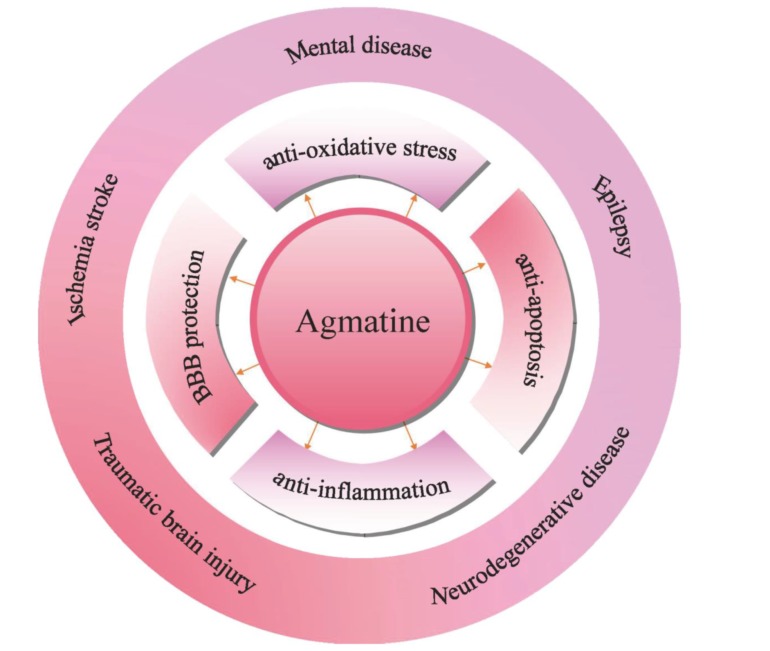
Numerous studies had demonstrated the neuroprotective effect of agmatine in varied types of neurological diseases, including acute attack (stroke and trauma brain injury) and chronic neurodegenerative diseases (Parkinson's disease, Alzheimer's disease). The potential mechanism of agmatine induced neuroprotection includes anti-oxidation, anti-apoptosis, anti-inflammation, brain blood barrier (BBB) protection and brain edema prevention.
The safety and low incidence of adverse effects indicate the vast potential therapeutic value of agmatine in the treatment of neurological diseases. However, most of the available studies relate to the agmatine are conducted in experimental models, more clinical trials are needed before the agmatine could be extensively clinically used.
神经疾病一直是全球范围内导致行动能力丧失和死亡的主要原因之一。然而,目前仍缺乏有效的治疗方法。胍丁胺作为一种内源性聚胺,在多种方面发挥着其多样的生物学特性和治疗潜力。
本综述将重点介绍胍丁胺在神经疾病中的神经保护作用及其潜在机制。
大量研究表明胍丁胺在多种神经疾病中具有神经保护作用,包括急性发作(中风和创伤性脑损伤)和慢性神经退行性疾病(帕金森病、阿尔茨海默病)。胍丁胺诱导神经保护的潜在机制包括抗氧化、抗细胞凋亡、抗炎、血脑屏障(BBB)保护和脑水肿预防。
胍丁胺的安全性和低不良反应发生率表明其在治疗神经疾病方面具有巨大的潜在治疗价值。然而,大多数现有的胍丁胺相关研究都是在实验模型中进行的,在胍丁胺广泛应用于临床之前,还需要更多的临床试验。