Denner Joachim
Robert Koch Fellow, Robert Koch Institute, Berlin, Germany.
Viruses. 2017 Aug 8;9(8):213. doi: 10.3390/v9080213.
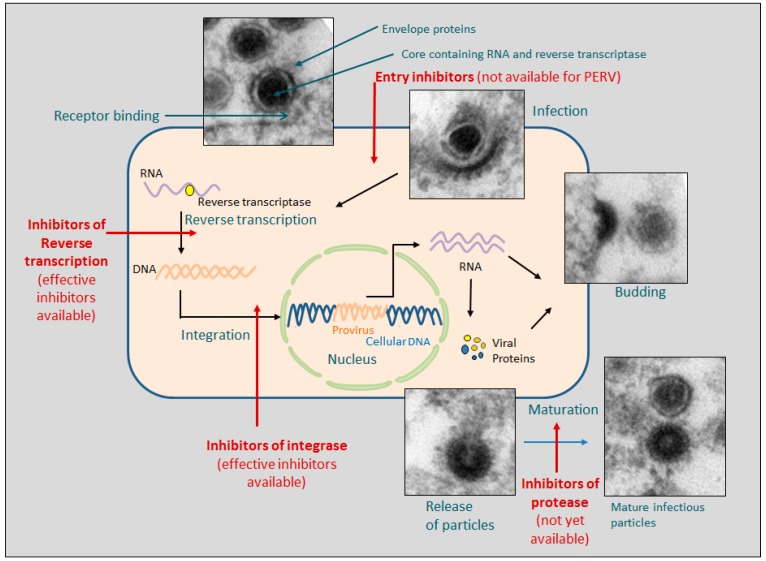
Porcine endogenous retroviruses (PERVs) are integrated in the genome of all pigs; they are released as infectious particles, and under certain conditions they can infect human cells. Therefore, they represent a risk when pigs are used as sources of cells, tissues, or organs for xenotransplantation. Xenotransplantation is under development due to the increasing shortage of human transplants. Whereas most porcine microorganisms which may be able to induce a disease (zoonosis) in the transplant recipient can be eliminated, this is not possible in the case of PERVs. Antiretroviral drugs which had been developed for the treatment of human immunodeficiency virus-1 (HIV-1) infections have been tested in vitro for their efficacy in inhibiting PERV replication. Inhibitors of the viral reverse transcriptase and of the integrase have been found effective. The most effective inhibitor of the reverse transcriptase was azidothymidine (AZT); the integrase inhibitors were the most potent inhibitors of PERV. Although in the past PERV transmission has not been observed after experimental or clinical xenotransplantation of pig cells or organs, and although PERVs may one day be inactivated in pigs by genome editing using CRISPR/Cas, knowing which antiretroviral drugs can effectively restrict PERV infection will still be important.
猪内源性逆转录病毒(PERVs)整合在所有猪的基因组中;它们以感染性颗粒的形式释放,在某些条件下能够感染人类细胞。因此,当猪被用作异种移植的细胞、组织或器官来源时,它们构成了一种风险。由于人类移植器官日益短缺,异种移植正在发展中。虽然大多数可能在移植受者中引发疾病(人畜共患病)的猪源微生物可以被清除,但PERVs却无法做到这一点。已开发用于治疗人类免疫缺陷病毒1型(HIV-1)感染的抗逆转录病毒药物已在体外测试其抑制PERV复制的功效。已发现病毒逆转录酶和整合酶的抑制剂有效。最有效的逆转录酶抑制剂是叠氮胸苷(AZT);整合酶抑制剂是最有效的PERV抑制剂。尽管过去在猪细胞或器官的实验性或临床异种移植后未观察到PERV传播,并且尽管有一天可能通过使用CRISPR/Cas进行基因组编辑使猪体内的PERV失活,但了解哪些抗逆转录病毒药物能够有效限制PERV感染仍然很重要。