Hopf Felix, Thomas Peter, Sesselmann Stefan, Thomsen Marc N, Hopf Maximilian, Hopf Johannes, Krukemeyer Manfred G, Resch Herbert, Krenn Veit
a Center for Histopathology and Molecular Pathology , Trier , Germany.
b Department of Dermatology and Allergologie , Ludwig-Maximilians-University (LMU) , Munich , Germany.
Acta Orthop. 2017 Dec;88(6):642-648. doi: 10.1080/17453674.2017.1362774. Epub 2017 Aug 8.
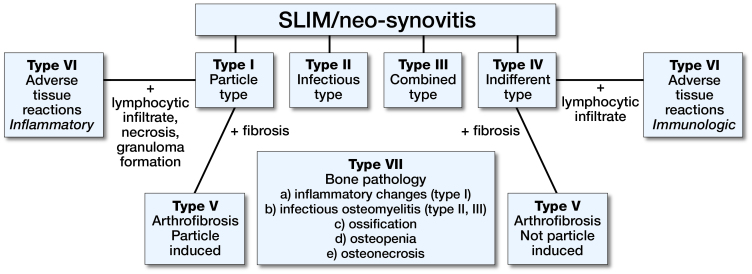
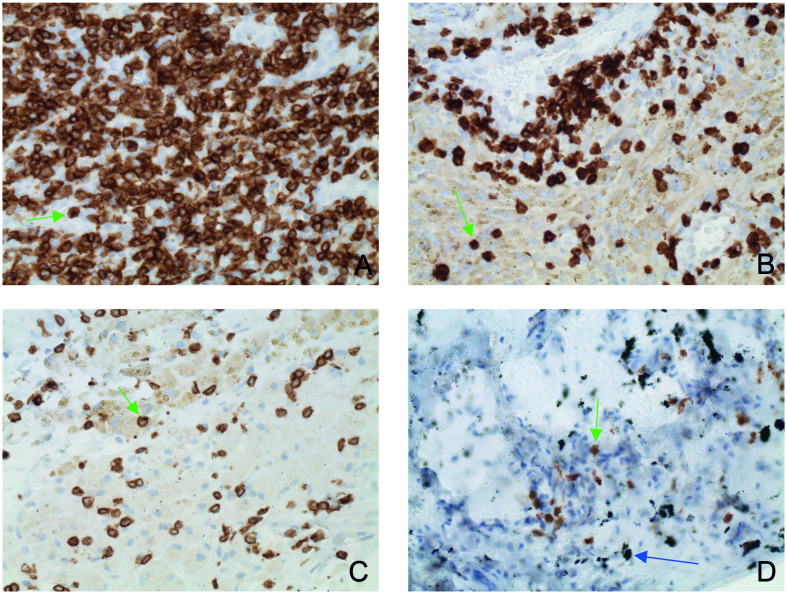
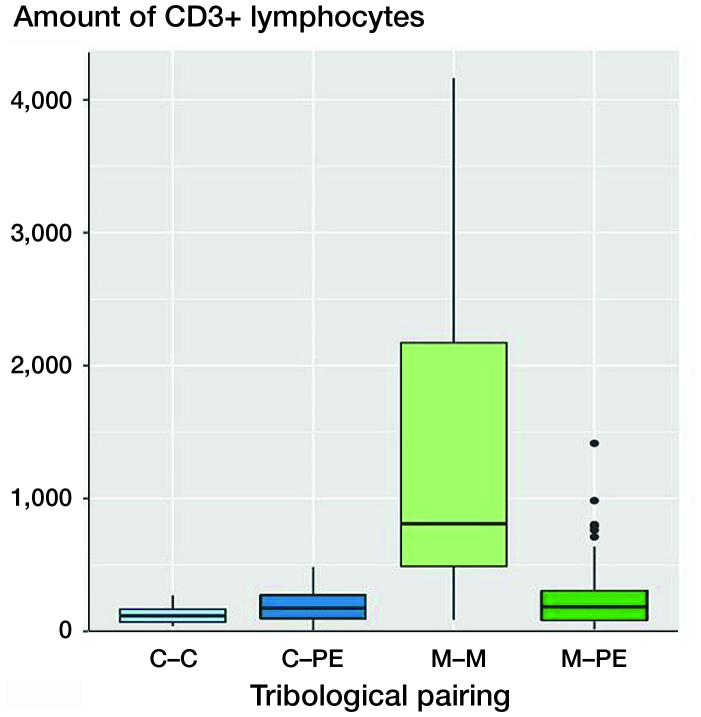
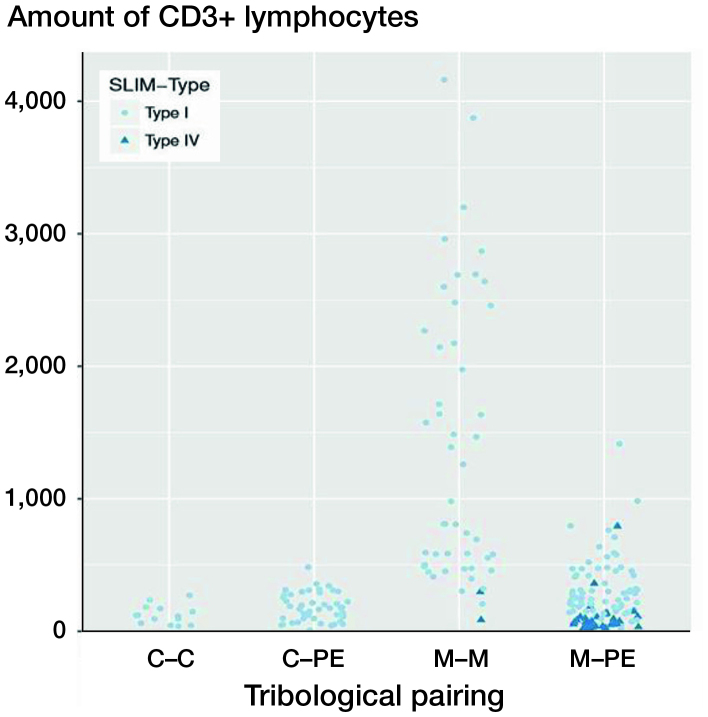
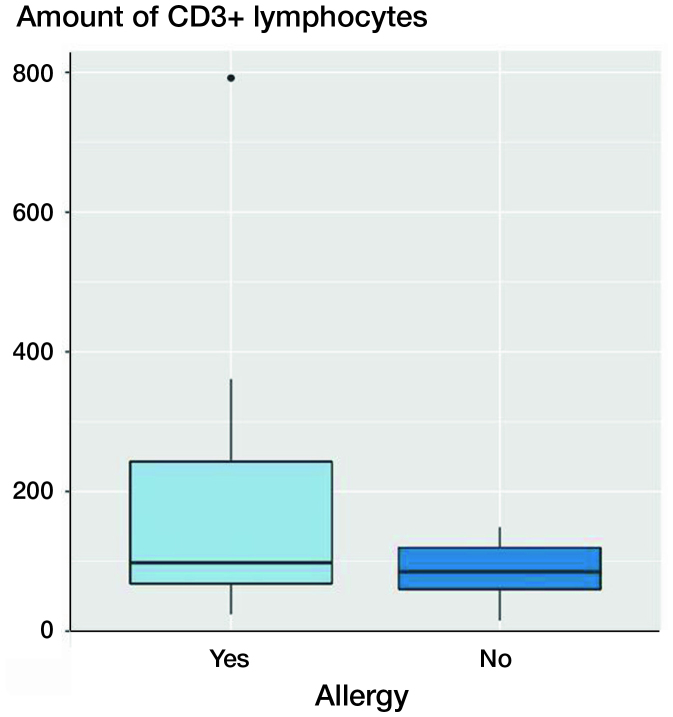
Background and purpose - The most frequent cause of arthroplasty failure is aseptic loosening-often induced by particles. Abrasion material triggers inflammatory reactions with lymphocytic infiltration and the formation of synovial-like interface membranes (SLIM) in the bone-implant interface. We analyzed CD3 quantities in SLIM depending on articulating materials and possible influences of proven material allergies on CD3 quantities. Patients and methods - 222 SLIM probes were obtained from revision surgeries of loosened hip and knee arthroplasties. SLIM cases were categorized according to the SLIM-consensus classification and to the particle algorithm. The CD3 quantities were analyzed immunohistochemically, quantified, and correlated to the particle types. Results - Metal-metal pairings showed the highest CD3 quantities (mean 1,367 counted cells). CD3 quantities of metal-polyethylene (mean 243), ceramic-polyethylene (mean 182), and ceramic-ceramic pairings (mean 124) were significantly smaller. Patients with contact allergy to implant materials had high but not statistically significantly higher CD3 quantities than patients without allergies. For objective assessment of the CD3 response as result of a pronounced inflammatory reaction with high lymphocytosis (adverse reaction), a defined CD3 quantity per high power field was established, the "CD3 focus score" (447 cells/0.3 mm, sensitivity 0.92; specificity 0.90; positive predictive value 0.71; negative predictive value 0.98). Interpretation - The high CD3 quantities for metal-metal pairings may be interpreted as substrate for previously described adverse reactions that cause severe peri-implant tissue destruction and SLIM formation. It remains unclear whether the low CD3 quantities with only slight differences in the various non-metal-metal pairings and documented contact allergies to implant materials have a direct pathogenetic relevance.
背景与目的——关节置换失败最常见的原因是无菌性松动,通常由颗粒引起。磨损物质会引发炎症反应,导致淋巴细胞浸润,并在骨-植入物界面形成滑膜样界面膜(SLIM)。我们根据关节连接材料分析了SLIM中CD3的数量,以及已证实的材料过敏对CD3数量的可能影响。
患者与方法——从松动的髋关节和膝关节置换翻修手术中获取了222个SLIM样本。根据SLIM共识分类和颗粒算法对SLIM病例进行分类。采用免疫组织化学方法分析CD3数量、进行定量,并与颗粒类型进行关联。
结果——金属-金属配对显示出最高的CD3数量(平均计数细胞数为1367个)。金属-聚乙烯配对(平均243个)、陶瓷-聚乙烯配对(平均182个)和陶瓷-陶瓷配对(平均124个)的CD3数量明显较少。对植入材料有接触性过敏的患者,其CD3数量高于无过敏的患者,但差异无统计学意义。为了客观评估因明显的炎症反应伴高淋巴细胞增多(不良反应)导致的CD3反应,确定了每个高倍视野的特定CD3数量,即“CD3聚焦评分”(447个细胞/0.3mm,敏感性0.92;特异性0.90;阳性预测值0.71;阴性预测值0.98)。
解读——金属-金属配对中高CD3数量可被解释为先前所述不良反应的底物,这些不良反应会导致严重的植入物周围组织破坏和SLIM形成。目前尚不清楚各种非金属-金属配对中CD3数量较低且差异微小以及已记录的对植入材料的接触性过敏是否具有直接的致病相关性。